 France
 English
 Deutsch
 Español
 Italiano
 Nederlands
 Polski
 Português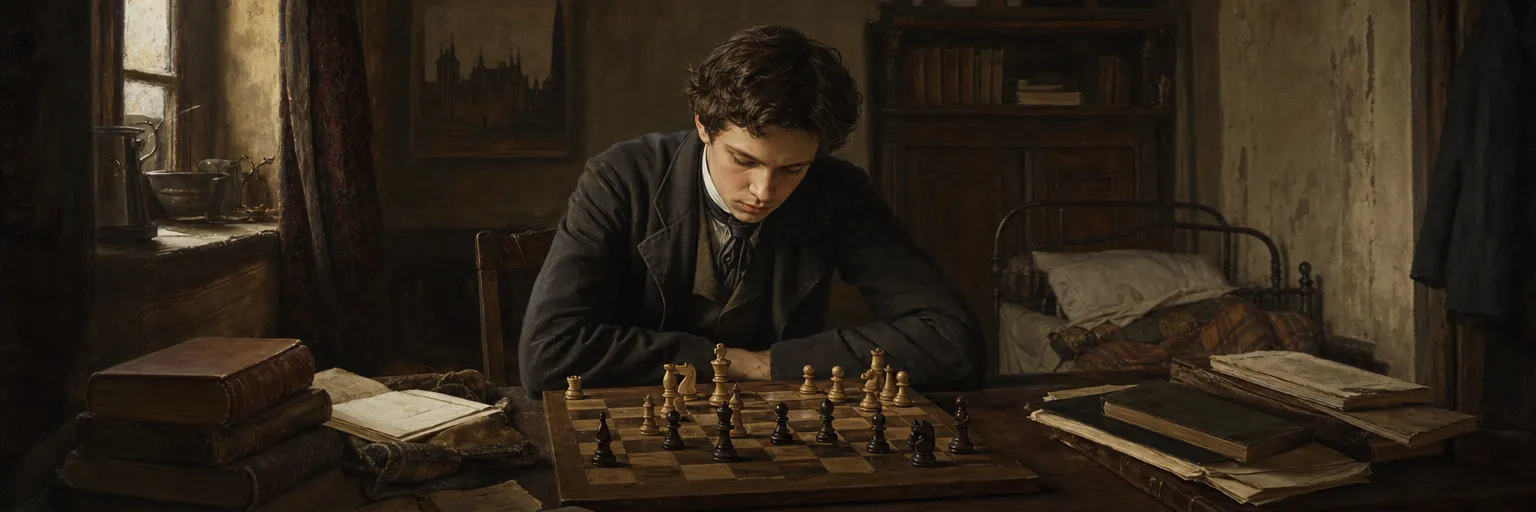
The origins of Wilhelm Steinitz and his beginnings in chess
Wilhelm Steinitz was born on May 14, 1836, in Prague, then part of the Austrian Empire. Born into a modest, large Jewish family, he grew up in an environment where intellectual rigor and a love of learning held an important place. Long before becoming a major figure in chess history, the young Steinitz stood out for his keen curiosity, great analytical ability, and remarkable determination to improve.
A childhood in Prague shaped by learning
In the neighborhood where he spent his early years, Wilhelm Steinitz discovered a rich cultural world, nourished by the city’s intellectual exchanges. Those around him encouraged him to develop his academic abilities, and he quickly became interested in disciplines that required logic and concentration. This intellectual training played a decisive role in shaping the man who would later become the first world chess champion.
At that time, chess did not yet represent a structured career, but rather an intellectual pastime prized in the cafés and intellectual circles of Central Europe. It was in this context that Steinitz gradually became familiar with the game, by observing, practicing, and refining his understanding of positions.
Discovering the game and his first ambitions
Wilhelm Steinitz’s first games already revealed a combative temperament. Very early on, he was not content to play merely for pleasure: he sought to understand the game’s deeper mechanisms, identify mistakes, and build more solid plans. This approach, still rare in his time, already foreshadowed the strategic evolution he would later bring to the history of chess.
While continuing his studies, particularly in a university setting in Vienna, he associated with more experienced players and faced stronger opposition. This contact with Vienna’s chess scene marked a decisive turning point. There, Steinitz built his reputation, improved his technique, and began to make a name for himself as a formidable player.
Vienna, the first springboard to recognition
Moving to Vienna marked an essential stage in Wilhelm Steinitz’s early years. The Austrian capital was then a dynamic intellectual center, where cafés welcomed many enthusiasts and masters of the game. In these meeting places, he refined his style through games played against a variety of opponents, often under demanding conditions.
His gradual successes allowed him to break out of the local circle and attract the attention of the European chess world. As he continued to deliver strong performances, Steinitz developed a more scientific vision of the game, based on positional solidity, the accumulation of small advantages, and strategic patience. These principles, still taking shape in his early years, would become central to his legacy and his future renown as world chess champion.
The foundations of a future master
Wilhelm Steinitz’s origins and his first steps on the chessboard shed light on the exceptional path he would later follow. His journey, between Prague and Vienna, shows how early talent, nurtured by hard work and observation, can transform a promising player into a pioneer. His beginnings are not merely a biographical anecdote: they also explain the birth of a new way of thinking that would leave a lasting mark on the history of modern chess.
How Wilhelm Steinitz became the first world chess champion
Wilhelm Steinitz’s recognition as the first world champion did not happen overnight. It was the result of a gradual rise, marked by victories against the best players of his time, sustained dominance in major tournaments, and a unique ability to impose a new vision of the game.
A meteoric rise on the international stage
After leaving Prague for Vienna, Steinitz quickly built his reputation in European chess circles. His participation in the London tournament in 1862 brought him to the attention of the highest level. Although he did not win the event, he impressed with his fighting style and tactical boldness, two qualities that immediately caught the attention of experts.
Over the years, he delivered one solid performance after another against the most feared masters of the day. This consistency helped make him an essential reference in international chess.
The decisive match against Adolf Anderssen
A key moment in his journey came in 1866, when he faced Adolf Anderssen, then regarded by many as the best player in the world. By winning this match, Steinitz established himself as the natural successor at the top of the chess hierarchy. This victory was crucial, because at that time, the world title had not yet been institutionalized as it would be later.
Thanks to this success, he was gradually recognized as the strongest player of his time. This sporting legitimacy laid the foundations for his status as the first world chess champion.
Dominance confirmed by results
Steinitz did not settle for a single feat. In the years that followed, he confirmed his supremacy by achieving excellent results in major competitions and holding off several leading rivals. His longevity at the top reinforced the idea that he was not merely a champion of circumstance, but indeed the undisputed number one of his era.
This consistency in performance is a fundamental element in understanding how Wilhelm Steinitz earned lasting worldwide recognition. In a context where the official rules surrounding the world championship were still unclear, only superiority on the chessboard could establish such authority.
The official crowning in 1886
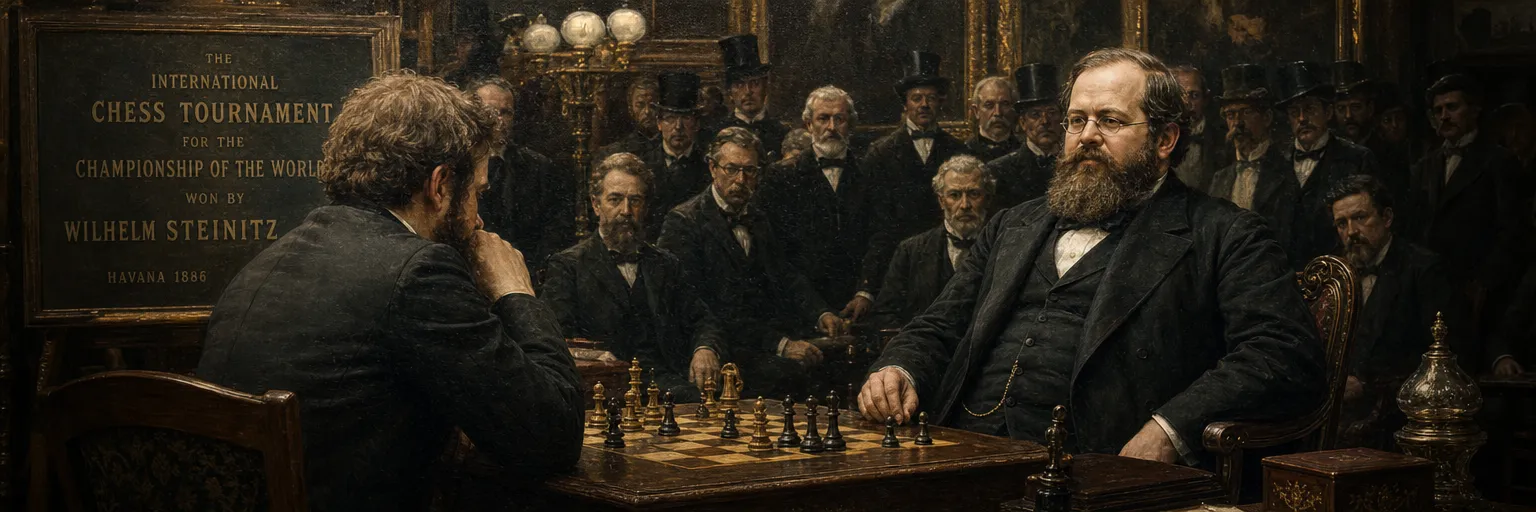
Although Steinitz had been regarded as the best since his victory over Anderssen, it was in 1886 that he received the official recognition associated with the world title. That year, he played a match against Johannes Zukertort, another major figure in 19th-century chess. The stakes went beyond simple personal rivalry: it was about clearly designating the holder of the supreme title.
By winning this encounter, Steinitz definitively entered history as the first world champion. This match marks a foundational date in the modern organization of chess, as it gave official form to a supremacy that had until then been recognized mainly through the consensus of players and observers.
A champion who redefined the notion of superiority
Beyond his victories, Steinitz also transformed the way a player's strength was assessed. Where many favored immediate attacking flair, he championed a more methodical approach, based on the accumulation of small positional advantages. This strategic revolution allowed him not only to win, but also to demonstrate that his dominance rested on solid, reproducible principles.
It is this dual success, both sporting and intellectual, that explains why Wilhelm Steinitz holds such a central place in chess history. From talented contender to officially recognized champion, his journey embodies the very birth of the modern world championship.
Wilhelm Steinitz's innovative playing style
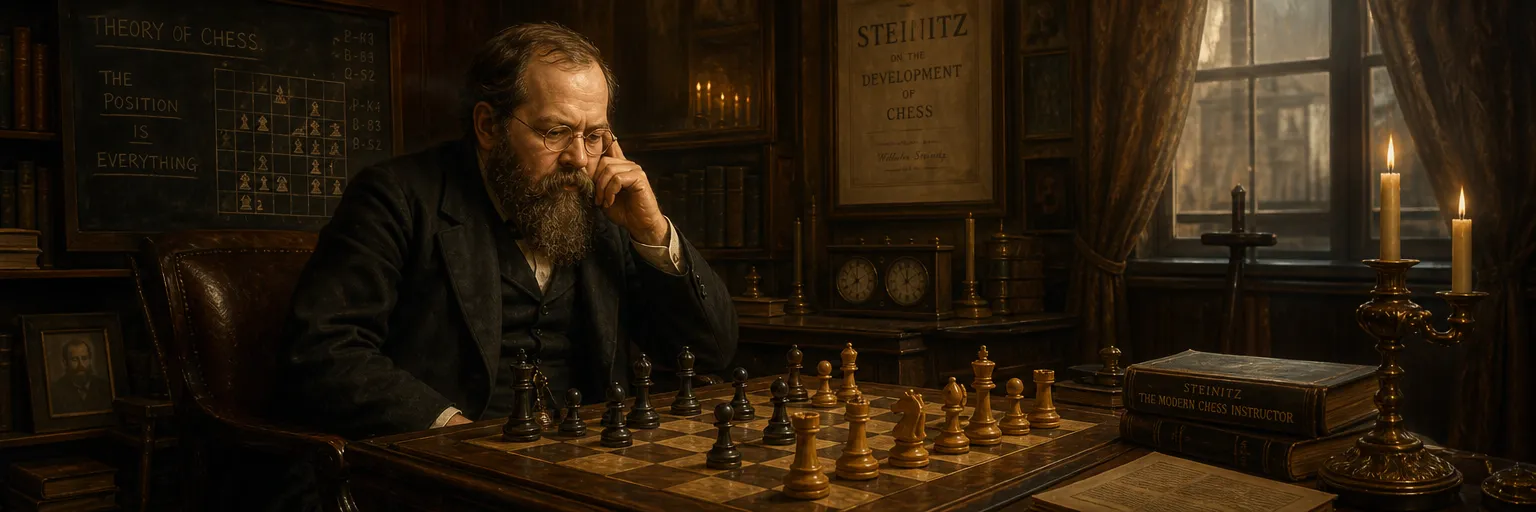
At a time when direct attacks and spectacular sacrifices dominated the chessboard, Steinitz imposed a radically different vision of the game. His approach was based on the idea that a truly effective offensive must be prepared methodically, building from concrete advantages accumulated gradually. This way of thinking permanently transformed modern chess strategy.
A break with romantic chess
Before him, many masters favored brilliance, sometimes at the expense of solidity. Wilhelm Steinitz challenged this tradition by asserting that an attack can only be justified if the opponent’s position has genuine weaknesses. He rejected risky combinations and preferred to improve his pieces, strengthen his pawn structure, and limit the opponent’s counterplay. This change marked a major turning point in the history of chess.
Defense and the accumulation of small advantages
One of Steinitz’s great innovations was demonstrating that defense is not a sign of passivity, but a strategic resource in its own right. He showed that a solid position can neutralize the enemy’s initiative before turning the tables. His method often consisted of obtaining slight positional advantages — a better square for a knight, a weak pawn in the opponent’s camp, control of a file — then converting them patiently. This concept profoundly influenced the theory of the modern world chess champion.
Positional principles at the heart of his thinking
Steinitz formalized several principles that became fundamental: the balance of the position, the value of lasting weaknesses, the importance of piece coordination, and the need to attack only at the right moment. He explained that when the position is sound, a premature attack can backfire against its author. Conversely, if imbalances appear, they must be exploited rigorously. Through this scientific reading of the game, Wilhelm Steinitz established himself as a major forerunner of the positional school.
A decisive legacy for later generations
Steinitz’s ideas initially caused misunderstanding, as they broke with the spectacular habits of the 19th century. Yet they later inspired the greatest players, from Emanuel Lasker to Tarrasch, and then the whole of contemporary strategic thought. His style did not merely make it possible to win games: it redefined the way chess is studied, understood, and played. That is why his contribution goes far beyond the scope of his results and explains why his name remains inseparable from the evolution of the first world champion.
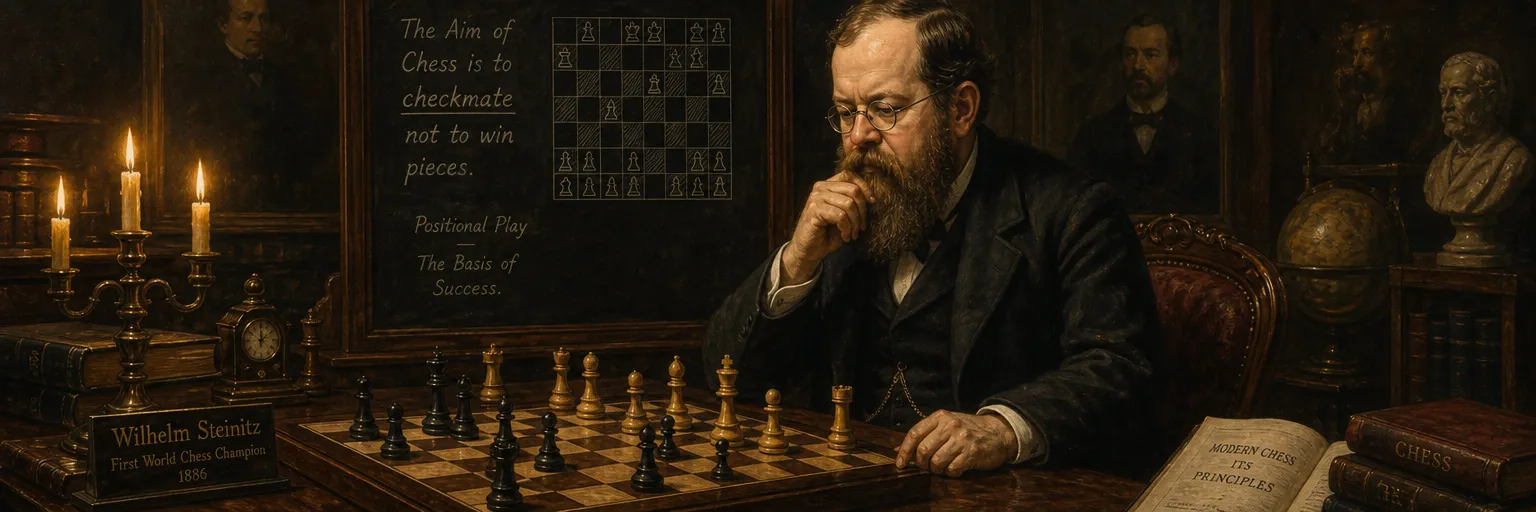
The strategic principles that transformed the history of chess
With Wilhelm Steinitz, the practice of the game changed dimension: victory no longer relied solely on tactical inspiration, but on a methodical accumulation of small advantages. This approach, revolutionary at the time, laid the foundations of modern strategy and permanently transformed the way chess is thought about.
Defense as the foundation of attack
Steinitz asserts that an effective attack can only be launched if the position justifies it. According to him, a player must first consolidate their camp, secure their king, coordinate their pieces, and limit weaknesses before seeking the initiative. This idea breaks with the Romantic tradition of the 19th century, when brilliant—even dubious—offensives were often favored. Thanks to this more rational reading of chess, he shows that patience and solidity can be more powerful than a premature assault.
The accumulation of small advantages
Among Wilhelm Steinitz’s major contributions is the notion of a gradual advantage. Rather than relying on an immediate combination, he seeks to improve his position little by little: better pawn structure, strong squares for the pieces, control of space, and king activity in the endgame. This method gives new depth to the game’s strategic principles. It proves that a slight imbalance, exploited with precision, can be enough to tip a high-level game.
Positional weaknesses at the heart of the analysis
Steinitz also emphasizes the importance of lasting defects in an opponent’s position. An isolated pawn, a weak square, poor coordination, or an exposed king become, in his view, long-term targets. It is no longer just a matter of seeing immediate threats, but of understanding the deep logic of the position. This way of evaluating the balance of power foreshadows all modern chess thought and directly influences the future great theoreticians of chess.
A decisive legacy for modern theory
Steinitz’s ideas have profoundly shaped the history of the game, to the point that they are still taught today. Champions such as Emanuel Lasker, José Raúl Capablanca, and Aron Nimzowitsch extended, refined, or enriched his concepts. By giving strategy a rigorous intellectual framework, Wilhelm Steinitz ushered chess into a new era, in which every plan must be justified by the real characteristics of the position. His legacy therefore goes far beyond his results: he redefined the very way a game is understood.
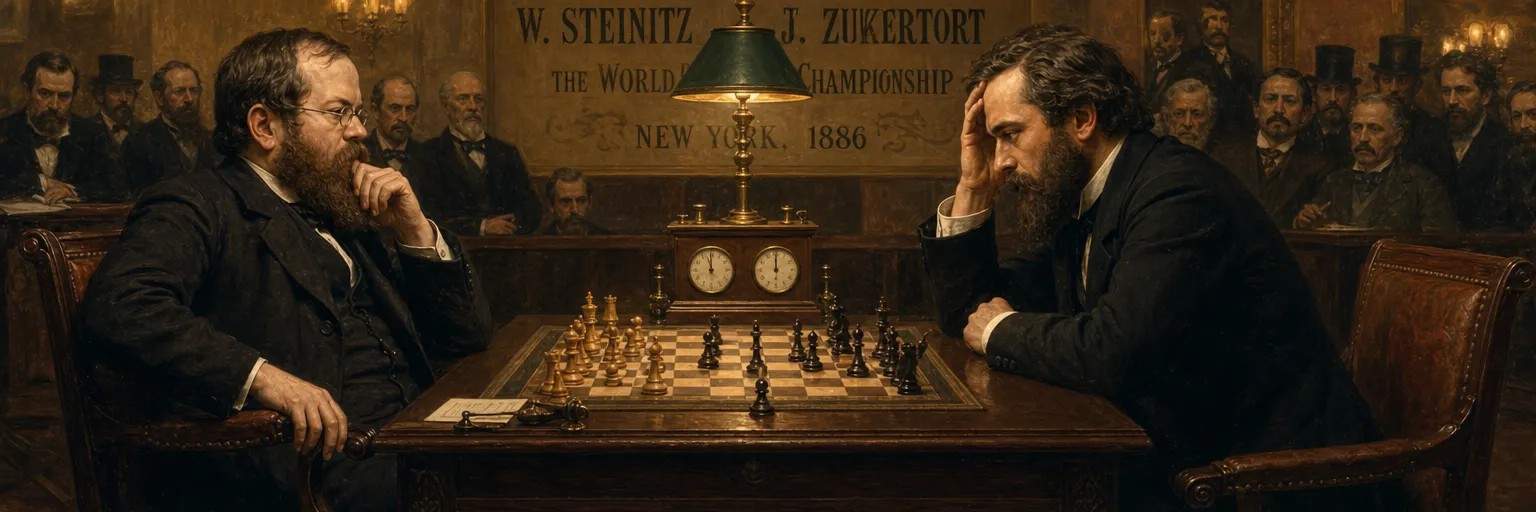
The historic duel against Johannes Zukertort
In 1886, the clash between Wilhelm Steinitz and Johannes Zukertort marked a major turning point in the history of the game. This match, played between New York, St. Louis, and New Orleans, is generally regarded as the first officially recognized World Chess Championship. Beyond its result, it symbolizes the opposition between two conceptions of the game: Zukertort’s brilliant fighting spirit and Steinitz’s positional rigor.
A highly anticipated clash at the top
At the time, Johannes Zukertort was one of the most feared players on the international scene. His tactical talent, attacking flair, and tournament successes made him a natural rival for Steinitz. The confrontation therefore drew immense attention in the chess world, as it was meant to determine who deserved the title of first world chess champion.
The format of the duel was based on a clear objective: the first player to win ten games would win the match. This framework gave the encounter a particular intensity, especially since each side embodied an almost opposite vision of top-level play. Zukertort often sought the immediate initiative, while Steinitz relied on solidity, patience, and the methodical exploitation of his opponent’s weaknesses.
Steinitz’s decisive turnaround
The start of the match was nevertheless difficult for Steinitz. Zukertort took the lead and seemed capable of imposing his rhythm. But as the games went on, Steinitz’s mental endurance and strategic depth made the difference. Where his opponent ran out of steam, he maintained great consistency and managed to neutralize the most dangerous attacks.
This comeback perfectly illustrates Wilhelm Steinitz’s strength: not rushing, accepting tense positions, then turning the situation around through a better understanding of the balances on the chessboard. He ultimately won by a score of 10 victories to 5, with 5 draws, a result that cemented his place in the history of modern chess.
A foundational victory for the legend
Steinitz’s success against Zukertort was not merely a sporting victory. It officially established his status as world champion and gave lasting structure to the supreme competition in this discipline. From this duel onward, the idea of a clearly identified world title took on decisive importance in the world of chess.
This face-off also remains famous because it validated, at the highest level, the principles defended by Steinitz. His victory showed that a game built on positional logic, precise defense, and the accumulation of small advantages could triumph over the most spectacular style. In this respect, the duel against Johannes Zukertort remains one of the most memorable episodes of Wilhelm Steinitz’s career.
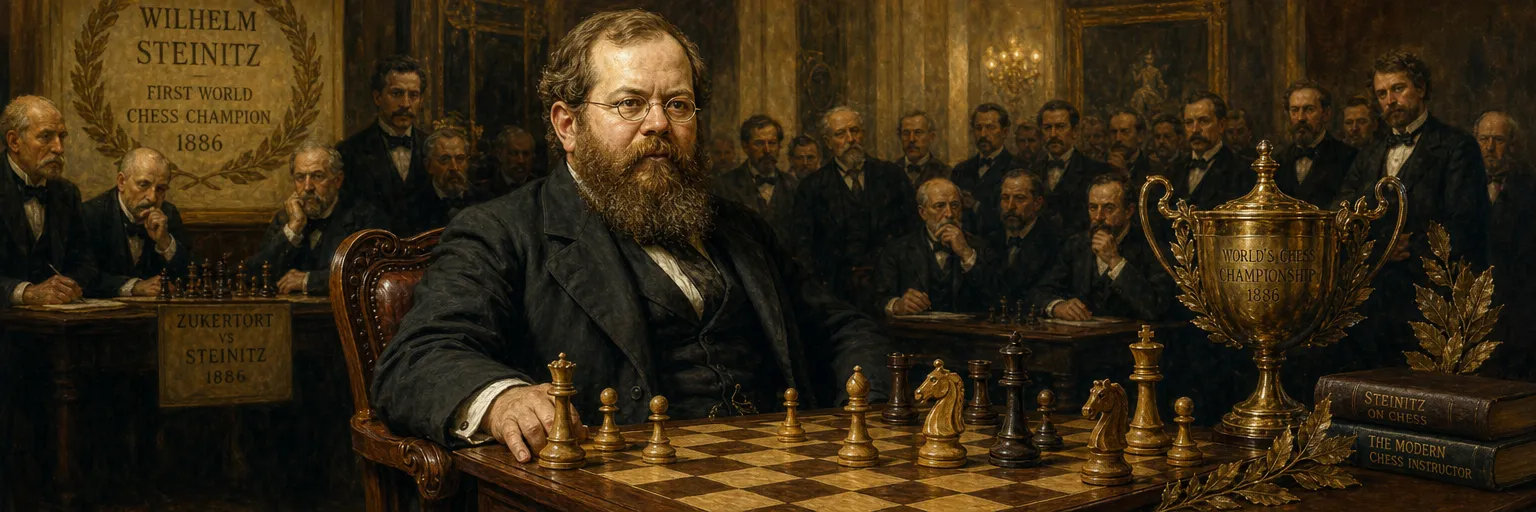
Wilhelm Steinitz's greatest successes
Long before official titles and modern cycles structured competition, Wilhelm Steinitz built a remarkable record that secured his place at the very top of the game for years to come. His match victories, tournament triumphs, and exceptional longevity forged the reputation of the first world chess champion and confirmed Wilhelm Steinitz’s major influence on chess history.
Major victories in the leading tournaments
Among Steinitz’s most important successes were his outstanding results in international competitions in the second half of the 19th century. He notably stood out in London in 1862, where he revealed his immense talent against the European elite. Over the years, he delivered one high-level performance after another and won several prestigious tournaments, reinforcing his image as a formidable master. These consistent results made him one of the most dominant players of his era and strengthened his status in the history of chess.
Impressive dominance in match play
Steinitz shone especially in head-to-head encounters, a format that was then essential for establishing the hierarchy among the best players. His victory over Adolf Anderssen in 1866 was a decisive milestone, as it led many observers to regard him as the strongest player of the time. He later confirmed this superiority by winning other top-level matches thanks to serious preparation, great psychological resilience, and an unprecedented strategic understanding. This series of performances directly contributed to his rise as the first world chess champion.
The world title and title defenses
The match he won against Johannes Zukertort in 1886 remains, of course, his most famous achievement, since it officially crowned Steinitz as world champion. But his merit did not stop with that initial conquest. He then successfully defended his title against strong opponents, including Mikhail Chigorin and Isidor Gunsberg. These successful title defenses illustrate Wilhelm Steinitz’s exceptional consistency at the highest level and show that his reign was no accident.
A legacy that goes beyond results
Steinitz’s greatest successes cannot be measured solely by the number of games he won or trophies he earned. His true triumph also lies in the way he transformed the understanding of the game. By imposing a more scientific and positional approach, he paved the way for future generations. That is why his name remains associated not only with major victories, but also with a profound evolution in the history of chess, where he remains an essential founding figure.
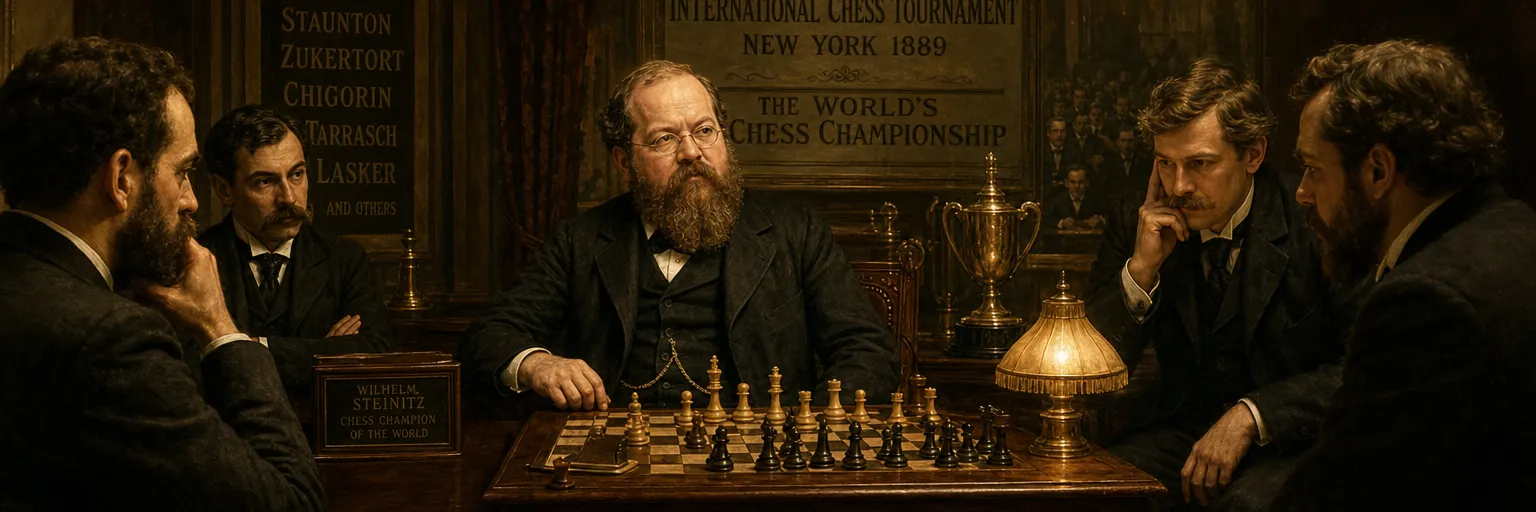
Wilhelm Steinitz against his main rivals
Steinitz’s great matches show just how much his dominance was built against exceptional players, whose styles were sometimes the opposite of his own. Each of these encounters helped shape his reputation, while also spreading his more scientific vision of the game throughout the chess world.
Adolf Anderssen, the clash between two eras
When Steinitz faced Adolf Anderssen in the 1860s, he was taking on one of the leading figures of romantic chess. Anderssen embodied tactical flair, open attacks, and spectacular combinations. By gaining the upper hand over such an opponent, Steinitz sent a strong message: a new way of playing was beginning to prevail. This duel symbolizes the transition between the old school and a more positional, more rigorous approach that would become the hallmark of the future champion.
Johannes Zukertort, the rival of the world championship crowning
Among all his opponents, Johannes Zukertort undoubtedly remains the most emblematic. Their 1886 match went beyond simple personal rivalry: it became the foundational reference for the title of world champion. Zukertort possessed formidable attacking talent and great creativity, capable of unsettling any player. Yet Steinitz ultimately gained the upper hand thanks to his resilience, strategic understanding, and ability to adapt. This victory permanently reinforced his status as the first world chess champion.
Mikhail Chigorin, the most famous stylistic opposition
Against Mikhail Chigorin, Steinitz met an opponent who represented almost the antithesis of his principles. The Russian master favored initiative, piece activity, and complex positions where the energy of the game often took precedence over established rules. The matches between the two men were followed particularly closely, because they set two profound conceptions of the game against each other. Steinitz demonstrated the solidity of his ideas, but Chigorin also proved that tactical creativity could trouble even the most methodical of strategists. This rivalry remains essential to understanding the evolution of chess at the end of the 19th century.
Isidor Gunsberg and the resistance of the challengers
The duel against Isidor Gunsberg shows a Steinitz still capable of defending his title against a new generation of competitors. Gunsberg is a well-rounded player, less flamboyant than some of his contemporaries, but particularly tenacious. Their encounter is closely contested and illustrates that Steinitz did not reign without opposition. Even when pushed to the limit, he retained that rare ability to turn small advantages into winning positions. It is also in this type of match that the full extent of Wilhelm Steinitz’s theoretical legacy becomes clear.
Emanuel Lasker, the successor who ended his reign
No account of Steinitz’s career against his main rivals would be complete without mentioning Emanuel Lasker. When the two men met for the world title in 1894, Steinitz was no longer at the height of his powers, while Lasker embodied the new generation. Younger, more flexible, and psychologically formidable, the German managed to gain the upper hand. This defeat brought the champion’s reign to an end, but it does not diminish his historical importance. On the contrary, it highlights Steinitz’s foundational role: without his innovations, the next generation, including Lasker, would undoubtedly not have approached the game with the same level of strategic rigor.
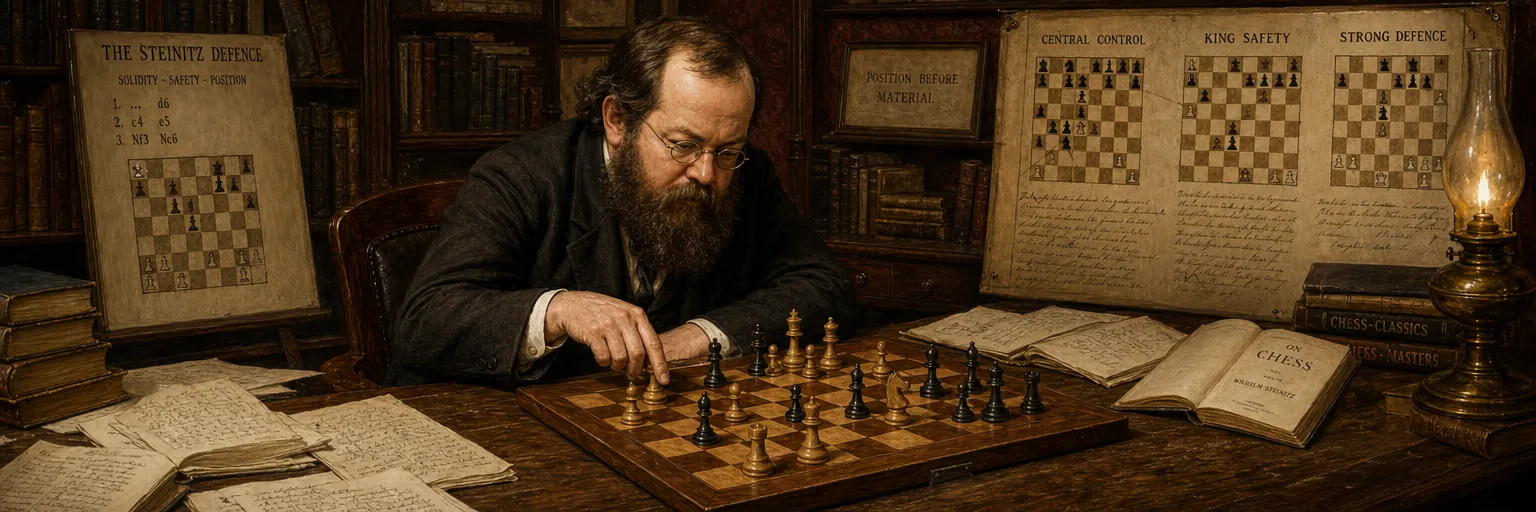
Wilhelm Steinitz’s legacy in chess theory
More than a champion, Steinitz remains a foundational reference point for understanding the evolution of strategic thought in chess. His contribution is not limited to a few isolated ideas: he helped structure a genuine method for evaluating positions, still visible in the modern teaching of the game. In this respect, Wilhelm Steinitz occupies a central place in the history of chess theory.
A new way of evaluating the position
Before him, many masters favored immediate attack and brilliant combinations. Steinitz argued instead that a sound offensive must be prepared through concrete elements: better pawn structure, piece activity, control of the center, king safety, or weaknesses in the opponent’s camp. This rational approach permanently transformed the practice of chess and laid the foundations of positional strategy.
His essential idea is simple yet revolutionary: when a position is sound, a direct attack is justified only if the opponent has already conceded weaknesses. Otherwise, one must first gradually improve one’s own position. This vision marked a break with the romantic chess style of the 19th century and paved the way for a more scientific understanding of the game.
The foundations of the positional school
By emphasizing the accumulation of small advantages, Steinitz became the forerunner of a school of thought that would deeply influence subsequent generations. His legacy can be seen in champions such as Emanuel Lasker, José Raúl Capablanca, and Tigran Petrosian, each of whom extended this more nuanced reading of positions in his own way. The concept of active defense, often associated with Steinitz, also changed mindsets: enduring an attack does not necessarily mean being lost, provided one responds with precision.
This conception enriched chess theory by showing that patience, prophylaxis, and piece coordination could prevail over spectacular attacking surges. Even today, manuals and coaches still draw on principles directly linked to his work, proof of the enduring modernity of his legacy.
A lasting influence on modern players
Steinitz’s impact extends far beyond his own era. In contemporary preparation, top-level players still evaluate positions according to criteria he helped formalize. Even with the aid of analysis engines, the notions of imbalance, structural weakness, and converting an advantage remain at the heart of the human understanding of the game.
In this sense, Wilhelm Steinitz’s legacy belongs not only to history: it remains alive in every serious game where one seeks to build a plan on solid positional foundations. It is this continuity that explains why he is regarded not only as the first world champion, but also as one of the true fathers of modern chess thought.
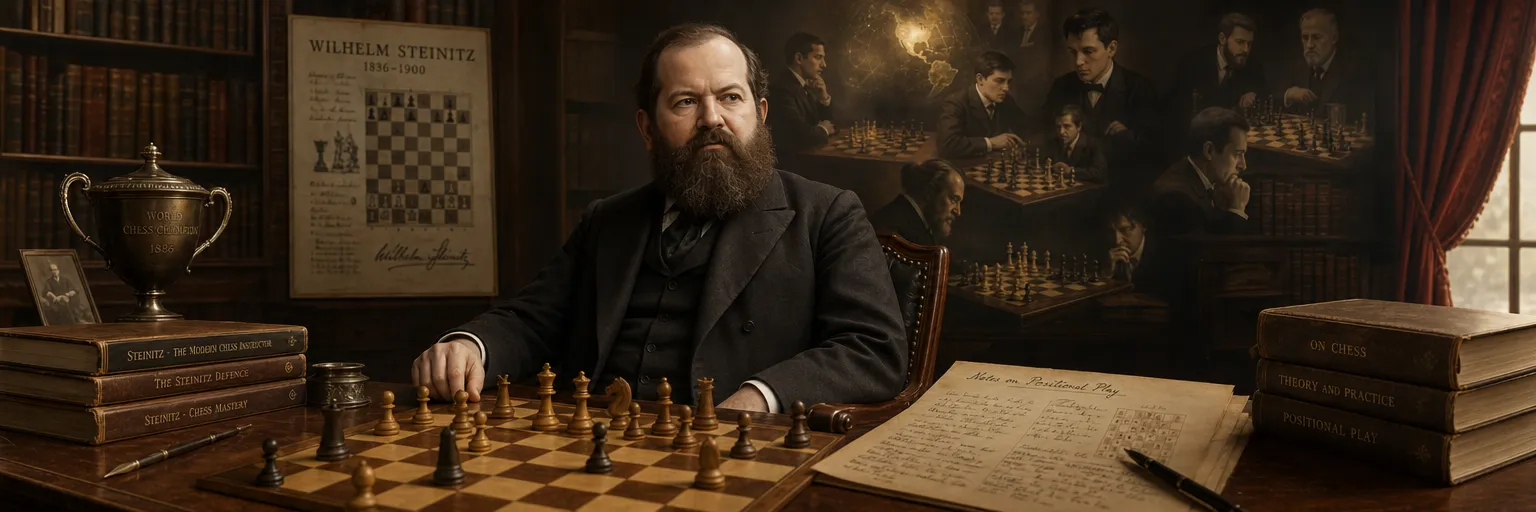
Why Wilhelm Steinitz remains a major figure in chess
Rarely has a player so profoundly transformed the way an entire game is understood. If Wilhelm Steinitz’s name remains essential, it is not only because he was the first world champion, but because he redefined the very foundations of modern strategy. His influence extends far beyond his era and continues to illuminate the practice of chess at the highest level as well as among amateurs.
A founder of modern chess thought
Steinitz established an idea that has become central: a successful attack must rest on solid positional elements, not on mere tactical momentum. This approach profoundly changed the history of chess by giving decisive importance to pawn structure, piece activity, weaknesses in the opposing camp, and strategic patience. In this sense, Wilhelm Steinitz appears as one of the true architects of the modern game.
A reference point for champions of later generations
Steinitz’s importance is also measured by the mark he left on the great masters who came after him. Emanuel Lasker, José Raúl Capablanca, Tigran Petrosian, and Anatoly Karpov all developed within a theoretical framework that his ideas helped build. Even when some of his analyses were later qualified, the foundation laid by Wilhelm Steinitz remained essential in learning strategy and defense.
A champion with a unique historical role
His status as the first recognized holder of the world title gives him a singular place in the story of the game. But beyond the symbolism, Steinitz showed that a world chess champion could also be a thinker, a theorist, and a teacher. This dual dimension, both sporting and intellectual, explains why his name remains associated with a major turning point in the evolution of competitions and in the way a player’s true strength is assessed.
A legacy still alive on the chessboard
Even today, the principles popularized by Steinitz can be found in manuals, strategy lessons, and computer analysis of positions. The idea of accumulating small advantages before launching an offensive remains at the heart of contemporary practice. It is this lasting relevance that makes Wilhelm Steinitz far more than a historical figure: he remains an essential source of understanding for all those who want to grasp the deeper logic of chess.
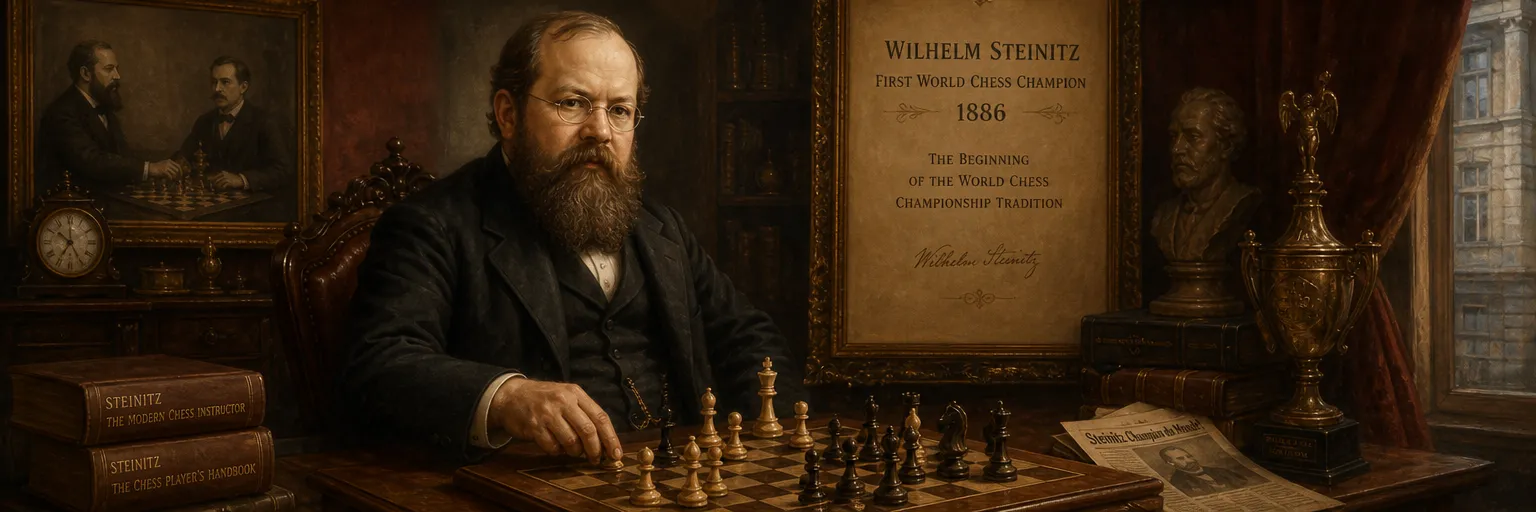
Wilhelm Steinitz’s place in the history of world chess champions
In the grand chronology of the game, Wilhelm Steinitz holds a unique position: he is not merely an inaugural sovereign, but the figure who gave the title of world chess champion a true historical foundation. His name marks the transition from an era dominated by reputation and informal challenges to a clearer conception of world supremacy, one that would go on to shape the chess elite for generations.
The founder of a prestigious line
Although other brilliant masters came before him, Steinitz is the one history remembers as the first world chess champion. This recognition rests not only on his victory over Johannes Zukertort in 1886, but also on his determination to defend his rank publicly against the best players of his time. In this sense, he inaugurated a line that would then lead to Emanuel Lasker, José Raúl Capablanca, Alexander Alekhine, and later to the greatest names of the modern era.
His place is therefore twofold: he inaugurates the official succession of champions and establishes the idea that a world title must be won against the best, then defended consistently. This institutional dimension explains why Wilhelm Steinitz remains an essential reference whenever the history of world crowns is retraced.
A champion who redefined the notion of superiority
Before Steinitz, a player's dominance often rested on flair, isolated results, or a reputation built within specialist circles. With him, superiority took on a more complete form. It was grounded in consistency in matches, strategic depth, and the ability to justify his choices through a genuine theory of the game. It is this combination that gives him a singular stature in the history of chess.
By becoming champion and then defending his crown, he showed that a king of chess must not only win, but also embody a superior vision of the game. This standard profoundly influenced the image of future holders of the world title, who were henceforth expected to be both competitors and thinkers.
A legacy visible in the champions who followed
Steinitz’s importance can also be measured by the mark he left on his successors. Emanuel Lasker extended his competitive realism, Capablanca illustrated the positional clarity inherited from his principles, and all 20th-century champions continued, in one way or another, the dialogue initiated by Steinitz between strategy, technique, and the science of the game.
Thus, his place in the historical hierarchy goes beyond the simple fact of having been the first. He is the starting point of an intellectual and sporting tradition that still defines today what a world champion represents. Through him, the title acquires symbolic depth: that of a summit conquered not only through talent, but through a new and enduring understanding of chess.
The first official world champion in history, Wilhelm Steinitz transformed the strategic understanding of chess through his revolutionary theories. His legacy was then carried forward by a player with an exceptional reign, capable of dominating the greatest masters for nearly three decades: Emanuel Lasker: the world champion who dominated chess for 27 years, an essential figure in chess history.
To learn more about the champions who shaped each era of the game of chess, also discover our complete guide dedicated to the greatest players of all time: Famous chess players: legends, champions, and modern stars.