 France
 English
 Deutsch
 Español
 Italiano
 Nederlands
 Polski
 Português
Who is Garry Kasparov?
Garry Kasparov is one of the most influential figures in the history of chess. Born on April 13, 1963, in Baku, then part of the Azerbaijan Soviet Socialist Republic, he quickly established himself as a prodigy capable of permanently transforming the way the game is played. His name is associated with exceptional theoretical preparation, a dynamic style, and an iron will that made him a truly distinctive champion. For many enthusiasts and experts alike, Garry Kasparov embodies excellence, ambition, and modernity in the world of 64 squares.
Early beginnings in Baku
From childhood, Kasparov displayed remarkable intellectual abilities. Spotted at a very young age, he joined Mikhail Botvinnik’s school, an absolute benchmark in training Soviet talent. This rigorous education allowed him to develop a deep understanding of openings, tactical calculation, and strategy. As he progressed, the future world chess champion stood out for his attacking energy and his ability to seize the initiative in almost any position.
A spectacular playing style
What makes Garry Kasparov so fascinating is his aggressive and creative approach. He excels in complex positions, where precise calculation combines with intuition. His games are often studied for their tactical richness, but also for their strategic depth. Thanks to relentless work and innovative preparation, Kasparov helped advance opening theory and further professionalize elite-level chess.
An icon beyond the chessboard
Over the years, Garry Kasparov has become much more than an exceptional player. His influence extends far beyond competition, notably through his public positions, his books, and his analyses of performance, decision-making, and intelligence. His match against the computer Deep Blue also strengthened his global fame, making him a symbol of the showdown between man and machine. Even today, the biography of Garry Kasparov continues to captivate all those interested in chess and in the great trajectories of genius.
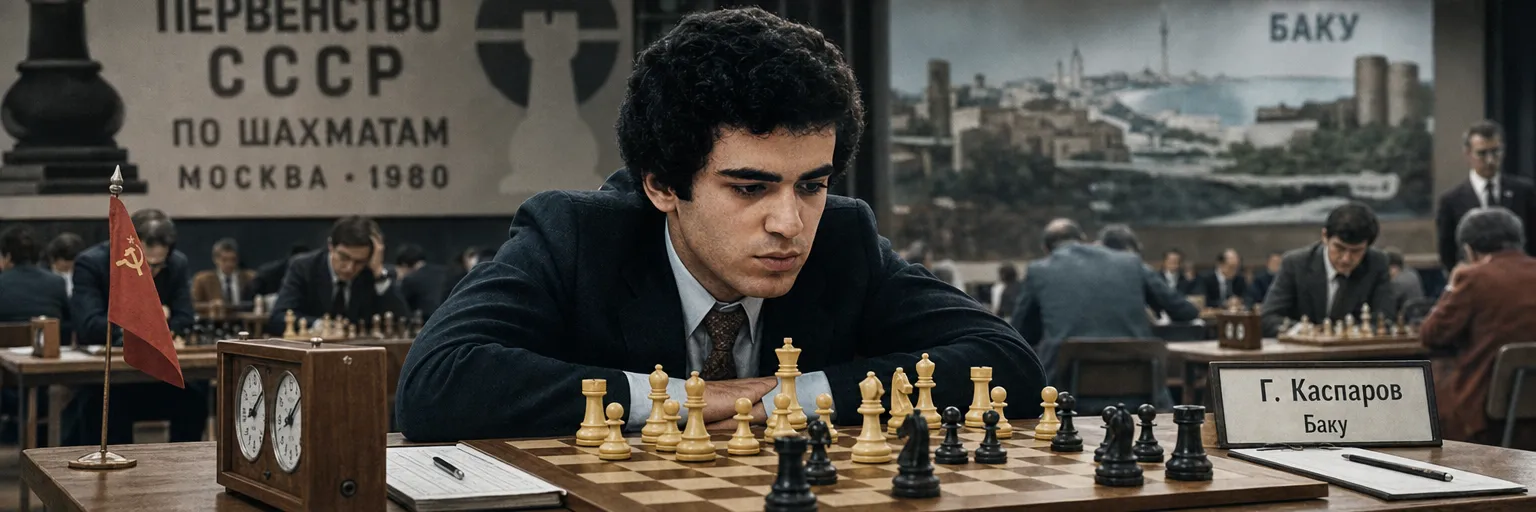
Garry Kasparov’s early years and his rise in the world of chess
Born on April 13, 1963, in Baku, Azerbaijan, then part of the USSR, Garry Kasparov grew up in an environment where reflection, discipline, and intellectual rigor held a central place. From a very early age, his talent for chess proved exceptional. Still a child, he impressed with his ability to calculate precisely, quickly recognize tactical patterns, and develop an understanding of the game far beyond his years.
Originally known as Garik Weinstein, he later adopted his mother’s surname, Kasparov. This change accompanied his path through a Soviet system in which chess represented far more than a simple pastime: it was a field of national prestige, with ruthless selection and elite training. In this particularly competitive context, the young prodigy quickly stood out.
Early training within the Soviet school
Garry Kasparov’s development belongs to the great tradition of the Soviet chess school, renowned for its methodical approach and exceptional standard of excellence. His admission to Mikhail Botvinnik’s school marked a decisive turning point. Botvinnik, a former world champion, detected in him a rare creative energy, a keen sense of initiative, and extraordinary ambition.
Through this training structure, Kasparov refined his style: he learned to combine theoretical preparation, strategic rigor, and tactical aggression. This combination became one of his trademarks. Where other young players were content to apply principles, he was already looking to impose the pace, unbalance positions, and put his opponents under pressure.
Impressive results from adolescence
As youth competitions followed one another, Garry Kasparov piled up top-level performances. He notably won the World Junior Championship, confirming that he was not merely a promising prospect, but a future contender for the world crown. His rise through the international ranks was rapid, almost meteoric.
In Soviet tournaments, among the strongest of the time, he demonstrated remarkable maturity. Facing the best players in the USSR then meant measuring oneself against the world elite. There, Kasparov forged his competitive character, psychological resilience, and reputation as a fighting player, always ready to play for a win, even in the most tense positions.
A style already recognizable and feared
From his earliest years at the highest level, Kasparov stood out for a dynamic, ambitious, and deeply modern style of play. He excelled in open positions, where his attacking sense and concrete calculation worked wonders. His opening preparation quickly became a major asset, foreshadowing the growing importance of analytical work in contemporary chess.
This playing identity contributes greatly to his irresistible rise. Unlike more cautious profiles, Garry Kasparov imposes an offensive, energetic, and often spectacular vision. His approach captivates the public as much as it worries his rivals, because it combines creativity, precision, and a constant determination to take the initiative.
The rise to the top of the world rankings
The beginning of the 1980s definitively established his place among the best players in the world. By advancing through the stages of the Candidates cycle, Kasparov confirmed that he already possessed the qualities of a future champion: exceptional preparation, rare competitive intensity, and unshakable confidence in decisive moments.
His rise was not based solely on his raw talent. It was also explained by an extraordinary work ethic and a deep understanding of the demands of the very highest level. As he progressed, Garry Kasparov became more than a young prodigy: he embodied a new generation ready to permanently transform the history of chess.
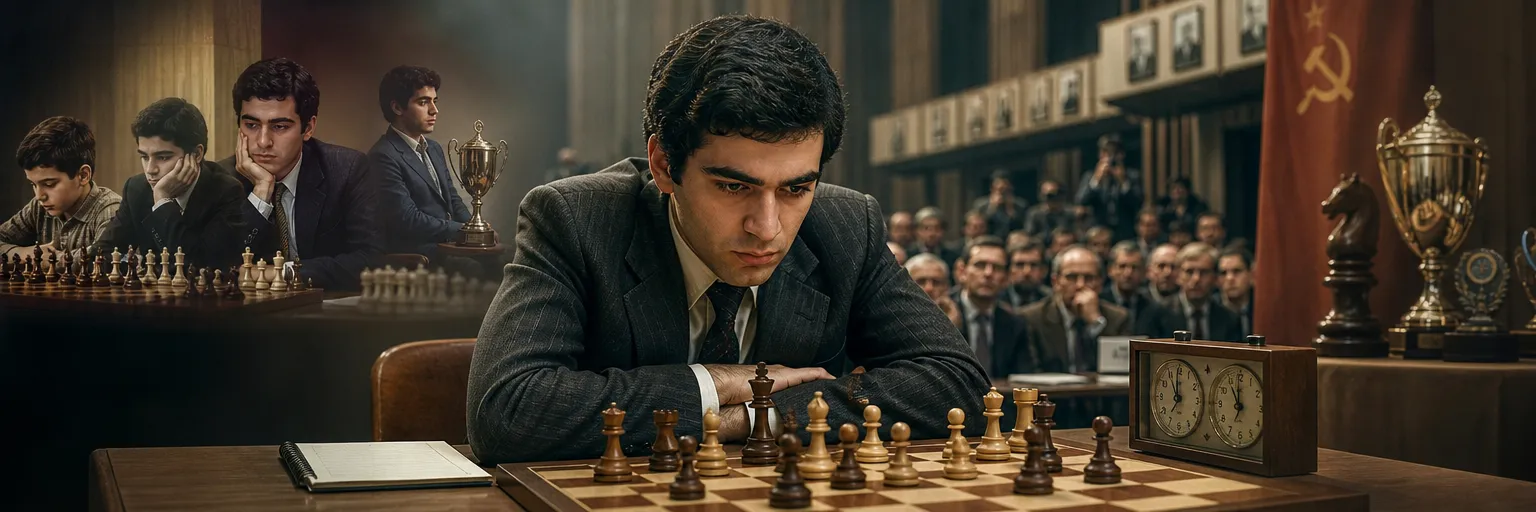
Garry Kasparov's journey to the world championship title
Very early on, Kasparov’s path took on an exceptional dimension. After confirming his talent in youth competitions, he gradually established himself among the Soviet elite, a world then regarded as the nerve center of global chess. His ambitious, energetic, and deeply prepared style allowed him to move through the stages with rare speed.
A meteoric rise on the Soviet and international circuit
During the late 1970s and early 1980s, Kasparov accumulated top-level performances. Trained in part at Mikhail Botvinnik’s school, he refined an approach based on calculation, initiative, and dynamic domination. By facing already established grandmasters, he demonstrated that he was not merely a prodigy, but a credible future contender for the world crown.
His results in major tournaments and qualification cycles strengthened his reputation. As he gained experience, Garry Kasparov developed a very distinctive chess identity: a search for complex positions, formidable theoretical preparation, and a constant determination to gain the psychological upper hand over his opponents.
The Candidates path to the top
To reach the ultimate match, Kasparov must make his way through the demanding Candidates cycle, a true selection process for the best players on the planet. There, he faces several top-level opponents and confirms his resilience in high-pressure matches. This phase is decisive, as it proves his ability to handle both long-term strategy and critical moments.
His success along this path propels him toward a historic clash against Anatoly Karpov, the reigning world champion. This duel also symbolizes a clash of styles: on one side, Karpov’s positional precision and composure; on the other, Kasparov’s creative energy and calculated aggressiveness.
The duel against Anatoly Karpov
The first world title match between the two men, played in 1984, remains one of the most famous in history. The confrontation is of extreme intensity and stretches over several months. Initially trailing in the score, Kasparov shows remarkable mental resilience, gradually managing to reverse the psychological momentum of the match.
Ultimately interrupted without a winner, this first duel paves the way for a rematch in 1985. This time, Kasparov appears more mature, better prepared, and even more determined. He manages to impose his rhythm in several crucial games and to contain the methodical phases of control from his rival.
1985, the year of worldwide consecration
By winning the 1985 match against Karpov, Kasparov becomes the youngest world champion in history at that time. This triumph marks a major turning point in the world of chess, both because of the new king’s youth and the modernity of his approach to the game. His victory is not an isolated feat, but the logical culmination of a rise built with rigor, ambition, and fighting spirit.
This world title ushers in a new era. From then on, Kasparov is no longer just an immense emerging talent: he establishes himself as the absolute benchmark at the highest level, capable of combining theoretical innovation, practical strength, and exceptional resilience in the most grueling matches.
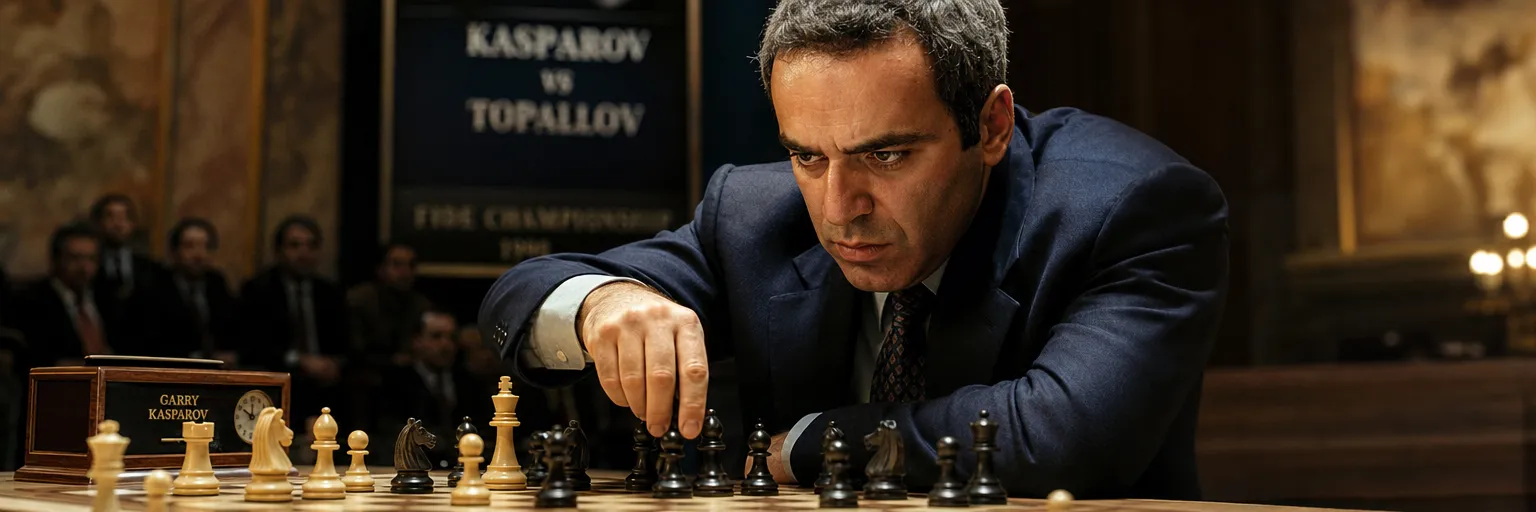
Garry Kasparov’s playing style and his strengths on the chessboard
On the chessboard, Kasparov stands out for his rare energy, a constant desire to seize the initiative, and an impressive ability to turn even the slightest advantage into a dangerous attack. His approach is based on a skillful blend of theoretical preparation, concrete calculation, and dynamic intuition, which made him one of the most feared players of his era.
Controlled aggression in the service of the initiative
The most striking trait of Garry Kasparov was undoubtedly his taste for active play. He very often sought to dictate the pace, create imbalances, and put his opponents under pressure from the very opening. Yet this aggressiveness was nothing improvised: it was built on a deep understanding of positions and excellent piece coordination. For him, attack was not only spectacular, it was also positionally justified.
Opening preparation of formidable precision
Kasparov made history through the importance he placed on studying openings. He used this phase of the game as a major strategic weapon, capable of giving him the initiative very early on. His command of complex variations, notably in the Sicilian Defense or the Queen’s Gambit, allowed him to steer the game toward terrain he knew better than his rivals. This rigor greatly helped strengthen his image as an ultra-prepared and always dangerous chess player.
A sense of dynamism and calculation
One of his great strengths lay in his ability to assess tense positions rich in tactical possibilities. Where others sought safety, Kasparov willingly accepted complex structures if they gave him prospects for activity. His quick calculation, tactical vision, and ability to anticipate several sequences in advance made him a true master of dynamic play. This power of foresight partly explains why Garry Kasparov dominated world competition so thoroughly.
Constant psychological pressure on the opponent
Beyond pure technique, Kasparov also excelled in the psychological dimension of games. His intensity at the board, body language, and fighting spirit often created an extra form of tension for his opponents. He knew how to maintain constant pressure, even in balanced positions, until he provoked an inaccuracy or a mistake. This ability to push the opponent out of their comfort zone is one of the hallmarks of his style.
A lasting legacy in chess history
Kasparov’s style left a deep mark on several generations of champions. His demanding preparation, taste for the initiative, and constant pursuit of activity helped modernize the way top-level chess is approached. Even today, his name remains associated with an ambitious and combative vision of the game, which explains why he remains an essential reference in the world of chess.
Garry Kasparov's exceptional achievements
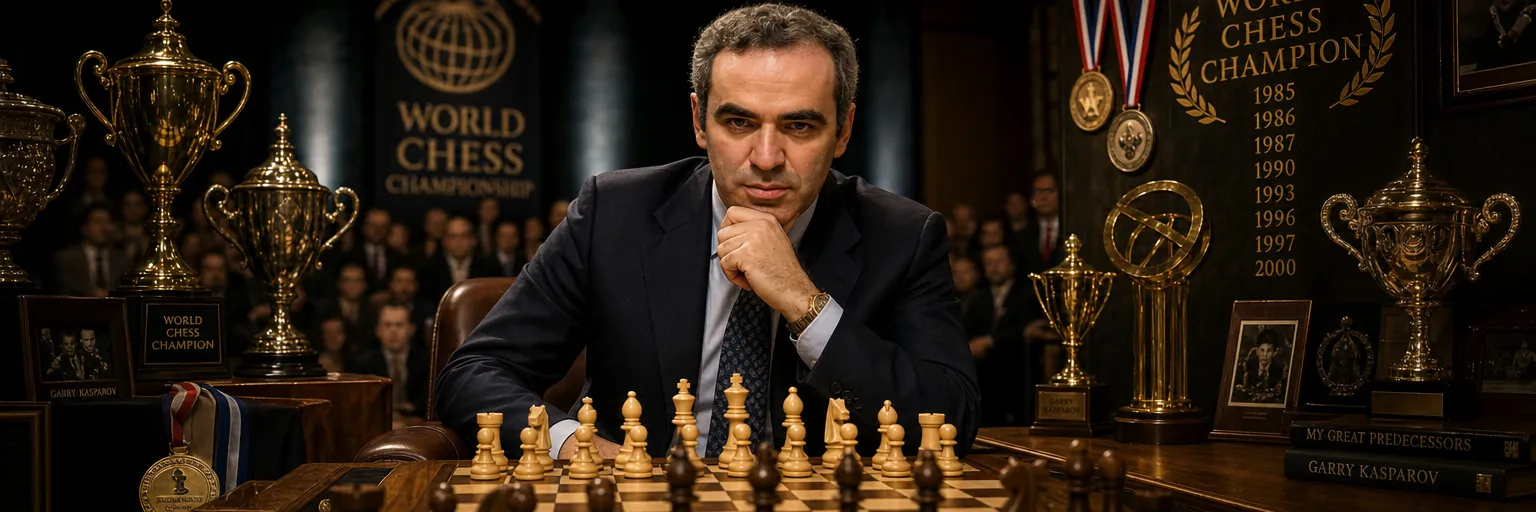
Few players can boast a collection of titles and records comparable to Garry Kasparov’s. His career at the highest level left a lasting mark on chess history, both through the longevity of his dominance and the scale of his achievements in the biggest international competitions.
A world champion with a historic reign
Kasparov became world champion in 1985 by defeating Anatoly Karpov at just 22 years old, making him one of the youngest champions in the discipline. He then retained his world crown for fifteen years, until 2000, a reign that alone illustrates the extent of his talent and his consistency at the top. This status as world champion was accompanied by a series of title defenses against the best players of his era, confirming his place among the greatest names in chess history.
Major victories in international tournaments
Beyond matches for the world title, Garry Kasparov won an impressive number of super-tournaments. He notably distinguished himself at Linares, often considered one of the strongest tournaments in the world, but also at Tilburg, Wijk aan Zee, Moscow, and Belgrade. His ability to dominate the elite in varied settings enhances the significance of his track record. For more than two decades, he racked up first-place finishes and set a standard of excellence that became a benchmark on the international circuit.
Records that shaped chess history
One of the most striking aspects of Kasparov’s career lies in his records. He held the world number one spot for many years and long held the highest Elo rating ever recorded at the time he set it. This statistical dominance reflects the exceptional consistency of his results against extremely high-level competition. In the world of chess, few players have exercised such a lasting hold over their generation.
Recognition far beyond titles
Garry Kasparov’s legacy is not limited to an accumulation of trophies. His influence also extends to the way he redefined the standards of modern chess, prepared for his matches, and inspired subsequent generations. His name remains associated with excellence, ambition, and fighting spirit. Through his achievements, Kasparov built a sporting legend that goes beyond the framework of competition and continues to fuel his renown around the world.
Garry Kasparov’s legendary duels against Anatoly Karpov
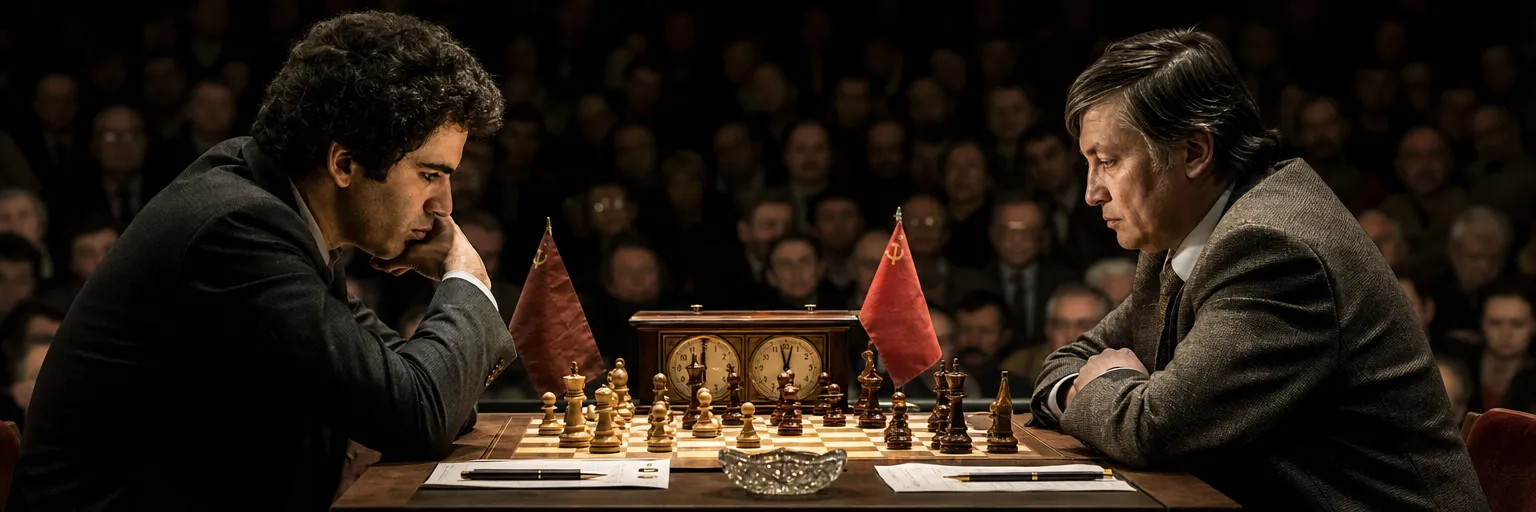
Few rivalries have shaped the history of chess as profoundly as the one between Garry Kasparov and Anatoly Karpov. For more than a decade, their clashes captivated the public, crystallized the tensions of the world championship, and gave rise to a series of matches of exceptional intensity. Beyond the results, these head-to-head encounters symbolized the opposition between two visions of the game, two temperaments, and two generations.
A rivalry at the pinnacle of world chess
When Kasparov emerged at the highest level, Karpov was already firmly established as world champion. Their confrontation quickly took on historical significance: on one side, Karpov embodied precision, positional control, and the art of gradually suffocating his opponent; on the other, Kasparov imposed a more dynamic style, focused on initiative, piece activity, and constant pressure. This contrast in styles made every game fascinating, because it went beyond the simple question of the result to become a true strategic clash.
Their first major duel for the world title, which began in 1984, remains one of the most controversial episodes in chess history. The match, extremely long and exhausting, was halted without an official winner after months of battle. This interruption fueled debate, intensified the tension between the two camps, and set the stage for an even more eagerly awaited rematch. In 1985, Kasparov finally came out on top and became the youngest world champion of the time, opening a new chapter in this legendary rivalry.
World championship matches that became legendary
Kasparov and Karpov did not face each other just once, but repeatedly, in a succession of top-level matches. After 1985, they met again in 1986, 1987, and 1990 for duels of remarkable depth. Such frequency is exceptional at that level and testifies to their domination of their era. With each encounter, the gap between the two champions seemed minimal, which only heightened the dramatic nature of their clashes.
These matches left a lasting mark on the memories of enthusiasts because they often turned on small details: more refined opening preparation, better nerve management, or a critical decision in a tense endgame. The Kasparov Karpov rivalry thus produced an impressive number of landmark games, still studied today for their strategic and psychological richness. It also helped popularize the World Chess Championship well beyond the circle of specialists.
Iconic games and constant tension
Among the many games played between the two men, some have become iconic for their depth and intensity. Kasparov often sought to unbalance the position quickly in order to impose his tactical energy, while Karpov responded with incredible resilience, a fine understanding of pawn structures, and a rare ability to exploit the slightest inaccuracy. This contrast produced clashes in which every move seemed loaded with significance.
Garry Kasparov’s legendary games against Karpov are not limited to spectacular attacks. They also show Kasparov’s ability to adapt, defend difficult positions, and win endgames under pressure. Across the board, Karpov demonstrated why he was regarded as one of the greatest technicians of all time. This constant tension, fueled as much by mutual respect as by rivalry, explains why their duels remain an essential benchmark in the world of chess.
A lasting legacy in the history of the game
Over the years, the rivalry between Kasparov and Karpov went beyond the sporting arena. It influenced opening theory, preparation for top-level matches, and the way champions approach modern competition. Their encounters showed that a world championship match is won not only through raw talent, but also through endurance, innovation, and psychological mastery.
Even today, the duels between these two giants are extensively commented on, replayed, and analyzed. They hold a central place in any biography of Garry Kasparov, because they defined a large part of his career and cemented his status as a legend. To understand the mark Kasparov left on the history of chess, it is impossible to overlook this masterful confrontation with Anatoly Karpov.
Garry Kasparov’s legendary games to revisit
Some of Kasparov’s games go beyond the simple matter of the result: they have become true benchmarks for understanding his creative genius, preparation, and sharp attacking sense. Revisiting these encounters helps explain why Garry Kasparov remains an icon of modern chess.
Kasparov vs. Topalov, Wijk aan Zee 1999
Often cited among the greatest games in history, this victory over Veselin Topalov perfectly illustrates Kasparov’s tactical power. With a succession of attacking moves, dynamic sacrifices, and exceptional piece coordination, he builds an attack of rare intensity. This legendary game is particularly appreciated by enthusiasts who want to study an attackconducted with boldness, precision, and a sense of timing.
The masterpiece against Anand in New York in 1995
During the World Championship match against Viswanathan Anand, Kasparov displays the full extent of his strategic mastery. After a carefully prepared opening phase, he gradually seizes the initiative and imposes a pace that his opponent can no longer contain. This game is often recommended for analyzing how a world champion turns a slight advantage into complete domination on the chessboard.
The landmark clashes with Karpov
Among the many battles fought against Anatoly Karpov, several games deserve to be revisited for their psychological intensity and technical richness. Kasparov combines theoretical preparation, fighting spirit, and a sense of initiative. In these top-level duels, you find everything that built his reputation: a concrete vision of positions, great confidence in calculation, and an ability to create complications at critical moments.
The victory over Deep Blue that defined its era
Before the famous rematch he lost in 1997, Kasparov had managed to defeat Deep Blue in a context already loaded with symbolic stakes. This game remains important because it highlights his adaptability against a non-human opponent capable of calculating at an unprecedented speed. For anyone interested in chess history and the relationship between man and machine, this moment remains essential.
Why these games still fascinate today
If these encounters continue to be studied, it is because they capture what made Garry Kasparov unique: attacking energy, depth of preparation, and the ability to turn a complex position to his advantage. They also provide excellent material for improvement, whether you want to understand the mechanics of the initiative, enrich your knowledge of famous chess games, or simply admire the style of a great master of the game.
Garry Kasparov against computers: the Deep Blue episode
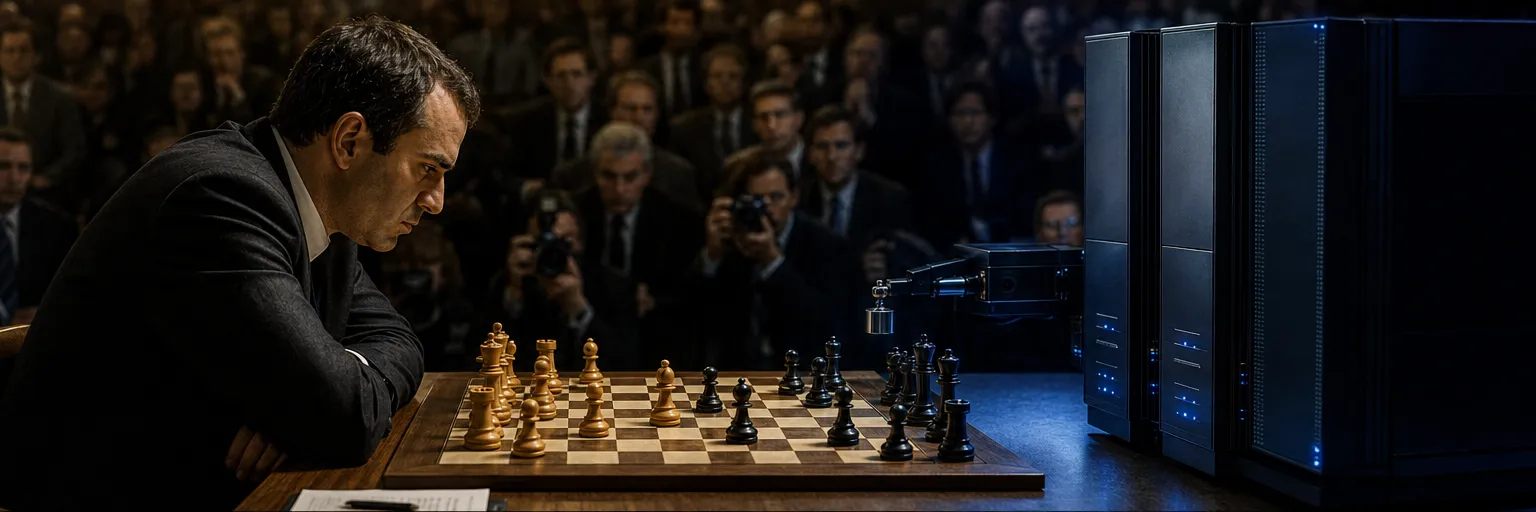
At the end of the 1990s, the confrontation between Garry Kasparov and Deep Blue went far beyond the scope of a simple chess match. It crystallized a fascinating question for the general public as well as for specialists: how far can a machine rival human intelligence in a game as complex as chess? This duel between the world champion and the computer designed by IBM then became a global event, followed as a technological and sporting turning point.
The 1996 match, the first strong signal
In 1996, Kasparov faced an initial version of Deep Blue. The Russian champion ultimately won the match, but the computer managed to win one game, a performance that was historic at the time against the world number one. This partial success of the machine already showed that computing power was progressing at great speed and that chess was entering a new era, in which computer-assisted preparation was becoming increasingly important.
1997, the rematch that changed history
The following year, IBM introduced an improved version of Deep Blue, capable of evaluating millions of positions per second. This time, the duel turned in the machine’s favor, as it defeated Kasparov by a score of 3.5 to 2.5. The world champion’s defeat caused an enormous media stir. For many, this match symbolized the first major victory of artificial intelligence over one of the most brilliant representatives of human strategic thought.
Beyond the raw result, the 1997 encounter remains marked by psychological tension. Kasparov believed that some of the moves played by the computer resembled very deep human decisions, fueling controversy over the exact role of IBM’s team during the match. This controversy further contributed to the legend of Kasparov versus the machine.
A media, scientific, and symbolic shockwave
The Deep Blue episode is not just an important chapter in Garry Kasparov’s career. It also became a key moment in the history of the relationship between humanity and technology. Media outlets around the world seized on the story because it touched on universal themes: creativity, intuition, computing power, and the limits of the human mind.
In the world of chess, this face-off accelerated the use of computers in training, opening analysis, and elite-level preparation. After this match, it became clear that the best players would now have to learn to work with machines, and no longer only against them.
The lasting legacy of the Kasparov–Deep Blue duel
With hindsight, the confrontation between Garry Kasparov and Deep Blue appears as a historic turning point. It did not mark the end of human genius in chess, but rather the beginning of a new phase in which humans and computers together redefined the standards of the game. Kasparov himself would later advocate the idea of collaboration between human intelligence and computing power, notably through the concept of "centaur chess."
This duel therefore remains an essential reference for understanding both the modernization of chess and Kasparov’s singular place in its history. Even in defeat, he helped make this match a legendary episode, still cited whenever the confrontation between man and machine is discussed.
Garry Kasparov's favorite openings
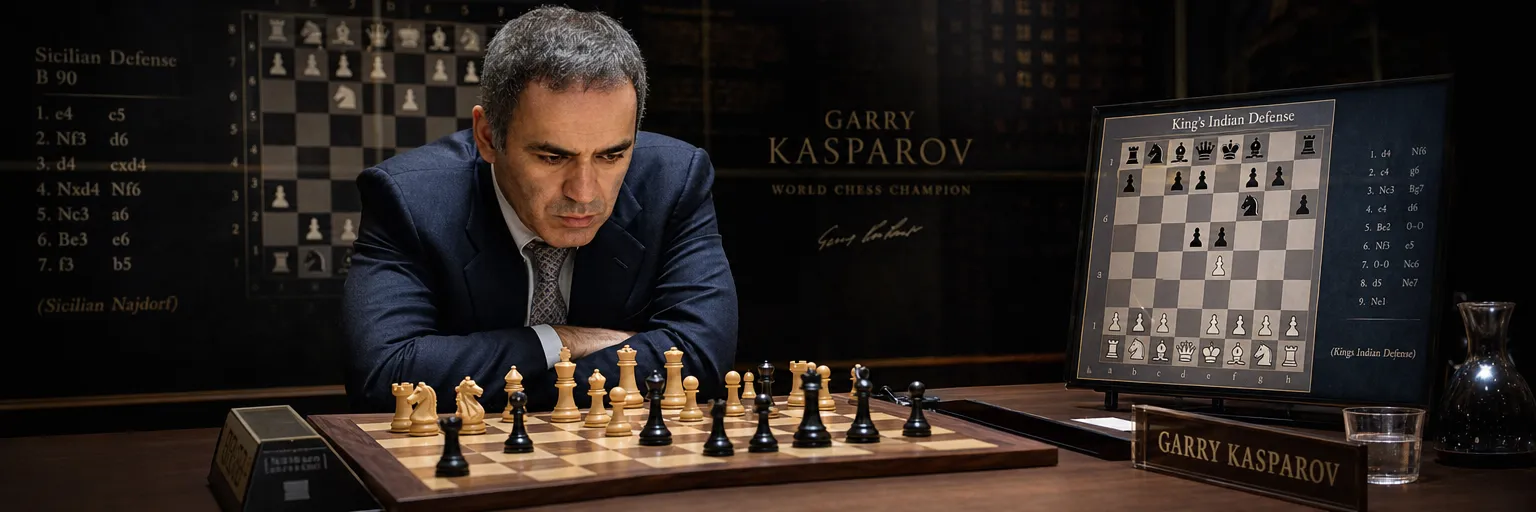
For Kasparov, the choice of opening was far from trivial: it was a true domain of domination, designed to dictate the pace, create imbalances, and steer the game toward dynamic positions. His theoretical preparation, renowned for being monumental, helped bring lasting change to several variations in modern chess theory.
With White, initiative above all
When he had the white pieces, Garry Kasparov very often sought systems that allowed him to gain space and apply rapid pressure. He notably made history with 1.e4, a first move perfectly aligned with his attacking temperament. In many games, he relied on his opponents' Sicilian Defense to enter sharp lines, especially the Najdorf Variation, which became one of his favorite battlegrounds.
Kasparov also contributed greatly to popularizing aggressive setups in the Ruy Lopez, where his understanding of initiative, development, and active piece play often made the difference. His objective was clear: to obtain a position rich in tactical possibilities while maintaining a solid strategic foundation.
The Sicilian Defense, an iconic weapon with Black
With Black against 1.e4, his name remains closely associated with the Najdorf Sicilian. This demanding and ambitious opening perfectly matched his style: complexity, counterattack, the fight for the initiative, and double-edged positions. Kasparov did not seek merely equality in it, but often concrete chances to play for a win against the best players in the world.
His work on opening theory in the Najdorf influenced several generations of grandmasters. Thanks to extremely deep preparation, he frequently entered variations where every tempo mattered, while retaining a remarkable ability to find new ideas at the highest level.
Against 1.d4, the King's Indian Defense as a signature
Against 1.d4, Kasparov often chose the King's Indian Defense, a combative opening that allows Black to temporarily concede space before launching a powerful counteroffensive. This choice perfectly illustrates his philosophy: accepting certain positional concessions in order to create maximum attacking potential.
Within this structure, he excelled at maneuvering before launching a pawn storm on the kingside or in the center. His mastery of typical plans, pawn breaks, and positional sacrifices often transformed theoretically balanced positions into formidable attacks. The Grünfeld Defense was also part of his repertoire, especially when he wanted to challenge White’s center immediately and energetically.
Preparation that changed theory
One of Kasparov’s greatest strengths lay in his ability to make the opening a direct extension of his vision of the game. He did not merely recite variations: he constantly enriched established ideas, introduced novelties, and prepared specific lines against his rivals. This approach reinforced the importance of opening preparation in top-level competition.
Even today, his choices in the Najdorf, the King’s Indian, or certain lines of the Ruy Lopez are still studied by players, coaches, and enthusiasts. Garry Kasparov’s favorite openings thus reflect a lasting legacy: that of a champion capable of turning the opening moves of the game into a decisive strategic weapon.
Garry Kasparov’s legacy in chess history
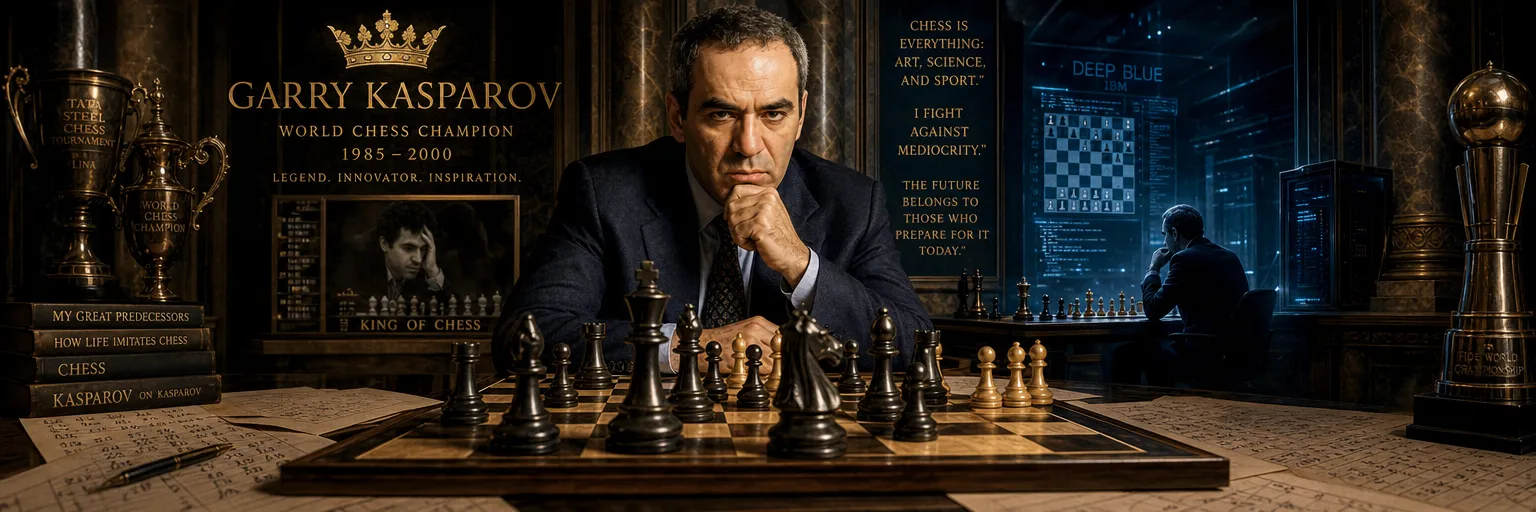
Beyond his titles, Garry Kasparov left a lasting mark on the way chess is thought about, prepared, and played. His name remains associated with a modern vision of the game of chess, in which controlled aggression, theoretical innovation, and a demanding work ethic redefine the standards of the very highest level. For many observers, he still embodies the image of the world chess champion capable of combining tactical power, strategic depth, and intellectual influence.
A revolution in player preparation
Kasparov helped transform chess preparation into a scientific, intensive, and collaborative endeavor. With his teams of analysts, he pushed the study of openings, opponent analysis, and the exploitation of novelties to great lengths. This approach shaped an entire generation of grandmasters, who then adopted working methods that were more rigorous, more specialized, and increasingly supported by technology.
His legacy can also be seen in the importance placed on the initiative. For him, preparation was not merely intended to equalize or secure a position, but to create concrete problems from the very first moves. This philosophy has had a lasting influence on the evolution of modern chess.
A model for future generations
Many champions and title contenders have acknowledged Kasparov’s influence on their development. His opening repertoire, his attacking games, and his ability to apply constant pressure have become benchmarks studied all over the world. For many young talents, he represents an example of fighting spirit, discipline, and ambition at the highest level.
His impact, moreover, goes beyond sporting results alone. Through his books, analyses, and public statements, he helped spread a deep chess culture, showing that a game could be understood as a work of creation as much as a competitive clash.
A major role in the dialogue between man and machine
The episode against Deep Blue strengthened Kasparov’s place in history, not only as a player, but also as a central figure in a technological turning point. His matches against the computer symbolized the meeting between human intuition and computing power. Even in defeat, he helped popularize a reflection that has become essential in the world of professional chess: how to use machines to improve without losing the richness of human understanding.
This dimension has profoundly shaped contemporary training. Today, the use of analysis engines and databases is part of competitors’ daily routine, in a logic that Kasparov largely helped bring to light.
Why his name remains essential
If Garry Kasparov remains an absolute reference, it is because his legacy brings together several dimensions rarely combined in a single player: sporting dominance, theoretical innovation, media influence, and lasting impact on the practice of the game. His career continues to fuel debates about the greatest player of all time, and his chess work remains a source of study for anyone seeking to understand the evolution of chess at the highest level.
In short, Kasparov’s legacy is not limited to an exceptional list of achievements. It is measured by the mark he left on the ideas, methods, and ambitions of an entire world, making him an essential figure in the history of chess.
Garry Kasparov’s path after competition
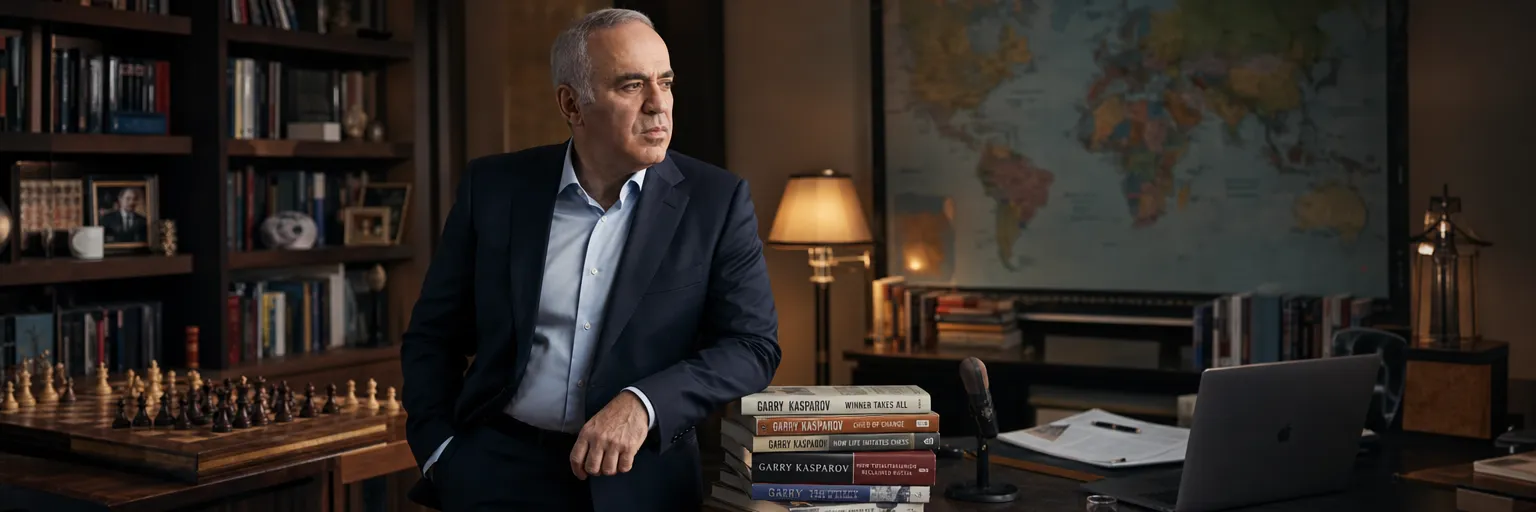
When he retired from professional chess in 2005, Garry Kasparov did not disappear from the public stage. On the contrary, the former world champion redirected his energy toward other battles, putting his reputation, analytical skills, and powers of persuasion to work in the service of political, intellectual, and educational causes. This new phase of his life extends, in another form, the high standards that defined his entire career.
A clear political commitment
After leaving competition, Garry Kasparov became deeply involved in Russian political life. An outspoken opponent of Vladimir Putin’s regime, he took part in several democratic movements and became one of the best-known voices of the liberal opposition. His positions, often direct and uncompromising, earned him international visibility, but also intense pressure in his home country.
Over the years, Kasparov transformed his image from that of a former chess champion into that of a committed intellectual. He regularly appears in the media, at conferences, and in opinion pieces devoted to democracy, civil liberties, and authoritarian drift. This political transformation shows that his influence extends far beyond the chessboard.
A respected author and speaker
Alongside his civic engagement, he developed a significant career as an author. His books cover chess as well as strategy, decision-making, leadership, and the relationship between humans and technology. Through these publications, Garry Kasparov shares a way of thinking shaped at the highest level, in which preparation, anticipation, and adaptability play a central role.
His public speaking engagements have also resonated widely. In companies, universities, and at international events, he draws on his experience as a former world number one to speak about performance, innovation, and managing uncertainty. This ability to connect chess with the contemporary world explains why his voice continues to be heard well beyond the game’s enthusiasts.
Passing on his knowledge to new generations
Even far from major tournaments, Kasparov has maintained a close connection with his original world. He supports educational initiatives centered on chess, convinced of its value in developing concentration, logic, and discipline. He has also taken part in projects aimed at promoting the game among young people and demonstrating its usefulness in education.
This desire to pass on his knowledge is part of the natural continuation of his journey. The former world champion does not merely embody a glorious past: he also seeks to shape the future of the discipline. In this respect, Garry Kasparov’s path after competition illustrates a rare kind of reinvention, where sporting excellence becomes a driver of cultural, intellectual, and political influence.
Garry Kasparov’s books, positions, and commitments outside chess
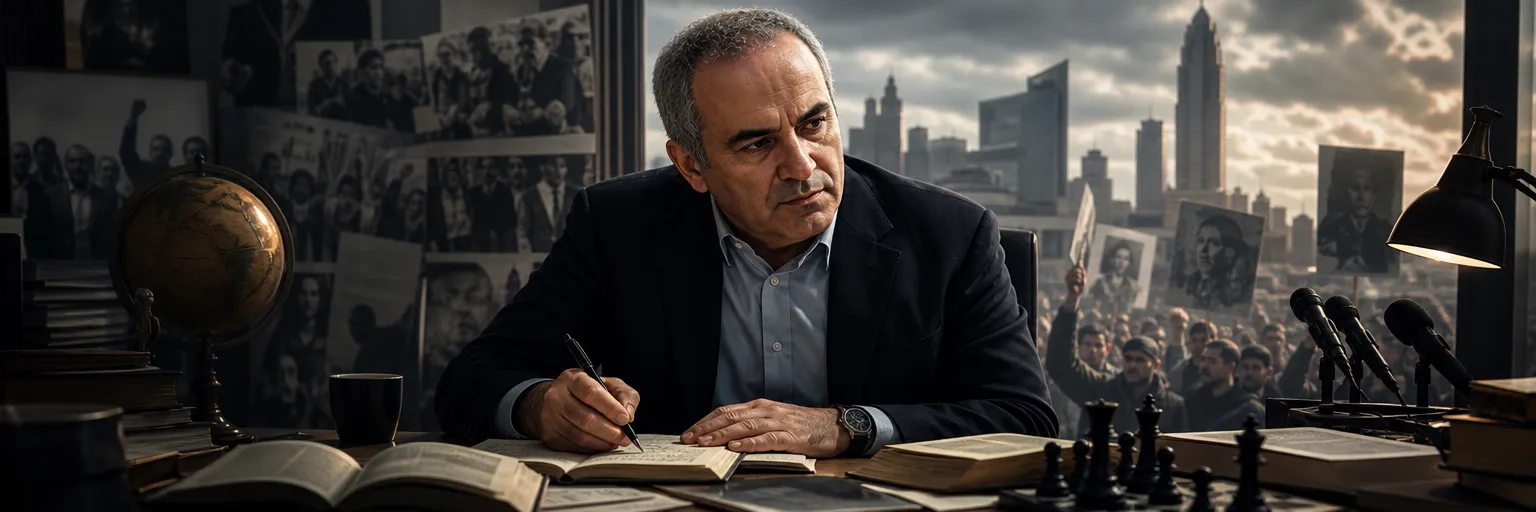
After leaving top-level competition, Garry Kasparov developed an especially intense intellectual and public career. His journey away from the chessboard combines writing, political analysis, the defense of civil liberties, and reflection on the relationship between humanity, power, and technology. This new phase has reinforced the image of a committed Garry Kasparov, capable of applying his strategic rigor to fields beyond chess.
A significant body of published work
Kasparov established himself as a prolific author. He has, of course, published landmark works on the game, notably through the My Great Predecessors series, highly regarded for the depth of its analysis and its historical reading of past champions. But his books are not limited to chess theory: he has also written about decision-making, leadership, innovation, and major geopolitical issues.
In texts aimed at a broader audience, he often connects the strategic logic learned on the chessboard to public life, the business world, and contemporary transformations. This ability to make complex subjects accessible has helped make him a respected voice far beyond the circle of chess enthusiasts.
Openly stated political positions
Garry Kasparov’s public profile has also been shaped by his interventions in public debate. Highly critical of the Russian government, he established himself as a leading figure of the democratic opposition, denouncing authoritarianism, corruption, and the erosion of checks and balances. His positions have brought him major international media exposure, but also pressure and personal risks.
His message is grounded in a consistent defense of democratic institutions, freedom of expression, and the rule of law. In this regard, Garry Kasparov appears as a committed intellectual whose voice goes beyond the simple status of former world champion to address the major political questions of his time.
A lasting commitment to democracy and civil rights
Over the years, Kasparov has taken part in numerous activist initiatives, conferences, and opinion pieces devoted to democracy. His commitment reflects a clear objective: to alert public opinion to authoritarian abuses and support movements committed to fundamental freedoms. He regularly speaks in the media, at universities, and in international forums to defend a demanding vision of civic responsibility.
This public dimension has profoundly transformed his image. From a former chess prodigy, he has become an influential observer of international affairs, capable of leveraging his experience, notoriety, and argumentative strength in the service of political and civic causes.
Technology, artificial intelligence, and strategic thinking
Kasparov has also established himself as a respected commentator on technological issues, particularly artificial intelligence. Drawing on his experience facing machines, he has developed a nuanced reflection on cooperation between humans and computers, emphasizing complementarity more than opposition. This approach has allowed him to occupy a distinctive place in debates surrounding innovation.
In his lectures as in his books, he defends the idea that technology should be understood as a tool for enhancing human capabilities. Here again, his reasoning retains a framework drawn from chess: anticipation, adaptation, reading power dynamics, and the importance of preparation.
An influence that extends far beyond sport
Garry Kasparov’s post-career path shows just how far his influence extends beyond his titles. As an author, speaker, political opponent, and analyst, he has managed to build a lasting presence in the global public sphere. His books, speeches, and battles offer another reading of his trajectory: that of a man who continued to shape his era, no longer only through his moves on the chessboard, but through his ideas and convictions.
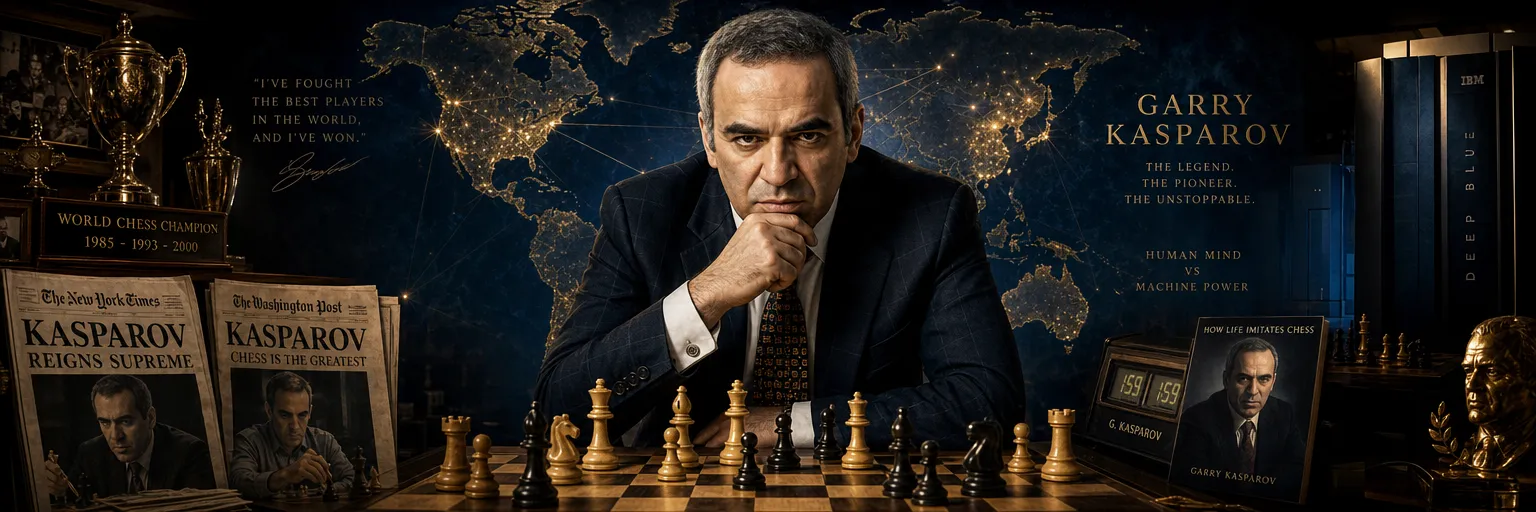
Why Garry Kasparov remains a global benchmark in chess
More than a former champion, Garry Kasparov embodies a standard of excellence that continues to influence players, coaches, and enthusiasts around the world. His name remains associated with enduring dominance, a modern vision of preparation, and a rare ability to evolve the very understanding of the game. In this respect, Garry Kasparov remains an essential figure whenever top-level chess is discussed.
Dominance that left its mark on several generations
For many years, Kasparov maintained an exceptional level of performance against the best players of his era. His longevity at the top, his status as world champion, and his consistency in major tournaments forged a reputation that extends far beyond his titles. For many, he still embodies the model of the complete competitor, capable of combining calculating power, intuition, and fighting spirit.
A new way of preparing for games
One of the reasons he remains a benchmark also lies in his approach to work. Kasparov helped professionalize preparation, particularly in the study of openings, the in-depth analysis of variations, and the methodical use of novelties. This rigor transformed elite-level standards and influenced the entire modern history of chess, far beyond his own career.
A spectacular and instructive style
His games continue to be studied because they combine efficiency and creativity. For him, attack was not just brilliant: it was built on positional logic, remarkable piece coordination, and a sharp sense of initiative. Revisiting a Garry Kasparov game means understanding how a player can gain the psychological edge, accelerate the pace, and turn mounting pressure into a decisive offensive.
A lasting influence on chess culture
Kasparov also remains a benchmark because he helped popularize chess among a much wider audience. His matches against Karpov, then against Deep Blue, gave the discipline worldwide visibility. His journey showed that chess could be at once a strategic art, an elite sport, and a field for reflection on technology, mental preparation, and decision-making.
A legacy still alive among today’s champions
Many contemporary grandmasters acknowledge the importance of his legacy. His sense of dynamism, his constant ambition, and his demanding approach to work continue to inspire the new generation. Even in a world transformed by analysis engines and databases, the mark left by Garry Kasparov remains visible: in training methods, in opening preparation, and in the very idea of what an exceptional player can bring to chess.
Garry Kasparov left his mark on the history of chess thanks to his incredible aggressiveness on the board, his immense theoretical preparation, and his clashes that became legendary. Before him, another prodigy had already shaken the chess world by becoming a true international icon: Bobby Fischer: career, genius, and legendary games, famous for his historic duel against Boris Spassky during the Cold War.
Also discover other fascinating portraits of champions and iconic players who have left a lasting mark on the history of chess: Famous chess players: legends, champions, and modern stars.