 France
 English
 Deutsch
 Español
 Italiano
 Nederlands
 Polski
 Português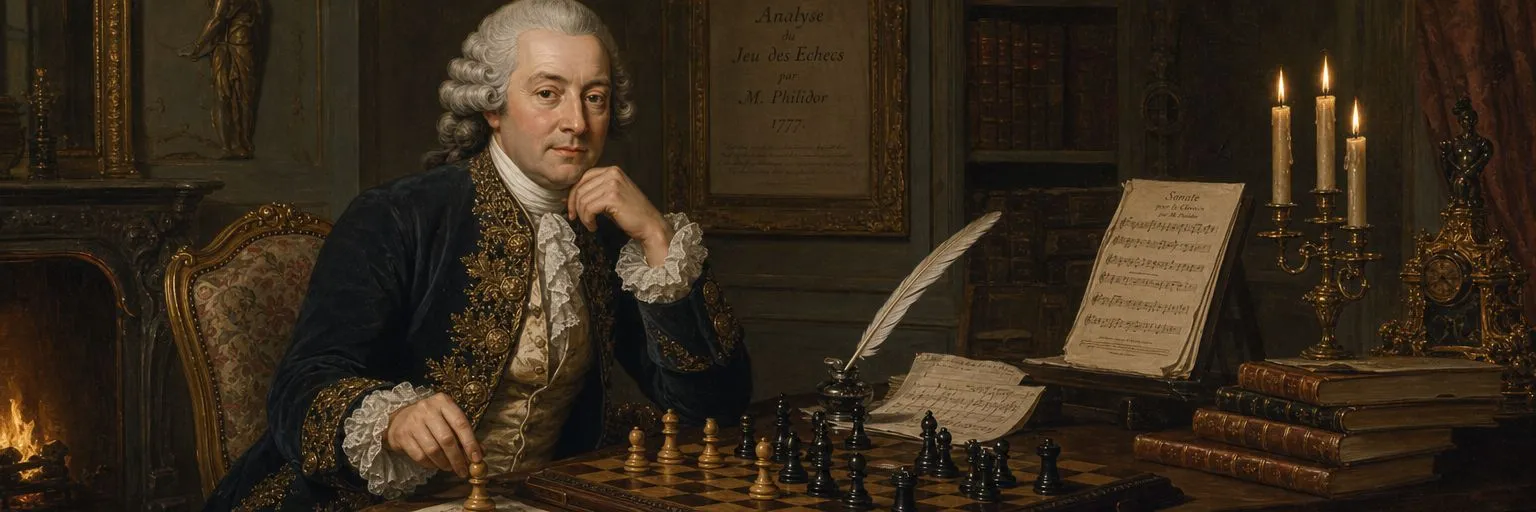
Who was François-André Philidor?
François-André Philidor, born in 1726 and died in 1795, is one of the most remarkable figures in the history of chess. A renowned composer in his time, he nevertheless left his most lasting mark as an exceptional theorist and player. His name remains associated with a new way of thinking about the game, more positional, more structured, which profoundly influenced the generations that followed.
A musician who became a chess master
Coming from a family of musicians in service to the French court, Philidor first distinguished himself in the field of music. From a very young age, he composed and moved in Parisian artistic circles. But at the same time, he developed a remarkable talent for chess, a discipline in which he quickly earned a reputation as a formidable player. This dual career made him a singular figure, capable of shining as much on stage as in front of a chessboard.
A revolutionary thinker of the game
What sets Philidor apart from many players of his time is his exceptional strategic understanding. At a time when spectacular attacks dominated, he highlighted the fundamental role of pawns in building a solid position. His famous formula, according to which pawns are "the soul of chess," alone sums up the originality of his vision. This approach helped make François-André Philidor a major forerunner of modern strategy.
A name tied to a legendary defense
If his legacy is still alive today, it is also thanks to the famous defense that bears his name. The Philidor Defense has become an iconic opening, studied by beginners and experienced players alike. It perfectly reflects his style: caution, solidity, and a sense of organization. Through this theoretical contribution, François-André Philidor continues to hold a central place in the world of chess.
A legacy still present
Beyond his games and analyses, Philidor helped transform the way the game is thought about. His influence extends far beyond his century, because his ideas laid the groundwork for the great strategic principles that still dominate modern competitions. Today, he remains an essential reference for understanding the evolution of chess and the origin of certain fundamental concepts of positional play.
The origins of a prodigy between music and chess
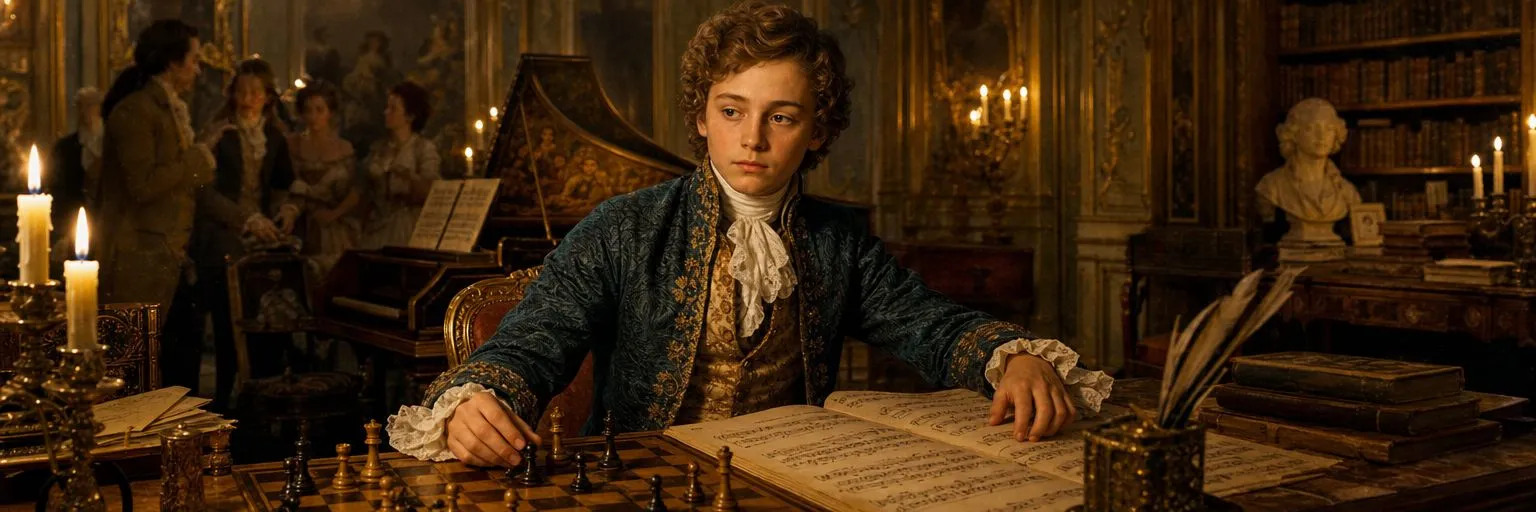
Born in Dreux in 1726 into a family of musicians serving the royal court, François-André Danican Philidor grew up in a world where rigor, memory, and harmony held a central place. Long before being associated with a defense that would become famous, the young Philidor was first trained in listening, discipline, and the art of combining several voices into a coherent whole. This musical sensitivity would profoundly shape his way of approaching the chessboard.
A family legacy shaped by music
The Danican family, to which Philidor belonged, already enjoyed a solid reputation in the French musical landscape. From an early age, he was introduced to singing and composition, notably within the Royal Chapel. This prestigious setting exposed him to a culture of high standards in which every detail mattered, from the precision of rhythm to the balance of ensembles. This education fostered in him an exceptional sense of organization, a quality that would later be reflected in his strategic vision of the game.
Discovering chess in an elite environment
It was through contact with cultivated and aristocratic circles that the young Philidor discovered chess. At a time when the game was as much an intellectual pastime as a social marker, he quickly distinguished himself through his calculating ability and his understanding of positions. Where others were content with spectacular attacks, he was already beginning to perceive the internal logic of structures, invisible power dynamics, and the value of time. This approach foreshadowed the future theorist François-André Philidor would become.
When the musician’s ear meets the strategist’s mind
Philidor’s path is fascinating because it rests on a rare dual excellence. In music, he composed operas and earned recognition on French and London stages. In chess, he developed an original way of thinking, based on the coordination of the pieces and above all on the central role of the pawns. His famous principle, according to which pawns are the soul of chess, perfectly illustrates this way of organizing the game like a musical score. In his case, creativity never stands in opposition to structure: it flows from it.
The foundations of a reputation destined to outlast his century
This youth spent between art and reflection prepared the rise of an extraordinary figure. By combining the sensitivity of a composer with the lucidity of a player, Philidor laid the foundations of a way of thinking that would have a lasting influence on the history of the game. His name would not remain attached only to his exploits in games or his blindfold exhibitions, but also to a modern conception of chess, in which patience, construction, and positional mastery take precedence over tactical fervor alone.
Philidor at court and in European salons
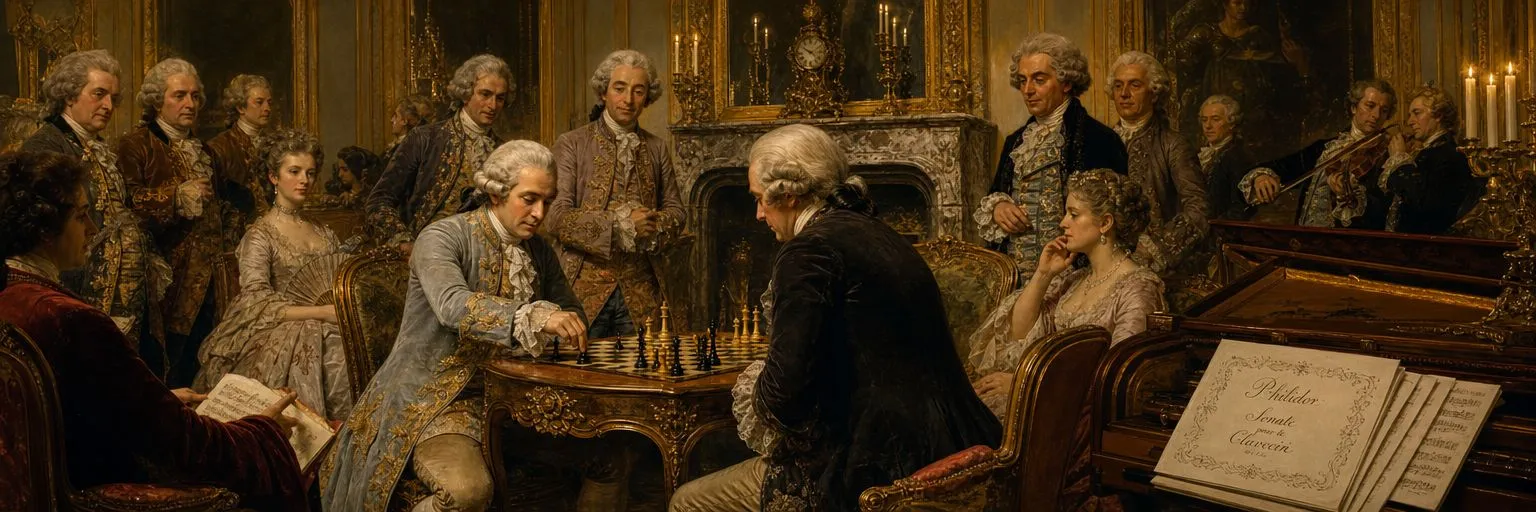
Far beyond the chessboard, Philidor established himself as a sought-after figure in the aristocratic and intellectual circles of the 18th century. His dual reputation as a composer and chess master opened the doors of the court to him, as well as those of the cafés and salons frequented by diplomats, nobles, artists, and thinkers. In these social spaces, his talent fascinated as much as it impressed.
A notable presence in circles of power
Thanks to his family heritage and musical skills, Philidor moved at an early age in environments close to royal power. This proximity to the court helped strengthen his prestige, while his demonstrations on the chessboard fueled his renown. At a time when chess was also a cultural marker, he became one of the few players capable of turning a scholarly pursuit into a true social spectacle.
The Café de la Régence, the stage of his renown
In Paris, the Café de la Régence held a central place in his career. A true nerve center of European chess, this venue brought together the best players and attracted visitors from across the continent. Philidor asserted his superiority there with remarkable ease, multiplying games, analyses, and exhibitions. It was there that a large part of his legend was forged, in an environment where brilliant conversation accompanied the most refined strategy.
From European salons to intellectual acclaim
Philidor’s reputation quickly spread beyond French borders. In England in particular, he found an enthusiastic audience, eager to discover the man many already considered the greatest player of his time. In European salons, his mastery of the game was seen as the expression of a methodical, almost scientific intelligence. His name then circulated as a major reference, associated with a modern vision of chess and an unprecedented understanding of defense and pawn structure.
A figure at the crossroads of art and strategy
What also set Philidor apart in these elite circles was his ability to embody two forms of excellence. A renowned composer and theoretician of the game, he represented a rare synthesis of artistic sensitivity and strategic rigor. This singularity enduringly fueled his aura and explains why his influence extended far beyond his own era. In courts as in salons, Philidor thus became the symbol of a brilliant mind, capable of bringing together culture, social prestige, and tactical genius.
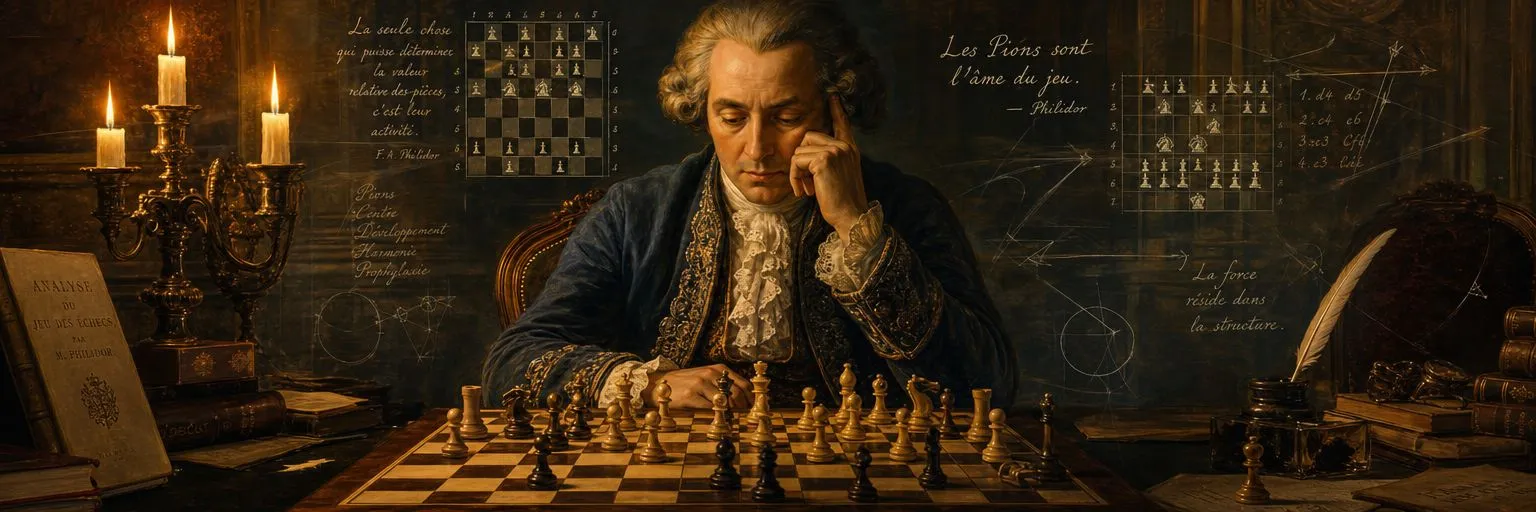
How Philidor transformed chess strategy
With Philidor, the way of thinking about chess changed profoundly : instead of focusing solely on spectacular attacks and immediate combinations, he emphasized a more structured, patient, and positional vision of the game. His major contribution was to show that the strength of a position depends not only on active pieces, but also on pawn structure, controlled space, and overall coordination.
The revolution of pawn structure
Philidor’s most famous idea is summed up in a phrase that became historic : pawns are the soul of chess. Through this insight, he asserted that pawn structure determines the rhythm of the game, the weaknesses to exploit, and long-term plans. This way of reading the game, now fundamental, was innovative at the time. It helps explain why certain seemingly quiet positions actually contain lasting advantages that a patient player can capitalize on.
A more strategic than tactical approach
At a time when many players were primarily seeking brilliance and immediate sacrifice, Philidor developed a more rational method. He stressed harmonious development, caution in advancing the pieces, and the need to prepare the attack rather than launch it without a solid foundation. This evolution marked a turning point in the history of chess, because it foreshadowed the great principles of modern strategy : prophylaxis, control of the center, strong squares, and gradual plans.
The legacy of the Philidor Defense
His thinking is also embodied in the famous Philidor Defense, an opening that illustrates his preference for solidity and positional coherence. Even though modern theory has expanded and sometimes nuanced its use, this defense retains major symbolic importance. It reminds us that Philidor did not simply leave his name to an opening line : he helped usher chess into an era in which strategic understanding became just as important as tactical inspiration.
A lasting influence on later generations
The masters who followed him, from classical theoreticians to more contemporary champions, inherited this new way of evaluating a position. By placing pawn logic and the methodical construction of play at the heart of reflection, Philidor laid the groundwork for the entire future evolution of chess theory. His influence therefore extends far beyond his own century : it can be found in almost every game where a player seeks to build an advantage before delivering the final blow.
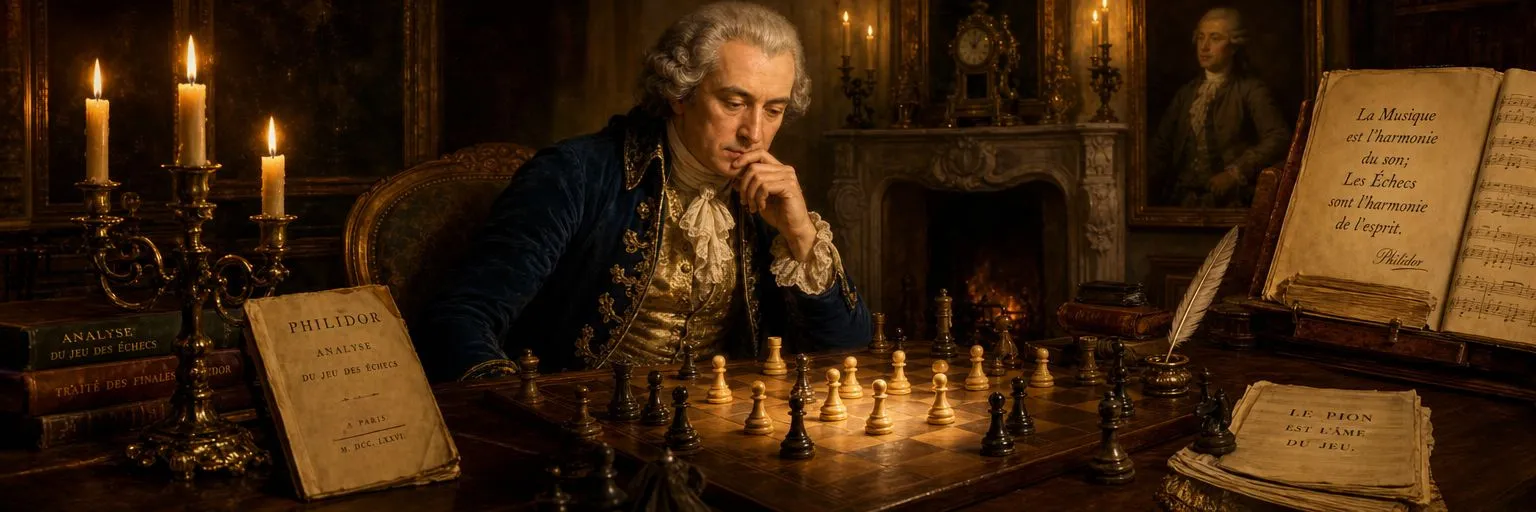
“Pawns are the soul of chess”: a foundational idea
With this now-famous phrase, Philidor sums up an intellectual revolution : he asserts that the true logic of the game is not limited to brilliant sacrifices or direct attacks on the king. For him, the pawn structure determines space, weaknesses, strong squares and, ultimately, the plan to follow. This intuition, simple in appearance, profoundly shaped the history of chess and established Philidor as one of the great thinkers of strategy.
A break with the game’s spectacular vision
In the 18th century, many players valued immediate initiative and rapid offensives above all else. Philidor, however, observed that pieces cannot act effectively without a solid foundation. Pawns are not mere extras : they organize the camp, support advances and restrict the opponent’s possibilities. This way of seeing the game foreshadows a far more modern understanding of chess strategy, in which patience and coordination often take precedence over surprise.
Why pawns occupy a central place
Every pawn move creates lasting consequences, because unlike the other pieces, a pawn does not move backward. Philidor understood very early on that these advances shape the entire game. A pawn majority, an isolated pawn, a pawn chain or doubled pawns are not mere technical details : they are signs that reveal the strengths and weaknesses of a position. By emphasizing this dimension, he laid the groundwork for a more refined reading of the position and the long term.
A body of thought that goes beyond the Philidor Defense
Although his name is often associated with the Philidor Defense, his legacy extends far beyond a specific opening. His famous maxim influenced the way chess is taught, analyzed and played. It invites us to look at the chessboard as a coherent whole, in which pawns condition the activity of the major and minor pieces. This approach paved the way for the great positional theorists of the following centuries, who in turn would take up the idea that pawn structure is one of the game’s essential foundations.
A legacy that remains relevant today
Even today, this vision remains entirely relevant. Beginner players quickly learn that a thoughtless pawn push can permanently weaken their position, while experienced players know that a sound structure can be enough to shape an entire plan. By placing pawns at the heart of strategic thinking, François-André Philidor left behind an interpretive key that is still used in contemporary analysis. His formula remains one of the most famous in chess history because it expresses, in just a few words, a timeless strategic truth.
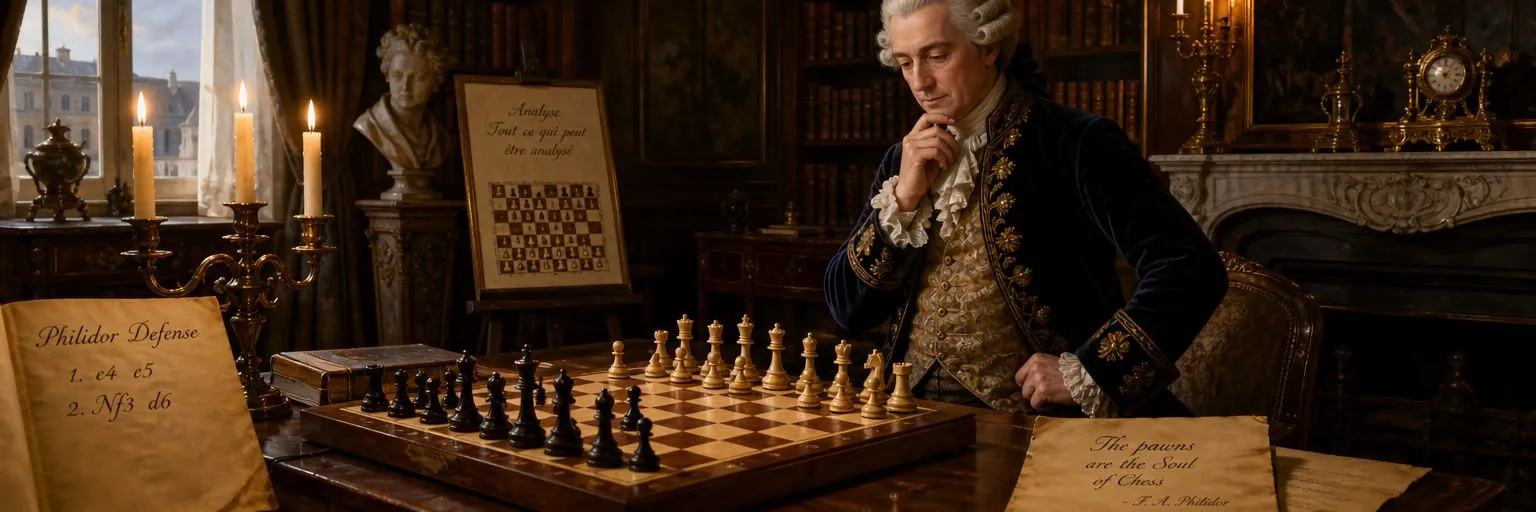
The Philidor Defense: principles, ideas, and objectives
Associated with the move order 1.e4 e5 2.Nf3 d6, the Philidor Defense perfectly reflects the thinking of its creator: first consolidate the position before seeking the initiative. Less spectacular than other responses to 1.e4, it is based on a simple logic: support the e5 pawn, limit early weaknesses, and prepare a coherent development of Black’s pieces.
A restrained structure, but one built on solid ideas
The core of the Philidor Defense is to build a compact position. By playing ...d6, Black protects e5 without immediately advancing other central pawns too ambitiously. This approach often gives rise to a resilient pawn structure, in which Black seeks to avoid unnecessary imbalances while retaining counterplay opportunities.
In this spirit, development proceeds with caution: the minor pieces come out to support the center, the king can castle fairly quickly, and Black waits for the right moment to challenge White’s space more directly. This concept clearly illustrates a form of positional strategy, in which solidity takes precedence over immediate effect.
The strategic ideas behind the opening
The Philidor Defense is not aimed solely at holding an equal position: it also seeks to pose concrete problems for the opponent. By often allowing White to occupy more space at the outset, Black hopes to provoke overconfidence, then strike back with breaks such as ...f5 or ...d5 depending on the variation and piece placement.
This opening requires a good understanding of the center, the timing of exchanges, and defensive coordination. It reflects a vision in which patience is a weapon. Rather than forcing complications from the very first moves, Black relies on the solidity of their position, the gradual improvement of the pieces, and the exploitation of any inaccuracies from White.
Clear objectives for Black
The aims of the Philidor Defense are generally threefold : to secure the position, complete development without any major weaknesses, and prepare credible counterplay in the center or on the kingside. It therefore suits players who appreciate solid positions, rich in maneuvering and strategic decisions.
From a historical perspective, this defense also illustrates Philidor’s modernity. By placing so much importance on the cohesion of Black’s camp, the value of the pawns, and the overall balance of the position, he heralded a far more sophisticated way of playing than the mere search for direct attacks. This explains why the Philidor Defense, despite its age, continues to attract the interest of both amateurs and connoisseurs.
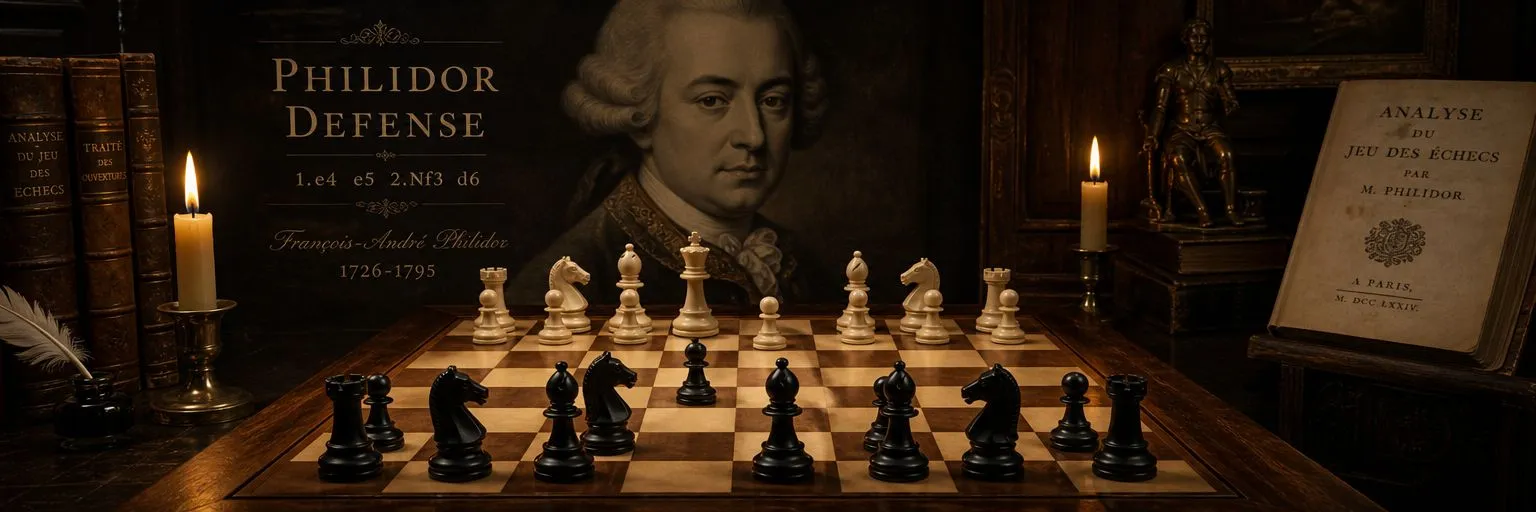
How to adopt the Philidor Defense with Black
Choosing the Philidor with the black pieces means embracing a restrained, solid, and deeply strategic approach. After 1.e4 e5 2.Nf3 d6, Black does not necessarily seek to challenge the center aggressively right away : instead, they build a reliable foundation, limit early weaknesses, and prepare coherent development. This Philidor Defense is particularly well suited to players who like compact structures, clear plans, and well-prepared counterattacks.
Laying the foundations
The first instinct should be to understand the idea behind the move ...d6. By supporting the e5 pawn, Black consolidates the center and retains a certain flexibility for piece development. In a chess opening for Black of this kind, the goal is not to gain time at all costs, but to achieve a healthy position in which each piece can find its natural square.
The most common setup is based on ...Nf6, ...Be7, ...0-0, then often ...c6 or ...Nbd7 depending on the position. This setup avoids unnecessary complications and makes it possible to reach a middlegame where strategic understanding matters just as much as theory. To play the Philidor Defense with Black well, it is therefore essential to prioritize piece harmony over the search for immediate effects.
Knowing the typical plans
Once development is underway, several plans come up frequently. Black may aim for the break ...d5 if circumstances allow, in order to equalize more actively in the center. They may also prepare ...c6 followed by ...Qc7, with the idea of reinforcing e5 and keeping options on both wings. In some lines, the knight from b8 goes to d7, supports f6, and helps control the central squares.
What makes this structure interesting is its logic : it invites patient play, without losing sight of counterplay opportunities. A good Philidor Defense player knows how to wait for the right moment to react, rather than exposing themselves too early. This philosophy remains faithful to Philidor’s legacy, centered on pawn solidity and overall coordination.
Avoiding common mistakes
The main trap is playing too passively. If Black simply piles up defensive moves without a clear plan, White can take space, launch an attack, and impose their rhythm. Adopting this opening does not mean suffering passively : on the contrary, you must watch for opportunities to break free in the center and activate your pieces.
Another classic mistake : developing the dark-squared bishop too early or misplacing the knights, which can hinder overall coordination. In this positional opening, every tempo counts. Black must also be careful not to stifle their own play for too long, especially if the d6 pawn becomes merely an anchor point without any dynamic prospects.
Adapting the Philidor to your playing style
The Philidor is not reserved for ultra-defensive players. It can perfectly suit those who like to provoke the opponent, let them advance, then exploit the imbalances created. It is especially useful for club players who want a solid defense in chess without memorizing an excessive number of variations.
To adopt it successfully over the long term, the most effective approach is to study a few model games, identify recurring pawn structures, and practice recognizing the key moments : when to play ...d5, when to exchange in the center, when to seek counterplay on the kingside or queenside. In this way, the Philidor Defense becomes less a simple sequence of moves and more a true strategic framework for playing Black with confidence.
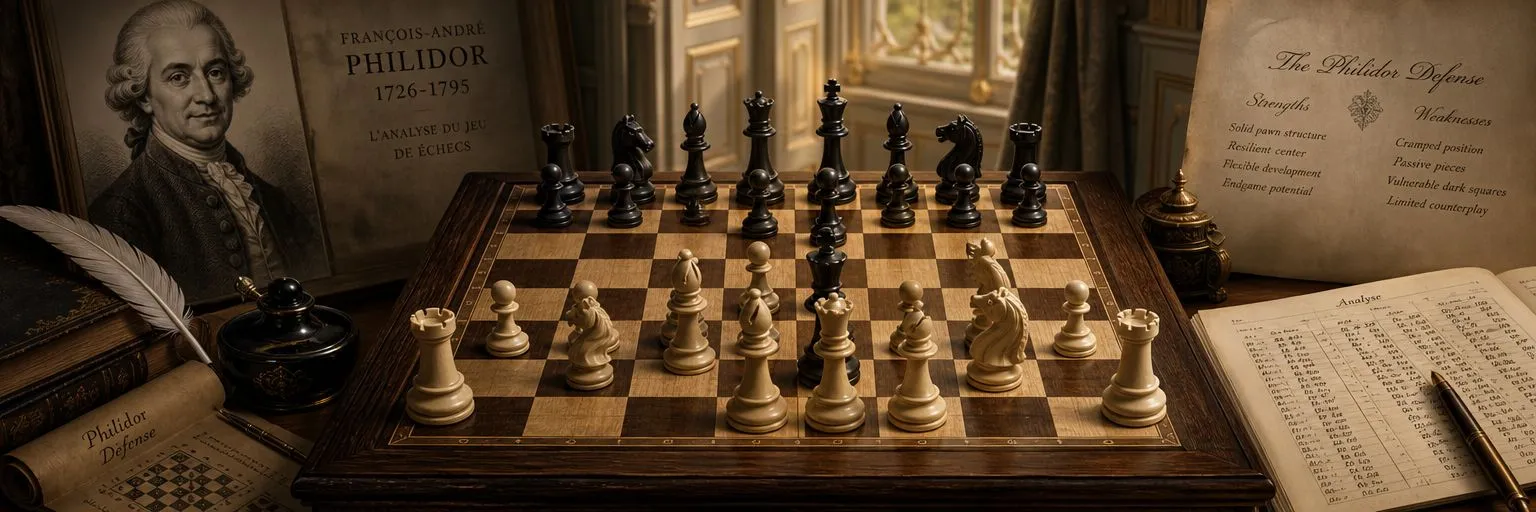
Strengths and weaknesses of the Philidor Defense
Often seen as a discreet opening compared with more ambitious systems, the Philidor Defense nevertheless retains real practical value. It appeals to players looking for a reliable structure, clear plans, and a compact position, while still requiring a good understanding of tempos and central breaks.
A solid and coherent foundation
The Philidor Defense’s main strength lies in its solidity. By playing ...d6 early in the opening, Black supports the e5 pawn and limits immediate weaknesses. This setup encourages measured development, with clear ideas : develop the pieces harmoniously, castle quickly, and wait for the right moment to challenge White’s center.
This logic is particularly well suited to players who favor long-term strategy. The Philidor Defense often makes it possible to avoid certain ultra-theoretical lines of the Ruy Lopez or the Italian Game, which makes it an interesting practical weapon, especially against opponents who are better prepared in the most common openings.
Simple plans, but not simplistic
Another advantage lies in the clarity of its setups. Black generally aims to consolidate the position before considering counterattacks, often with ...Nf6, ...Be7, ...0-0 and, depending on the variation, ...c6 or ...f5. This approach clearly illustrates Philidor’s positional legacy : give up a little space at the start in order to later aim for a sound structure and gradual activity.
For fans of instructive openings, the Philidor Defense therefore offers an ideal ground for learning patience, piece coordination, and the importance of good timing in pawn breaks.
Sometimes too little space
Its qualities do, however, come with drawbacks. By adopting a cautious stance, Black can end up in a somewhat passive position if development lacks energy. The move ...d6, while solid, also temporarily blocks the dark-squared bishop and often gives White greater freedom in the center.
Against a precise opponent, this lack of immediate initiative can become uncomfortable. White then has more space, develops the pieces more naturally, and can impose a tempo that puts Black under pressure. Without an understanding of the defensive ideas, the Philidor Defense may turn into a cramped position.
A positionally demanding opening
Contrary to what its apparent simplicity might suggest, this defense requires real strategic finesse. It does not forgive successive passive moves well : if Black merely defends without preparing counterplay, they can suffer for a long time. You therefore need to know when to exchange, when to close the center, and when to seek a freeing break.
In this sense, the Philidor Defense does not suit every player profile. Players who like immediate activity or very open positions may find it too restrictive. On the other hand, those who appreciate compact structures and maneuvering battles will find in it an opening that is rich, subtle, and faithful to the spirit of its inventor.
When to choose it
The Philidor is particularly interesting for catching opponents off guard, for moving away from the most common theoretical paths, and for steering the game toward a strategic battle. It can be formidable at amateur level, where understanding plans often matters more than memorizing long variations.
Its overall assessment is therefore nuanced : solid, instructive, and flexible, but sometimes passive if handled poorly. It is precisely this balance between caution and counterattacking potential that explains why the Philidor Defence continues to fascinate chess players, from history enthusiasts to practical players seeking a reliable weapon with Black.
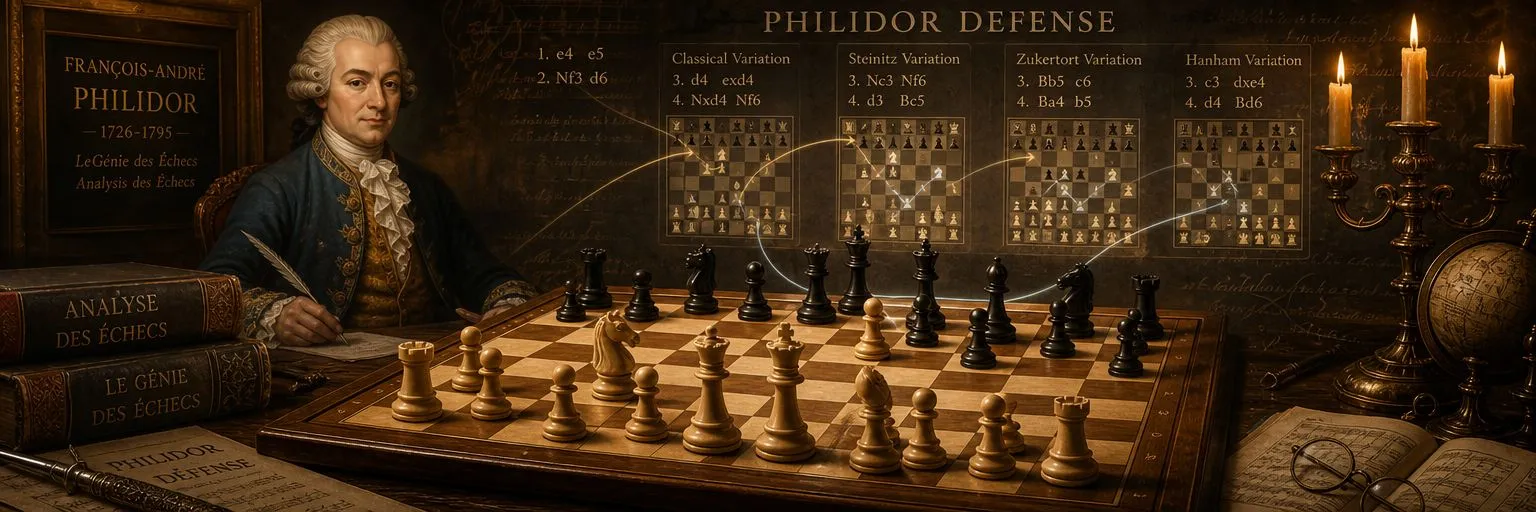
Famous variations of the Philidor Defence
Behind its apparent sobriety, the Philidor Defence has given rise to several clearly distinct theoretical branches. Some aim for a compact and reliable structure, while others embrace sharper positions. This richness explains why this chess opening continues to appeal both to lovers of classical plans and to players looking for effective surprise weapons with Black.
The Hanham Variation, the one most faithful to the spirit of Philidor
The Hanham Variation is often regarded as the most positional form of the Philidor. Black develops the pieces cautiously, aiming for a solid structure built around ...Nd7, ...Ngf6, ...Be7, and ...0-0. The central idea is to avoid premature weaknesses while preparing a counterattack in the centre or on the kingside. For many players, it is the version that best represents the chess strategy associated with Philidor : patience, coordination, and a sense of timing.
The Philidor Gambit and more aggressive lines
In contrast to the calmest setups, some Philidor lines lead to more open confrontations. The Philidor Gambit, in its historical sense, illustrates this desire to sharpen the game quickly. Even if these variations are not always the most played at the highest level, they have real practical value in rapid games or against an ill-prepared opponent. They remind us that a defence known for its solidity can also conceal tactical resources and very direct attacking ideas.
The Antoshin Variation, between simplification and activity
The Antoshin Variation is characterised by Black’s rapid development and the search for active play, often after ...exd4 followed by ...Be7. Black sometimes accepts a slightly cramped position, but gains strategic clarity and ease of development. This line appeals to players who want an openingstructured without getting into endless theoretical complications. It also offers interesting transitions into endgames where the solidity of Black’s structure can make all the difference.
The modern variation with ...f5
Among the most ambitious options is the rapid setup of ...f5, often associated with the so-called modern approach to the Philidor. Here, Black does not merely contain White: they actively challenge space and seek immediate imbalances. This choice does, however, require a good knowledge of tactical motifs, as the exposure of Black’s king and the central tensions can become delicate. Well handled, this version of the Philidor Defense allows for combative and original positions.
Which variation should you choose based on your playing style?
The choice of a line largely depends on the player’s profile. Those who favor maneuvering and solidity will naturally gravitate toward Hanham. Fans of dynamic play can explore Antoshin or the modern systems with ...f5. In all cases, the famous Philidor variations show that this is not a rigid system, but a genuine strategic universe. That is also what gives this chess defense its longevity: it offers several paths while remaining faithful to the same logic of cohesion and resilience.
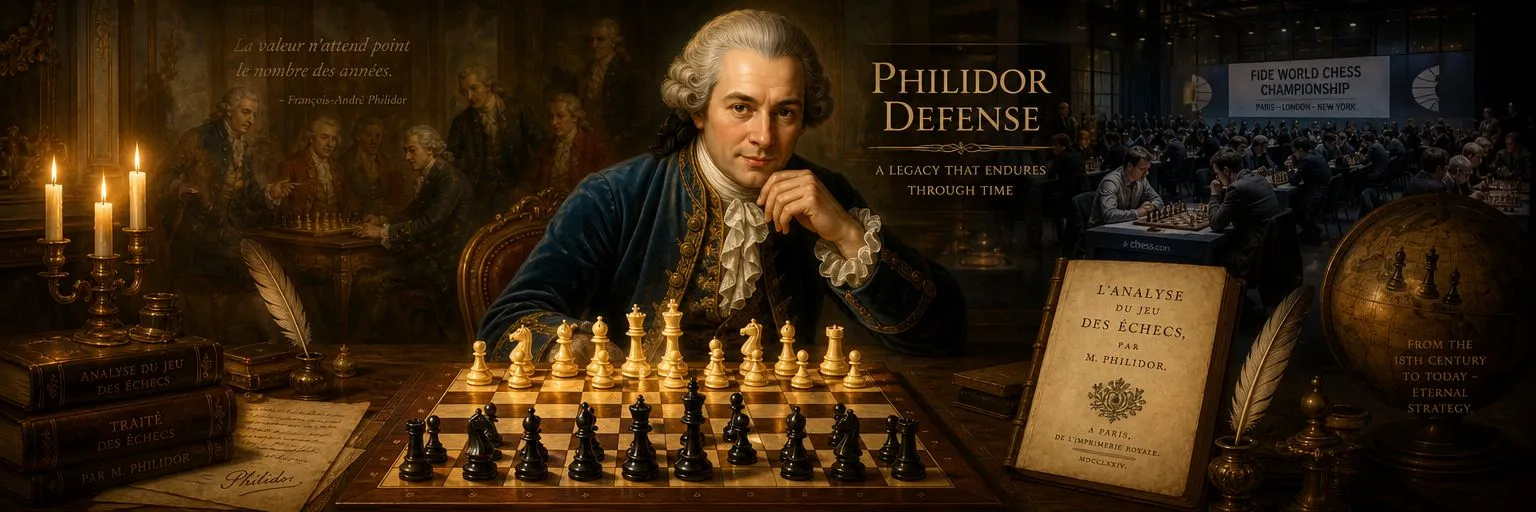
Why this defense remains legendary today
Few openings are capable of crossing the centuries without losing their identity. The Philidor Defense is one of those that continues to spark interest, not because it is the most spectacular, but because it embodies an enduring way of understanding chess: solidity, coordination, and strategic patience.
A playing philosophy that is still relevant today
What makes this defense so remarkable is that it is based on timeless principles. By sometimes delaying direct confrontation in favor of a sound structure, it reminds us that control of the squares, management of the center, and pawn organization remain essential at every level. This logic directly echoes the legacy of François-André Philidor, whose ideas go far beyond the scope of a simple opening.
A practical weapon for modern players
In the contemporary game, the Philidor Defense retains real practical value. It allows Black to obtain compact positions, often less theoretical than other open defenses, while still offering counterplay possibilities. For many club players, it represents a reliable choice against 1.e4 : a clear structure, understandable plans, and room for creativity once development is complete.
Between historical reputation and strategic richness
If this defense remains legendary, it is also because it connects chess history to current practice. Playing the Philidor Defense means adopting an opening associated with one of the greatest thinkers of the game, but it also means entering positions where understanding often matters just as much as memorization. This combination of historical prestige and strategic depth explains why it continues to be studied, played, and respected today.
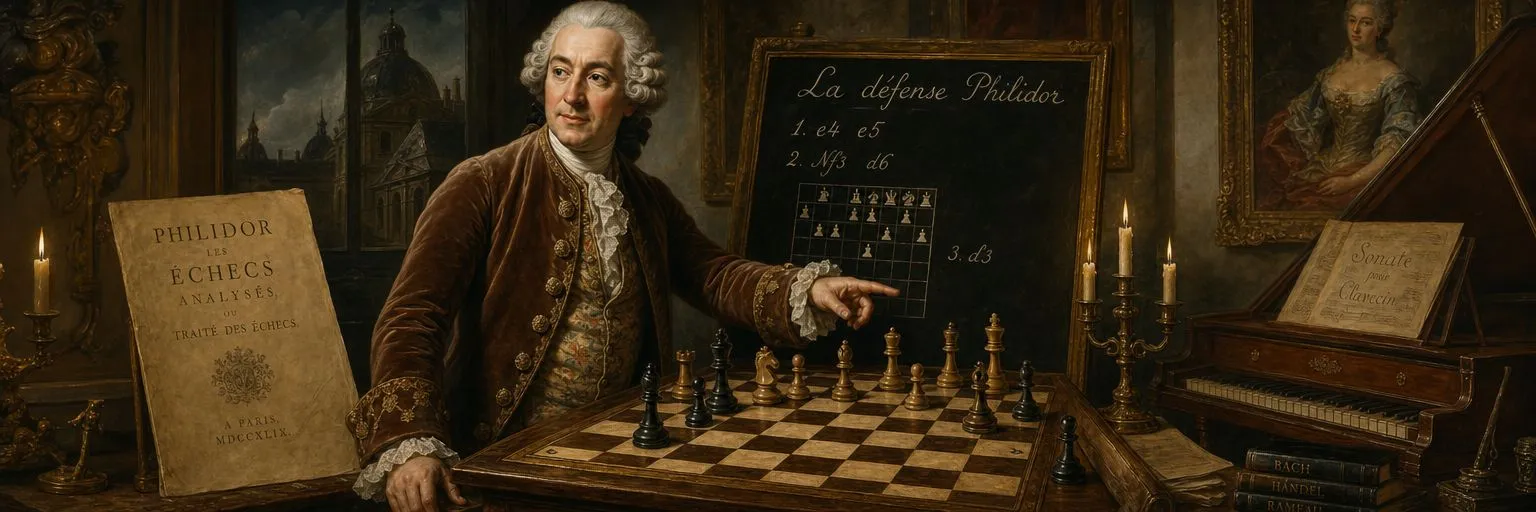
Philidor’s legacy in chess history
Across generations, Philidor’s name has gone beyond that of a simply famous player to become a lasting reference point in chess thought. His influence can be measured as much in opening theory as in the understanding of pawn structures, positional play, and the strategic logic that governs a well-conducted game.
A vision that changed the culture of the game
Before him, many masters mainly favored tactical brilliance and direct attacks. Philidor, by contrast, imposed a more methodical approach, in which every piece and every pawn contributes to an overall balance. This way of understanding chess paved the way for a modern reflection on coordination, space, and positional solidity.
His famous principle on the central role of pawns left a profound mark on the history of strategy. By giving decisive importance to structure rather than spectacle alone, he laid the groundwork for schools of thought that would come to dominate modern theory much later.
A name attached to a defense that became a classic
The Philidor Defense is the most visible legacy of this posterity. Even if it is not always the most ambitious opening at the highest level, it remains a strong symbol of disciplined, coherent play grounded in principles. In this respect, it reminds us that the pursuit of safety and organization can be just as rich as the search for immediate attacks.
The fact that an opening still bears his name several centuries later shows just how deeply François-André Philidor left a rare mark. Few historical figures can claim such a lasting presence in the daily practice of players, from amateurs to seasoned competitors.
A lasting influence on masters and teachers
Philidor’s ideas continued to shape the work of theorists, teachers, and grandmasters long after his time. His legacy can be seen in the way pawn majorities, chains, static weaknesses, and the importance of long-term planning are explained. In this sense, he was not only a champion, but also a true intellectual forerunner.
In modern learning, his name often comes up when it comes to teaching strategic fundamentals. This enduring relevance confirms that Philidor belongs to the very select group of thinkers who shaped the very way the game is understood.
A memory still alive in chess history
If his work continues to be cited, studied, and discussed, it is because it connects the classical origins of chess to the concepts that still structure modern play. His legacy is therefore not merely historical : it remains alive on the chessboard, in books, in theory, and in the culture of players around the world.
Thus, François-André Philidor’s place in chess history rests not only on a famous defense, but on a lasting revolution in strategic thought. It is this ability to endure through the centuries that makes him one of the most important names in the heritage of chess.
Philidor, an essential author and theorist
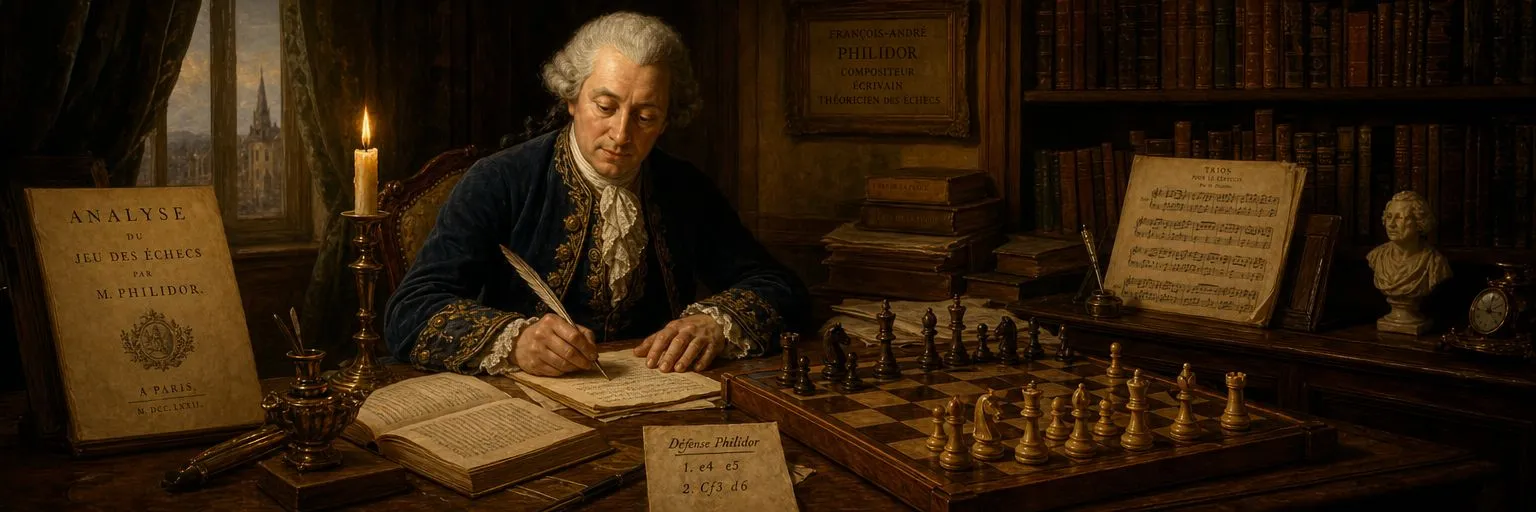
More than an exceptional practitioner, Philidor left a lasting mark through his writings, which profoundly shaped modern chess thinking. At a time when the transmission of knowledge remained fragmented, he formalized principles, organized ideas, and proposed a reading of the game based on positional logic rather than mere tactical brilliance.
A treatise that marked a turning point
His most famous work, Analysis of the Game of Chess, first published in 1749, quickly established itself as a reference. This book does not merely list moves : it presents a genuine method. In it, Philidor develops a coherent view of piece coordination, pawn structure, and the importance of strategic patience, making him a pioneer of chess theory.
A way of thinking ahead of its time
Philidor’s originality lies in his ability to see each position as an organic whole. Where many of his contemporaries favored immediate attack, he insisted on lasting imbalances, long-term weaknesses, and the essential role of pawns. This approach foreshadows many ideas of modern strategy and explains why François-André Philidor is still often cited as one of the game’s first great thinkers.
A theoretical legacy that remains alive
Although his name remains associated with a specific opening, his influence extends far beyond the Philidor Defence alone. His analyses helped legitimize the serious study of positions and establish chess as a fully fledged intellectual field. Even today, his work is revisited not only for its historical value, but also for what it reveals about the birth of a rational and structured vision of the game, at the heart of Philidor’s legacy.
Philidor facing the greatest players of his time
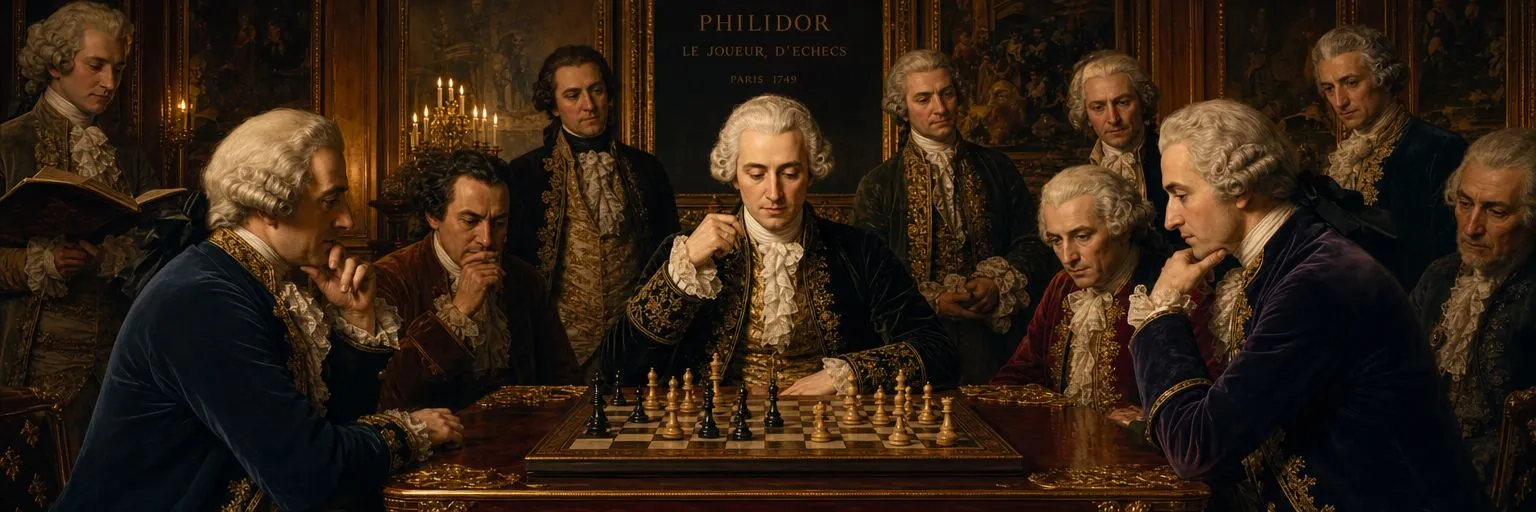
In the cafés, salons, and intellectual circles of Europe, François-André Philidor built a reputation that went far beyond that of a merely talented player. Considered by many to be the best master of the 18th century, he faced formidable opponents and asserted such superiority that his name quickly became synonymous with excellence in the history of chess.
Recognized dominance throughout Europe
At a time when official competitions did not yet exist in their modern form, a player’s worth was measured by the quality of his opposition, the testimonies of his contemporaries, and his ability to regularly defeat the best. Philidor stood out precisely on all three counts. In France as in England, he faced the most prominent players and prevailed with remarkable consistency, to the point that he was often presented as the unofficial champion of his time.
His encounters at the famous Café de la Régence, a leading venue of Parisian chess, contributed greatly to this aura. This setting brought together aristocrats, enlightened amateurs, and strong practitioners, offering Philidor an ideal stage on which to demonstrate the depth of his vision of the game. Where many still relied on immediate attack, he let structure, coordination, and patience speak for themselves.
Prestigious opponents, but a clear edge
Among the figures he encountered was notably Legall de Kermeur, one of the most renowned French masters of the first half of the century. Philidor learned in contact with that generation, then clearly surpassed it. His rise illustrates a turning point : he did not merely reproduce the strategic habits of his predecessors, he transformed them.
Against the best players of his era, he impressed as much with his composure as with his positional understanding. This superiority was not based solely on tactical calculation, but on a broader reading of the chessboard. It is in this gap in understanding that Philidor’s genius emerges, capable of making his games both methodical and innovative.
Blindfold exhibitions, proof of extraordinary mastery
Another aspect strengthens his legend : his famous blindfold games. Playing without seeing the chessboard was then considered an almost unimaginable feat, especially against several opponents simultaneously. Yet Philidor managed it with a mastery that astonished his contemporaries and fueled his international renown.
These demonstrations are not mere curiosities. They reveal an exceptional memory, but also a rare ability to visualize positions and anticipate plans. By taking on several strong players in this way without any visual aid, he confirmed that he did not dominate solely through experience, but through an inner understanding of the game that few rivals could match.
An authority that shaped his legacy
If Philidor left such a mark on his century, it is also because his victories over the best gave concrete weight to his ideas. When a master as respected as he was asserted that pawns structure the game and that strategy often takes precedence over immediate brilliance, his contemporaries listened. His practical authority thus reinforced his theoretical influence.
This dominant position against the great figures of his time explains why his name remains inseparable from a mythical defense and a foundational way of thinking. Philidor did not merely defeat his opponents : he imposed a new way of understanding chess, leaving a lasting mark on everything that followed.
What modern players can learn from Philidor
In the age of analysis engines, databases, and ultra-precise theoretical preparation, Philidor’s thinking remains surprisingly relevant. His contribution is not limited to a famous opening : it reminds contemporary players that a deep understanding of a position is often worth more than a sequence of moves memorized without logic.
Understand before reciting
One of Philidor’s most useful lessons is the primacy of ideas over automatism. A modern player may know dozens of variations, but if they do not understand the role of the pawns, the coordination of the pieces, and the long-term objectives, they quickly become vulnerable as soon as the opponent departs from theory. This approach encourages working on structure, weak squares, central breaks, and plans rather than relying solely on memory.
Restoring pawns to their true importance
The saying that pawns are the soul of the game remains a strategic compass. Even today, the quality of a pawn structure influences space, open files, king safety, and endgames. Remembering Philidor means learning not to underestimate a simple weakness, an isolated pawn, or a well-supported pawn chain. In an era when brilliant tactics are often admired, this lesson reminds us that many combinations are born first from a positional advantage patiently built up.
Playing with discipline and patience
Philidor also teaches mastery of a game’s psychological tempo. Not every moment calls for an immediate attack. Knowing how to consolidate, improve a poorly placed piece, wait for the right break, or refuse an unnecessary complication is part of what distinguishes solid players. This form of strategic patience is particularly valuable in classical time controls, but it remains just as rewarding in rapid and blitz, where sound positions often lead to fewer mistakes.
Building a complete style
Another essential part of Philidor’s legacy lies in the balance between defense and initiative. Modern players can take away that a good style does not consist only of attacking strongly, but of knowing how to shift from one mode to another : defending without passivity, simplifying at the right moment, then seizing the initiative again when the position allows it. This versatility has become indispensable in contemporary chess, where every lapse in judgment can be exploited with precision.
A lesson that still holds true for improvement
Studying Philidor is not about returning to the past out of nostalgia, but about rediscovering enduring principles : coherence, structure, foresight, and a sense of planning. For any player wishing to improve, his legacy reminds us of a simple truth : strategic foundations remain essential, even in the most dynamic modern chess.
François-André Philidor’s place in chess culture
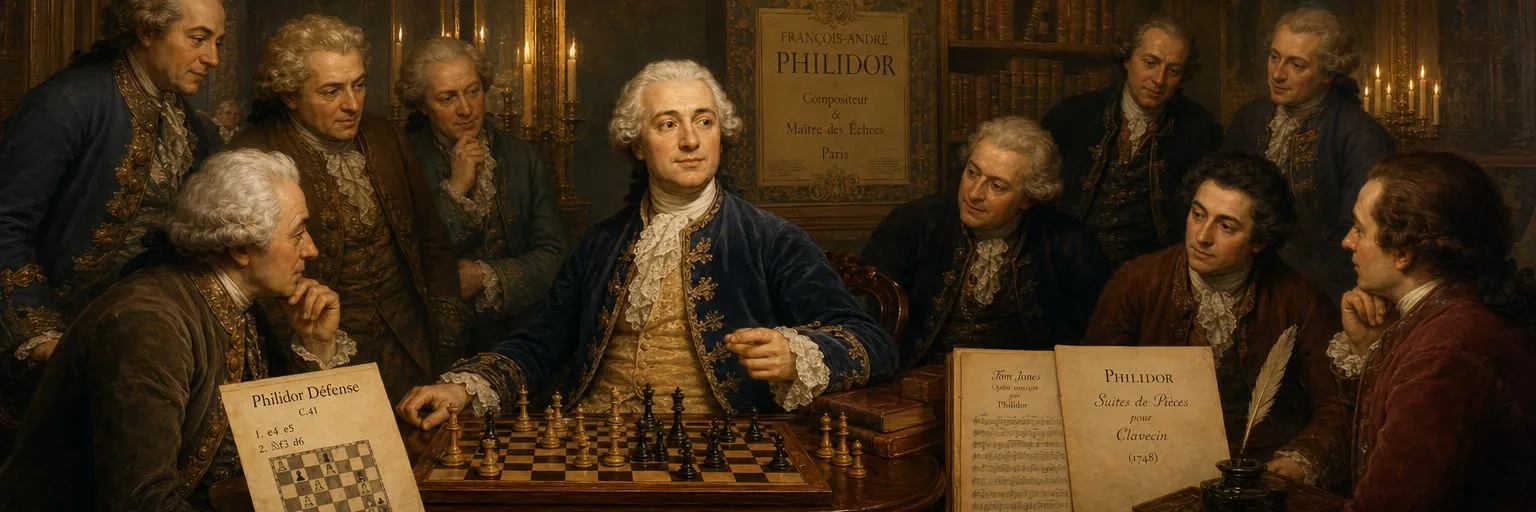
Far more than an 18th-century champion, François-André Philidor holds a unique place in the imagination of players. His name does not refer only to an era or an opening : it evokes a way of thinking about the game, a historical authority, and an enduring presence in the collective memory of chess enthusiasts.
A figure that became a symbol
Over time, François-André Philidor established himself as one of the rare early masters still instantly recognizable today. This recognition stems from his results, his analyses, and the power of his formulations, the most famous of which continues to be quoted in clubs, specialist works, and educational content devoted to chess culture.
In the history of the game, few names have endured through the centuries with such continuity. Philidor belongs to that category of pioneers whose influence goes beyond mere sporting achievement : he is one of the intellectual landmarks on which the chess tradition was built.
A legacy passed down through books, clubs, and theory
Philidor’s presence in chess memory is also explained by transmission. His ideas circulated through treatises, game annotations, and later through the teaching provided in academies and gaming circles. As theory developed, his name remained associated with foundational principles, as well as with the famous Philidor Defence, which helped anchor his legacy in the concrete practice of players.
Thus, Philidor’s place in the history of chess is not simply the result of retrospective tribute. It is still evident in everyday vocabulary, in educational references, and in the way the evolution of strategy is told. He remains an essential link between the beginnings of modern theory and a more refined understanding of positional play.
A cultural reference beyond the chessboard
Philidor’s importance also lies in his cultural dimension. A renowned composer as much as a genius player, he embodies an era in which art, reflection, and play could closely interact. This dual identity still fuels his legend today and reinforces his status in Europe’s intellectual heritage.
For many enthusiasts, Philidor therefore represents more than a famous name : he symbolizes the entry of chess into a form of theoretical modernity, but also into a learned culture shaped by transmission, study, and lasting admiration.
Considered one of the first great chess theorists, François-André Philidor profoundly influenced modern strategy thanks to his famous maxim on the importance of pawns. Several decades later, another prodigy would leave his mark on the history of the game with his exceptional talent and spectacular attacking style: Paul Morphy: the American chess genius of the 19th century, often regarded as the greatest player of his era.
To discover other key figures who have shaped the history of chess over the centuries, also explore our complete feature: Famous chess players: legends, champions, and modern stars.