 France
 English
 Deutsch
 Español
 Italiano
 Nederlands
 Polski
 Português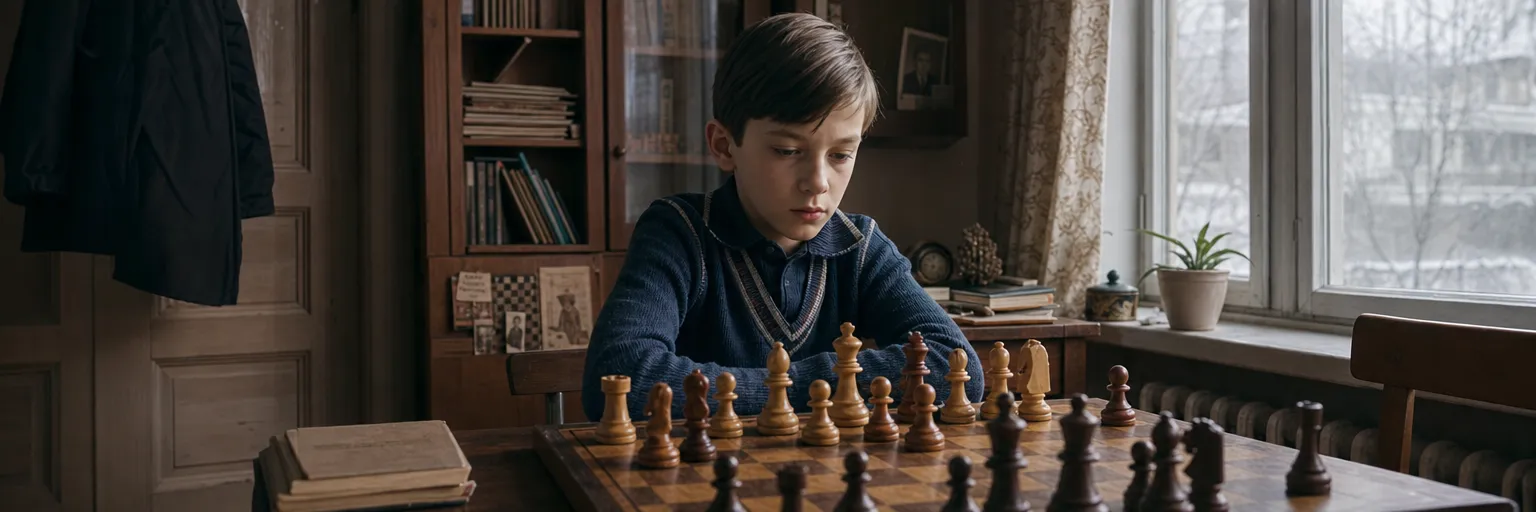
The youth of Anatoly Karpov and his beginnings in chess
Born on May 23, 1951, in Zlatoust, in the Soviet Urals, Anatoly Karpov grew up in an environment where discipline, study, and patience held a central place. From an early age, he displayed an uncommon analytical ability, a trait that would define his entire career and make him one of the greatest names in chess history. His childhood unfolded in a Soviet Union where chess was regarded as a true instrument of intellectual prestige, encouraging the emergence of young talents like him.
A talent revealed in childhood
According to many sources, Karpov learned the rules of the game around the age of 4. He quickly stood out for his calm, concentration, and remarkable sense of anticipation. Where other young players sought spectacular attacks, he was already showing a preference for positional precision and the gradual control of the board. This methodical approach would later become the trademark of the master of chess strategy.
His potential was quickly noticed in local, then regional, circles. By playing more and more games and youth tournaments, Anatoly Karpov refined a style based on logic, consistency, and a deep understanding of positions. These early years are essential to understanding how the future champion built his reputation: not on flashy effects, but on an exceptionally refined reading of the game.
Soviet training and the school of champions
Like many prodigies of his time, Karpov benefited from the Soviet training system, renowned for its high standards and rigor. His admission into top-level training structures allowed him, from a very young age, to face experienced players and intensive working methods. He then developed a more mature vision of the game, shaped by theoretical study, endgame analysis, and an understanding of the great strategic principles.
A key moment in his development came when he joined the school associated with Mikhail Botvinnik, a major figure in Soviet chess. Even though opinions on his potential differed at first, Karpov persevered and quickly confirmed his qualities. This stage played a major role in shaping Anatoly Karpov into a formidable player, capable of making the difference without any apparent agitation, simply through the accuracy of his decisions.
From early successes to the elite
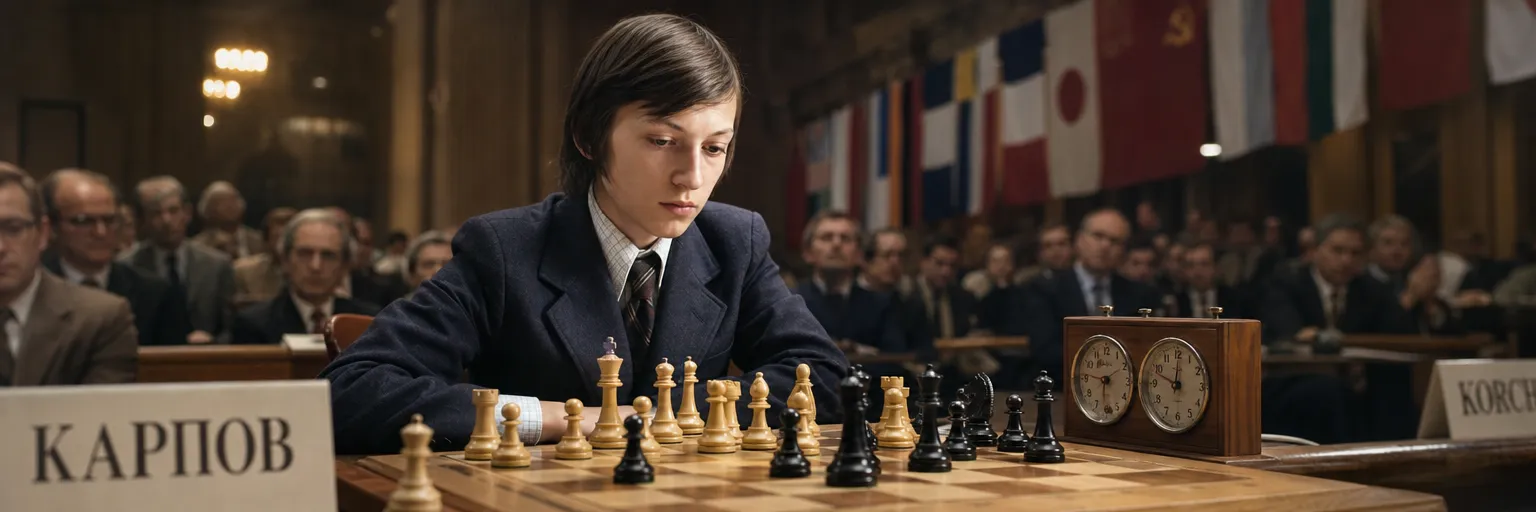
As a teenager, Anatoli Karpov’s results became increasingly impressive. He steadily climbed the ranks of the Soviet circuit, in a particularly competitive environment where every victory carried great value. In 1969, he won the World Junior Championship, a title that confirmed his emergence as one of the most serious prospects of his generation.
This triumph acted as an accelerator. It drew the attention of experts, who saw in him a player capable of establishing himself for the long term at the highest level. His early years in chess, marked by rigor, patience, and remarkable positional intelligence, already foreshadowed the exceptional path he would later follow. Long before becoming a legend, Anatoli Karpov was thus laying, from his youth onward, the foundations of a style that would leave a lasting mark on the history of the game.
The meteoric rise to the top of world chess
At the turn of the 1970s, Anatoli Karpov went from being a great Soviet hope to a credible contender for the world crown. His progress impressed as much for its speed as for its consistency : tournament after tournament, he refined a style based on precision, prophylaxis, and the methodical exploitation of the slightest weakness in his opponents’ play. This rise to prominence was not built on isolated flashes of brilliance, but on a rare ability to turn small advantages into clear victories.
Decisive performances on the international circuit
His results in major competitions quickly confirmed that he belonged among the elite. Karpov piled up successes against top-level opponents, demonstrating exceptional strategic maturity for his age. Where others dazzled through direct attack, he imposed a subtler rhythm, gradually smothering the opponent’s initiative. This consistency in international tournaments helped forge his image as a future champion and firmly established his name among the leading figures of world chess.
Strategic mastery already far beyond the norm
What set Karpov apart during this period was his almost instinctive understanding of positions. He excelled in seemingly quiet structures, where every exchange, every controlled square, and every enduring weakness took on crucial importance. His play perfectly illustrated the idea that in chess, domination can be silent. This approach, based on the accumulation of minimal advantages, quickly became his signature and made him a model for all lovers of positional strategy.
The road to the world title
His rise takes on a historic dimension as he draws closer to the absolute summit. By clearing the most demanding stages of the world championship cycle, Karpov proves that he possesses not only talent, but also the psychological resilience essential to the very greatest. His accession to the title thus marks the emergence of a player capable of embodying a new form of supremacy : less spectacular on the surface, yet formidably effective. With Anatoly Karpov, chess saw the rise of a champion whose strength lay above all in his mastery of time, space, and invisible mistakes.
The positional playing style that forged his legend
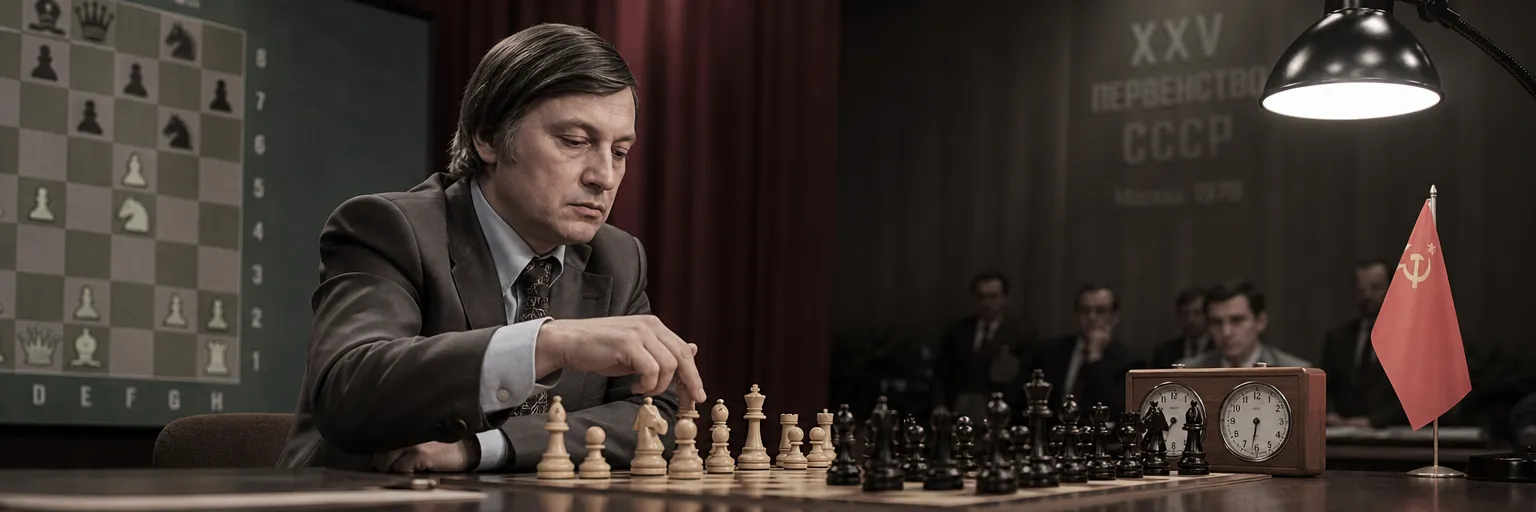
For Anatoly Karpov, dominance was not built on spectacular combinations in every game, but on a superior understanding of imbalances, tempo, and the opponent’s weaknesses. His approach to chess left its mark on history through a form of quiet efficiency, in which every move seemed to tighten an invisible vise until the opposing position became untenable.
Exceptional mastery of small advantages
Karpov’s hallmark lay in his ability to turn a detail into a lasting asset : a weak pawn, a poorly controlled square, a slightly passive piece, or a weakened structure. Where others sought an immediate attack, he preferred to accumulate tiny gains, then convert them with remarkable precision. This sense of positional play made him one of the most feared champions of his era.
His strength also came from his almost intuitive reading of closed or semi-open positions. He knew how to improve the activity of his pieces without creating counterplay, which gave his games an impression of constant control. This ability to exploit nuances permanently linked his name with the most refined chess strategy.
Control of space and key squares
Karpov excelled in the art of depriving his opponent of freedom. By locking down certain files, occupying strong outposts, and limiting the coordination of the enemy pieces, he imposed positions in which the slightest inaccuracy could have lasting consequences. His play did not seek only to improve his own situation : it also aimed to gradually reduce the resources of the opposing camp.
This logic of strategic suffocation explains why so many of his victories seem inevitable in hindsight. Once his positional initiative was established, it became extremely difficult to reverse the momentum. His sense of prophylaxis—that is, anticipating the opponent’s ideas—perfectly illustrates what true mastery of chess represents.
Formidable patience in the endgame
Karpov’s style shone especially brightly in the endgame, an area where his technique often made the difference. Many seemingly equal positions tipped under his methodical pressure. He knew how to activate his king at the right moment, fix weaknesses, improve his pieces, and wait for the exact moment to convert his advantage.
This technical excellence reinforced his reputation as a complete player. His talent was not limited to obtaining good positions in the middlegame : he also knew how to carry them through to victory with impressive restraint. At this level, Anatoly Karpov fully embodies the idea of the world chess champion capable of winning without any apparent brilliance, but with unquestionable authority.
A strategic legacy still admired today
Even today, his games serve as a reference for anyone who wants to understand how to maneuver without rushing, improve a position without unnecessary risk, and exploit almost invisible advantages. His style has influenced generations of players, coaches, and enthusiasts, captivated by this form of understated yet relentless elegance.
If Anatoly Karpov remains a major figure in the history of the game, it is because he proved that at the highest levels, strength is not expressed solely through direct attack, but also through the patient art of restricting, anticipating, and dominating. His name thus remains inseparable from a demanding, profound, and enduring vision of chess.
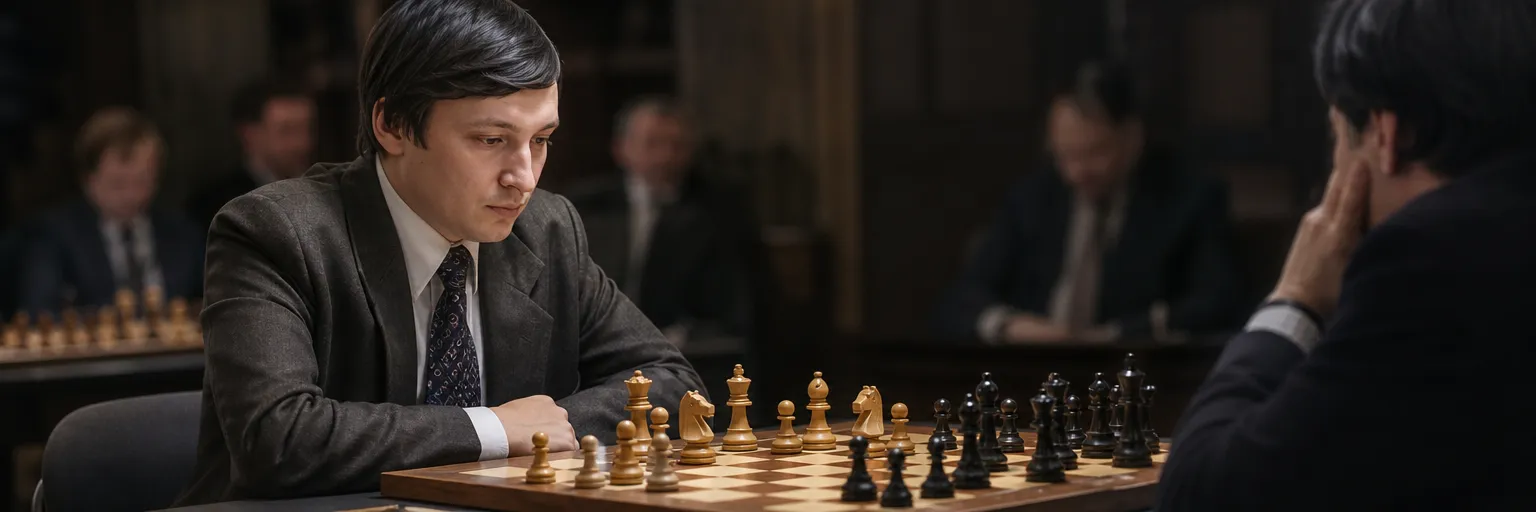
Karpov’s iconic strategic principles
The whole art of Karpov lay in his ability to turn very small advantages into suffocating positions for his opponent. Where others sought immediate attack, he favored the internal logic of the position, the gradual improvement of his pieces, and the methodical reduction of counterplay. This approach made him an absolute benchmark in chess strategy, admired as much for its effectiveness as for its precision.
Restriction before the assault
One of the most striking features of his play was his ability to limit his opponents’ possibilities before even thinking about winning material or launching a direct attack. Karpov excelled in the art of depriving his opponent of active squares, open files, and clear plans. This mastery of positional strategy often created a suffocating impression: the opponent still seemed balanced, but their pieces gradually lost all coordination.
This principle of restriction relied on a very subtle reading of lasting weaknesses, such as a backward pawn, a weak square, or a compromised structure. Karpov did not need to force events; he let the position speak for itself, until the other side was forced into passivity.
The accumulation of small advantages
For him, superiority did not always arise from a brilliant tactical blow. It was often born from a succession of seemingly modest decisions: a better square for a knight, a more active rook, a favorable exchange, a solidly supported pawn. This way of playing perfectly illustrates the idea of small advantages converted into concrete domination.
Karpov understood that, in a high-level game, a slight edge can become decisive if one prevents any liberating simplification. His genius therefore lay in maintaining the pressure without rushing, until the positional advantage turned into material gain or a winning endgame.
The harmonious coordination of the pieces
Another foundation of his style rested on the collective activity of his pieces. With Karpov, no piece seemed to act alone: each supported an overall plan, whether it was controlling a key square, strengthening a flank, or fixing a weakness. This harmony gave his play remarkable fluidity, typical of the great masters of positional mastery.
Rather than seeking spectacular moves, he improved the quality of his pieces one by one. This patience made his positions increasingly solid, while his opponent’s became quietly more fragile. It was precisely in this gradual build-up of pressure that his talent fully revealed its true dimension.
A superior sense of exchanges
Karpov chose his exchanges with exceptional rigor. He did not simplify for the sake of simplifying: he exchanged when a change of pieces favored his structure, his activity, or his endgame prospects. This understanding of transitions from the middlegame to the endgame is one of the major hallmarks of his legacy in chess.
By removing the opponent’s key pieces and keeping his own in the essential areas, he shaped the game to suit his needs. Many of his victories were thus built on subtle yet deeply strategic exchanges that permanently altered the evaluation of the position.
Excellence in technical endgames
If Karpov remains associated with a refined vision of the game, it is also because he knew how to convert slightly favorable positions into winning endgames with almost clinical precision. His approach to endgames was based on patience, king activity, rook coordination, and making the most of fixed weaknesses.
This ability to capitalize on a minimal advantage permanently strengthened his reputation as a master of strategy. Against him, an inferior but still defensible position often became a long exercise in survival, as he excelled at pushing his opponent toward mistakes without ever loosening his grip.
A lasting influence on the understanding of the game
Karpov’s strategic principles continue to inspire players who want to improve their reading of positions and management of tempo. His legacy goes beyond his record of achievements: he showed that a sober, logical, and methodical style of play could be formidably powerful. Through his games, one discovers a profound vision of positional chess, where patience and precision become decisive weapons.
Studying Karpov means understanding that a game can be won long before the final combination, in the silent choices that improve a piece, fix a weakness, or restrict the opponent’s space. It is this science of detail that still makes his style an essential strategic model today.
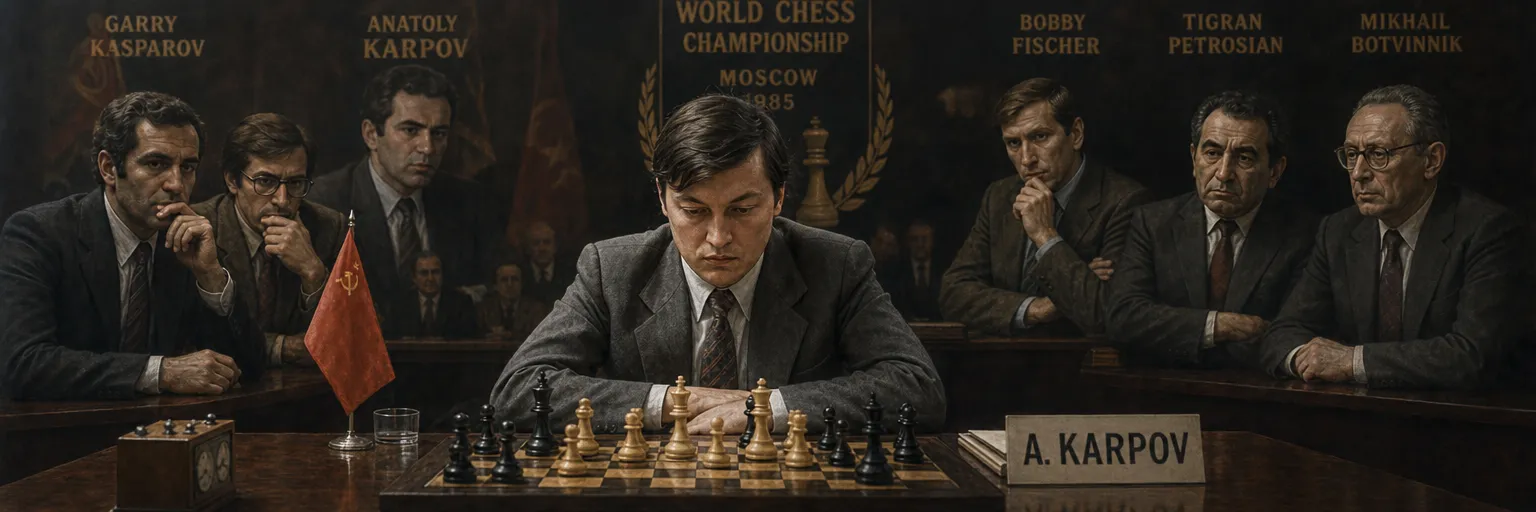
Anatoli Karpov against the greatest champions of his era
Measuring Anatoli Karpov’s greatness requires examining the quality of the opponents he faced at the highest level. In a particularly rich period in chess history, he went up against exceptional players with very different profiles, and it was precisely in these duels that his consistency, preparation, and strategic mastery stood out most clearly.
The missed yet historic meeting with Bobby Fischer
When Karpov became world champion in 1975 following Bobby Fischer’s forfeit, some observers felt that the decisive showdown had never truly taken place. Yet this episode left a lasting mark on his career. Inheriting the crown without playing against the American immediately placed the Soviet under immense pressure: he had to prove on the chessboard that he fully deserved his status. The tournaments and matches that followed quickly showed that Anatoly Karpov was not a champion by default, but rather a great competitor capable of imposing an exceptional level of play on the biggest names of his era.
The monumental duel against Garry Kasparov
No rival left a greater mark on Karpov’s path than Garry Kasparov. Their confrontation went beyond the simple sporting framework: it pitted two visions of the game, two generations, and two temperaments against each other. Karpov embodied control, precision, and gradual attrition; Kasparov, by contrast, symbolized energy, initiative, and dynamic power.
Their first world title match, which began in 1984, remains one of the most famous in chess history. Extremely long, tense, and physically exhausting, it highlighted Karpov’s psychological resilience, as he was able to neutralize the attacks of his young challenger for months. Even though Kasparov eventually prevailed in their later encounters, Karpov remained a formidable opponent and still managed to push his rival into matches of rare intensity. This rivalry largely helped shape the image of the Soviet world champion as a model of discipline and positional depth.
Top-level clashes against Soviet grandmasters
Beyond Kasparov, Karpov constantly had to measure himself against an especially deep Soviet elite. Viktor Korchnoi, for example, was one of his toughest opponents. Their world title matches in 1978 and 1981 remain famous for their extreme tension, both on the sporting and psychological levels. Against Korchnoi, Karpov demonstrated his ability to stay cool in the most emotionally charged contexts, while maintaining a clear and methodical line of play.
His duels against players such as Tigran Petrosian, Lev Polugaevsky, Mikhail Tal, and Vasily Smyslov should also be remembered. Each represented a specific challenge: prophylactic defense, tactical imagination, experience, or endgame mastery. In this ultra-competitive landscape, Karpov stood out for a rare quality: he knew how to adapt his approach without abandoning his positional identity.
Superiority built against contrasting styles
Anatoly Karpov’s strength also lay in his ability to dominate champions with highly varied repertoires. Against tactical players, he reduced their activity until every counterattack was drained away. Against endgame specialists, he displayed impressive technical precision. And against experts in theoretical preparation, he often found deeper plans in the middlegame.
This versatility explains why his record remains one of the most impressive of the 20th century. He did not merely defeat great names: he was able to remain at the top in an era when every tournament brought together several credible contenders for the highest title. By facing the greatest champions of his time, Karpov confirmed that he himself belonged to the very exclusive circle of the game’s absolute legends.
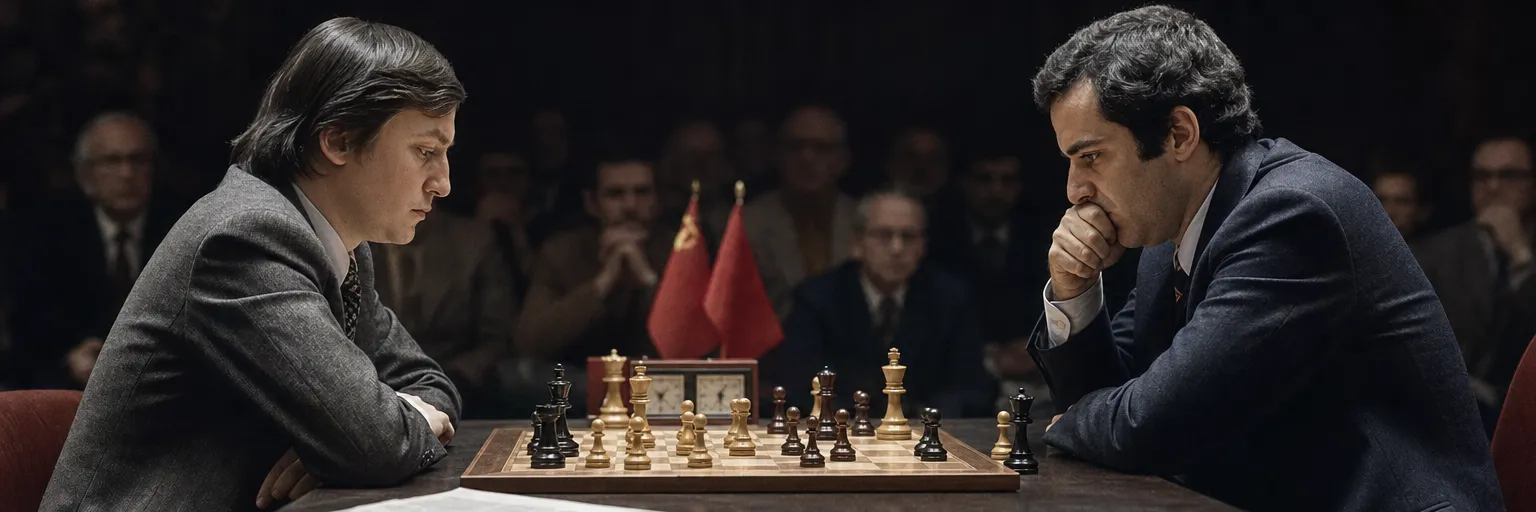
The historic rivalry between Karpov and Garry Kasparov
Few duels in the history of the game have reached the intensity of the one between Anatoly Karpov and Garry Kasparov. Far beyond a simple changing of the guard at the top, their clash embodied a conflict of generations, temperaments, and strategic conceptions. On one side, Karpov represented positional mastery, prophylactic precision, and the art of gradually suffocating the opponent; on the other, Kasparov imposed combative energy, razor-sharp theoretical preparation, and a constant desire to energize the position.
A clash of styles and personalities
This opposition fascinated the entire world because it went beyond pure technique. Karpov advanced with an almost clinical sense of control, seeking invisible weaknesses and favorable endgames. Kasparov, for his part, aimed for the initiative, tactical pressure, and complex imbalances. Each world title match thus became a full-scale demonstration of the great schools of chess, between the accumulation of small advantages and the pursuit of decisive attacks.
The psychological contrast further heightened the drama. Karpov seemed cold, methodical, and difficult to unsettle. Kasparov, by contrast, displayed a volcanic presence, fighting confidence, and marked competitive aggression. This tension fueled a rivalry followed by millions of enthusiasts, making their encounters an essential chapter in the history of the world champion.
The 1984 match, a major turning point in world history
The first great duel for the world crown, in 1984, remains one of the most famous ever contested. The extremely grueling format required winning six games with no strict limit on the number of encounters. Karpov quickly took the lead and for a long time seemed close to retaining his title. Yet as the match dragged on, Kasparov’s resistance grew, while the physical and mental endurance of both players was put under severe strain.
The controversial interruption of the match left a lasting impression. At that point, Karpov was still leading, but the psychological momentum seemed to be shifting. This episode helped forge the legend of their duel, blending sporting excellence, political tension, and debate over the organization of the championship. For many observers, this confrontation redefined the way a chess match at the highest level was perceived.
1985 and Kasparov’s rise
The following year, in the new World Championship, Kasparov succeeded in changing the course of history by defeating Karpov. This victory did not mean the end of his rival’s dominance, but it symbolized a change of era. Karpov remained a player of extraordinary consistency, capable of competing in every phase of the game, while Kasparov established himself as the new dominant figure at the top of the world stage.
This passing of the torch was never complete or simple. Karpov continued to push Kasparov to his limits in several other championship matches, often very close. Their rivalry stood out precisely because of this rare balance: even when Kasparov gained the historical upper hand, Karpov remained strong enough to threaten the hierarchy again and preserve his status as a chess legend.
A rivalry that enriched Karpov’s legacy
Repeatedly facing Kasparov paradoxically strengthened Karpov’s stature. Far from being overshadowed by his successor, he demonstrated exceptional resilience, intact strategic depth, and a remarkable ability to adapt to one of the most formidable opponents of all time. His games against Kasparov are still studied today for their positional richness, defensive precision, and competitive intensity.
Ultimately, this historic rivalry gave an additional dimension to Anatoly Karpov’s legacy. It showed that his genius was not limited to winning the title, but was also expressed in his ability to sustain an elite duel for years against a revolutionary opponent. That is also why Karpov’s name remains inseparable from the greatest chapters in chess history.
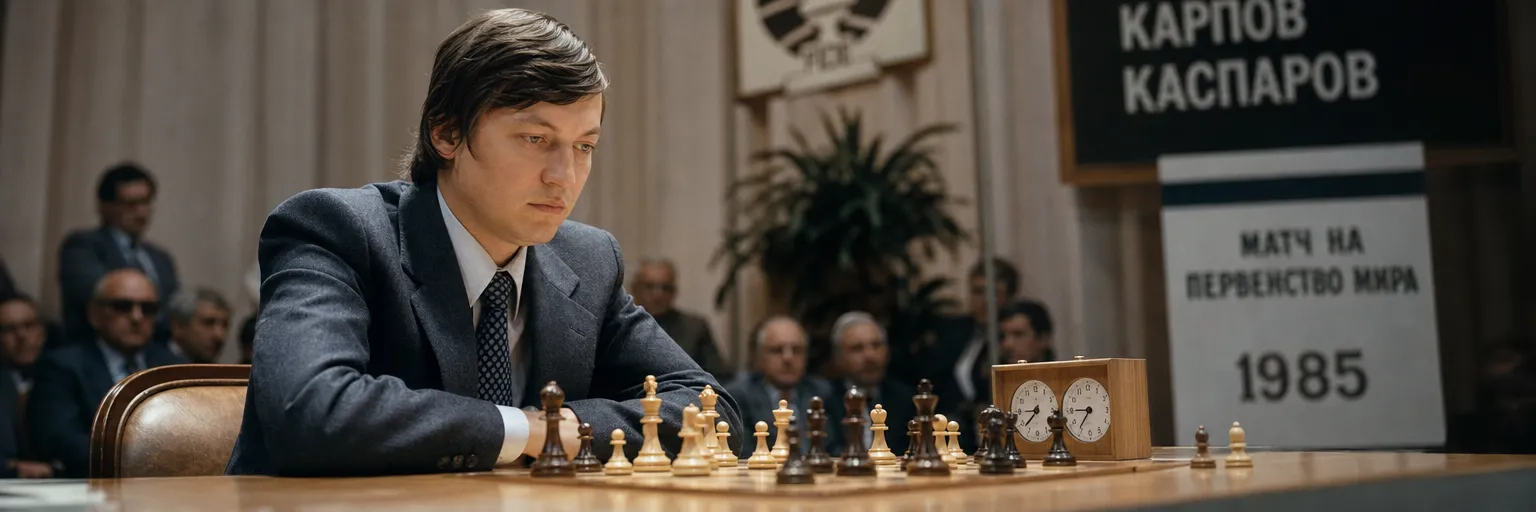
Anatoly Karpov’s most famous games
Some games alone sum up Anatoly Karpov’s genius: constant pressure, seemingly simple choices and, in the end, an opponent’s position slowly drained of all energy. His best games are captivating not only for their result, but for the clarity with which they illustrate his vision of chess, built on control, anticipation and the methodical exploitation of the slightest weakness.
The masterclass against Viktor Korchnoi
Among his most memorable clashes, those played against Viktor Korchnoi hold a central place. In several of these World Championship games, Karpov shows his ability to control tense positions without ever rushing. He imposes positional play of remarkable precision, limiting his opponent’s counterplay before converting the slightest edge. These duels contributed greatly to shaping his image as a cool, rigorous and almost inexhaustible strategic champion.
The strategic lesson against Unzicker
His victory over Wolfgang Unzicker, often cited among the greatest references of his career, is a model of gradual domination. In it, Karpov develops his pieces with exemplary harmony, improves every important square, then tightens the grip until Black’s position becomes untenable. This game is frequently studied to understand how a grandmaster can turn a slight edge into a decisive advantage without resorting to spectacular sacrifices. It perfectly reflects Anatoly Karpov’s style, a master of accumulating small gains.
Masterpieces against Kasparov
Even at the heart of his most famous rivalry, Karpov produced several exceptional games against Garry Kasparov. Some of his victories in their World Championship matches reveal extraordinary strategic depth, particularly in closed structures where patience and a sense of timing become essential. Against an explosive and creative opponent, he manages to impose his rhythm, reduce the enemy’s activity and let his endgame skill speak for itself. These games show just how well the World Chess Champion could adapt his approach without abandoning his identity as a player.
Endgames that became textbook models
Several of Karpov’s famous games have also remained memorable for their endgame phase. Where others were content to maintain the balance, he found subtle plans, activated his king at the right moment and pushed his opponent into mistakes in seemingly equal positions. This exceptional technique has made many chess gamessigned by Karpov into genuine teaching tools. Even today, coaches and enthusiasts analyze them to learn the art of restriction, prophylaxis, and technical conversion.
Why these games remain essential
If these encounters are so often commented on, it is because they reveal a form of domination that is less visible, yet remarkably effective. Karpov did not always seek immediate brilliance; he preferred to impose an irrefutable logic, built on control of key squares, restriction of the opponent’s pieces, and favorable transitions into the endgame. In this respect, his greatest successes remain essential for anyone wishing to understand the strategic dimension of chess at the highest level.
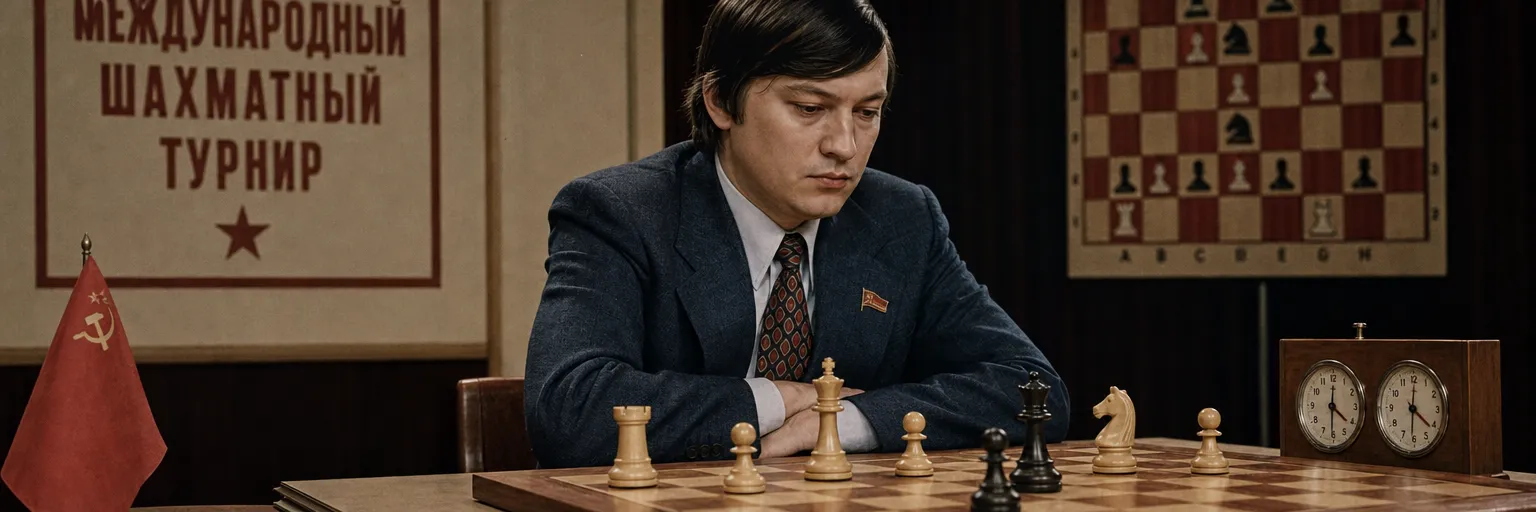
The Soviet champion’s favorite openings and endgames
In Anatoly Karpov’s repertoire, every opening choice seemed to extend the same guiding idea: obtain a sound position rich in nuances, then apply gradual pressure until the opponent cracked. More than a seeker of immediate complications, the Soviet champion favored systems capable of supporting his positional style, his technical precision, and his exceptional sense of coordination.
Openings in the service of control
With the white pieces, Karpov often relied on 1.e4, but without systematically seeking the sharpest variations. He excelled in structures where the initiative arose from better development, a strong square, or a lasting weakness in the opposing camp. Against the Sicilian, the Caro-Kann, or the French Defense, he knew how to steer the game toward setups where strategic understanding mattered as much as theoretical memorization.
With black, his name is often associated with the Caro-Kann Defense and the Nimzo-Indian Defense, two openings perfectly aligned with his vision of chess. The former gave him a solid foundation, few weaknesses, and harmonious play. The latter allowed him to fight immediately for the central squares while creating subtle imbalances. In both cases, Karpov sought less the spectacular effect than the ideal structure for applying lasting pressure.
The Caro-Kann, a weapon of active patience
The Caro-Kann Defense perfectly illustrates Karpov’s philosophy. Often regarded as robust and reliable, it allows natural piece development and limits early risks. Karpov found in it favorable ground for neutralizing the opponent’s initiative before gradually taking control of the key squares.
For him, this opening was never passive. On the contrary, it became an instrument of strategic control: favorable exchanges, a slightly superior endgame, a better-used pawn majority, or a knight planted on a strong square. This attention to detail transformed seemingly equal positions into uncomfortable scenarios for his rivals.
The Nimzo-Indian and the art of subtle imbalances
Against 1.d4, the Nimzo-Indian Defense matched his taste for flexible positions, where tension remains present for a long time. By quickly pinning the knight on c3 and challenging White’s structure, Karpov obtained strategically complex positions without descending into tactical chaos.
This opening allowed him to play on several fronts: weakening the opponent’s doubled pawns, fighting for the bishop pair, controlling the dark or light squares depending on the chosen structure. Here again, his genius lay in his ability to read the true direction of the game before anyone else, then let his chess technique speak with remarkable economy of means.
Model transitions into the endgame
One of Karpov’s great strengths lay in the way he linked the opening, middlegame, and endgame without any break. Many champions excel in one specific phase; he stood out above all in transitions. A small spatial edge, a semi-open file, or a weak pawn was enough to prepare a favorable simplification. This ability explains why his opening choices were so closely tied to his ambitions in chess endgames.
He readily accepted positions where the advantage was not spectacular but lasting. Through highly precise exchanges, he eliminated the opponent’s counterplay and steered the struggle toward endings where his understanding of structures worked wonders. His repertoire was therefore not designed merely to survive the opening, but to build slow, methodical domination.
A virtuoso of technical endgames
If Karpov left such a mark on history, it was also thanks to his extraordinary mastery of chess endgames. Rook endgames, minor-piece endings, or positions with a slight material advantage: he excelled in every domain where precision and patience become decisive. Where others were content with a draw, he kept posing concrete problems, move after move.
His reputation as a master strategist was forged largely in these late phases, where every tempo counts. He knew how to activate his king at exactly the right moment, fix the enemy pawns on the right color, improve a piece without rushing, and convert the slightest advantage with impressive rigor. For him, the endgame was not a mere epilogue: it was often the logical culmination of a plan conceived from the very first moves.
Why this repertoire remains a benchmark
Karpov’s openings and endgames continue to be studied because they show how to build a game on solid, coherent, and deeply strategic foundations. His example proves that it is not necessary to seek maximum complication to dominate at the highest level. By combining safety, an understanding of structures, and a sharp sense of converting advantages, Anatoly Karpov left a lasting model for all lovers of positional play.
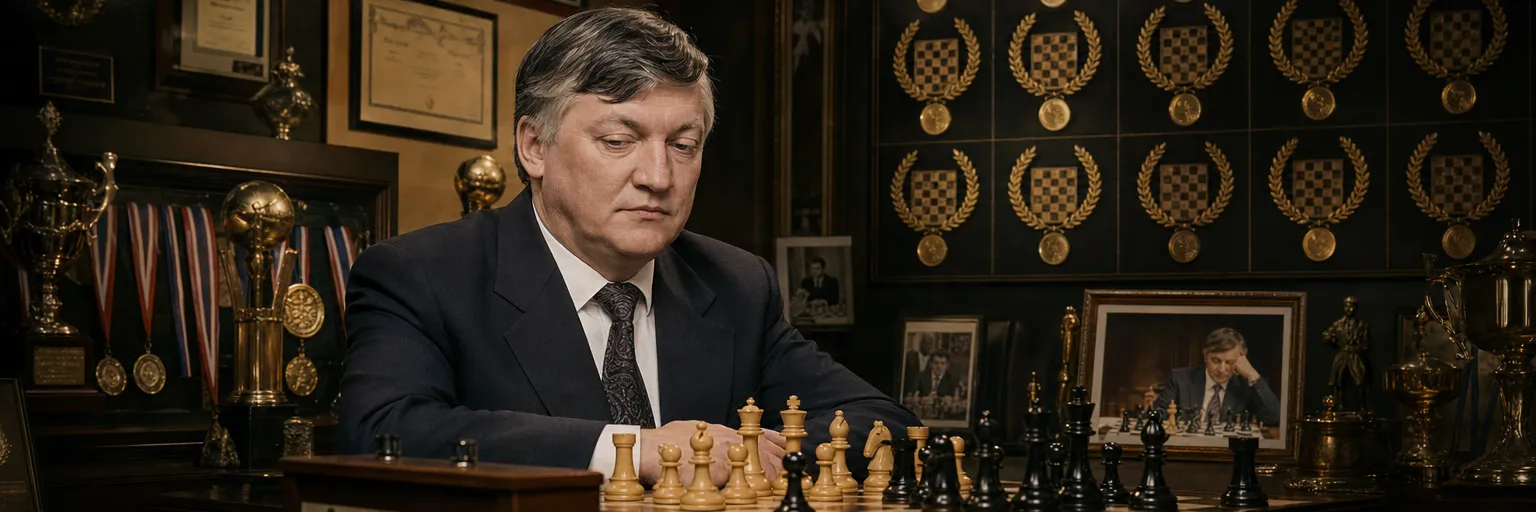
The titles, records, and distinctions of his career
Anatoly Karpov’s achievements rank among the most impressive in chess history. Far beyond his image as a methodical champion, he amassed over several decades world crowns, victories in the biggest tournaments, and statistical performances that confirm his place at the top of the game. His career illustrates a rare form of continuity at the highest level, with a consistency that few players have managed to match.
A world champion firmly established at the top for the long term
Karpov became world champion in 1975 and then retained the crown until 1985, a longevity that left a deep mark on the modern era of chess. During this period, he established himself as an absolute benchmark of the world chess champion, defending his standing with exceptional mastery of strategy, timing, and technique. Even after losing the title to Garry Kasparov, he remained a major figure in the world elite and later reclaimed a world title in the context of the split within the international federation.
A string of successes in major tournaments
Karpov’s strength cannot be measured only by his world title matches. He won a remarkable number of international tournaments, often ahead of the best players of his generation. This accumulation of first-place finishes in top-level competitions helped build his reputation as a chess legend. His sense of positional control, his ability to limit risks, and his effectiveness against opponents with very different styles enabled him to establish lasting dominance on the circuit.
Records that highlight his exceptional consistency
Throughout his career, Anatoly Karpov produced top-level performances with remarkable consistency. He remained for a long time among the very top players in the world Elo rankings, confirming his status as a Soviet grandmasteressential. His number of victories in elite tournaments, his repeated presence in world championship cycles, and his longevity at the top all stand as major statistical milestones in the history of the game. In his case, a record is not merely a number: it reflects a methodical dominance, built on precision and patience.
Honors, recognition, and legacy
Beyond the trophies, Karpov received numerous sporting and institutional distinctions, first in the Soviet Union and then on the international stage. This recognition goes beyond results alone, as it also acknowledges the influence of a player who became a model of rigor for several generations. His name remains associated with a demanding vision of top-level chess, in which deep positional understanding prevails over spectacular effect. In this respect, his awards and tributes naturally extend the impact of a career that shaped part of the global history of the sixty-four squares.
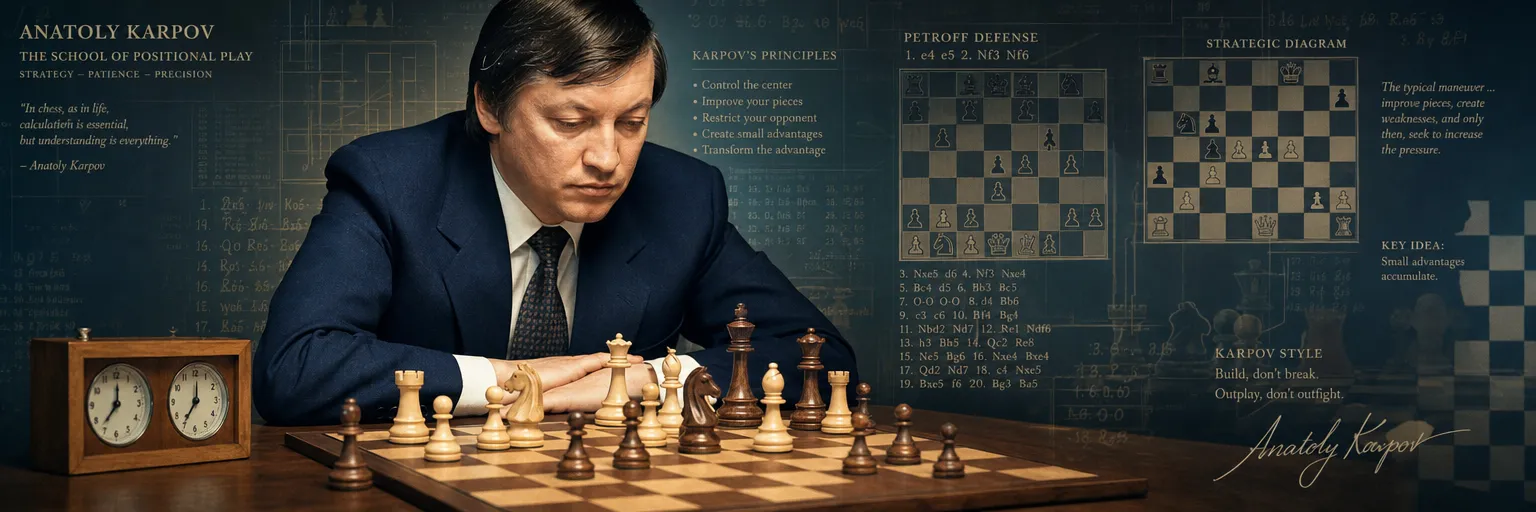
Anatoly Karpov’s influence on chess theory
Beyond his titles and legendary matches, Anatoly Karpov left a profound mark on the way the game is understood. His theoretical legacy is not limited to a few opening variations: it touches the very logic of chess strategy, the evaluation of quiet positions, and the art of converting the slightest advantage into an almost inevitable victory.
A new benchmark for positional play
Karpov helped modernize the vision of positional play by showing that lasting domination could arise from almost invisible details: a weak square, a backward pawn, poor piece coordination, or a lack of space. Where others sought a direct attack, he demonstrated that a precise, patient, and coherent plan was often enough to neutralize any opposing initiative. This approach enriched chess theory by giving even greater value to static factors and prophylaxis.
Karpov’s contribution to openings
In the field of opening theory, Anatoly Karpov did not merely repeat established patterns: he refined systems reputed to be solid in order to reveal their full practical potential. With White as with Black, he favored structures that allowed him to retain maximum flexibility, gradually improve his pieces, and steer the game toward positions he understood better than his rivals. His work on lines in the Caro-Kann, the Nimzo-Indian Defense, and certain Spanish variations influenced generations of professional players.
Prophylaxis as a major theoretical tool
One of the most striking contributions of the Soviet world chess champion lies in his mastery of prophylaxis. Karpov excelled in the art of anticipating his opponent’s intentions before they even became dangerous. This ability gave new theoretical weight to active waiting moves, gradual restrictions, and limiting plans. Thanks to him, many coaches and analysts placed greater emphasis on the following question: not only “what is the best move for me?”, but also “what plan should be prevented on the other side?”
A lasting influence on the study of endgames
Endgames also hold a central place in Karpov’s legacy. His sense of technical precision, his exemplary coordination of the king and his pieces, as well as his understanding of structural imbalances, enriched thinking on rook, bishop, and minor-piece endgames. Many of his games are still used as teaching models to illustrate the transition between the middlegame and the endgame, an essential area of chess theory. For Karpov, the endgame was not simply a final phase: it represented the logical culmination of pressure built up since the opening.
A model studied by several generations
The influence of Anatoly Karpov can also be measured by the place his games occupy in manuals, training courses, and modern databases. Many grandmasters have studied his method to better understand the conversion of small advantages, the superiority of a strong square over a temporary initiative, and the power of a plan without weaknesses. In this sense, Karpov left a profound mark on the history of chess: he proved that rigorous strategic thinking could turn sobriety into an absolute weapon and permanently advance the understanding of the game at the highest level.
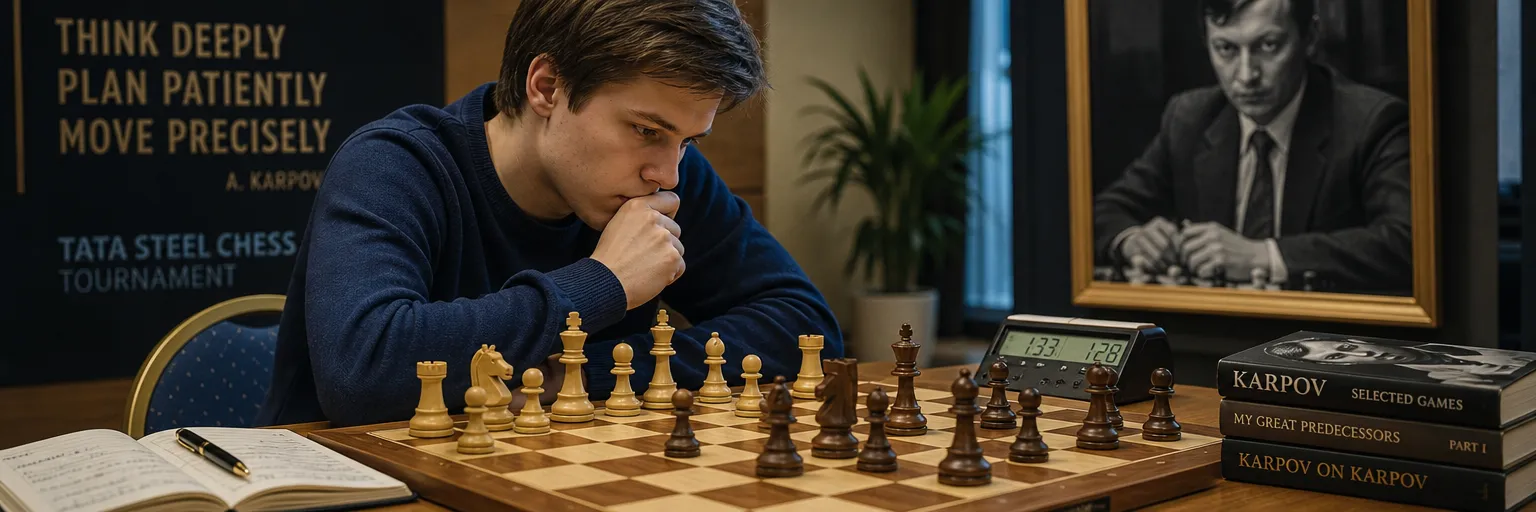
What amateur players can learn from Karpov
Observing Anatoly Karpov’s games is an excellent way to improve without getting lost in unnecessary complexity. His play shows that it is not essential to look for a brilliant move at all costs in order to win: it is often enough to improve your pieces, limit the opponent’s counterplay, and be consistent. For amateur players, this approach is especially valuable, as it reminds us that victory often comes from better strategy, good patience, and a clear reading of the position.
Play simply, but with a clear plan
One of Karpov’s great lessons is to prioritize useful moves over spectacular ideas. Many amateur players lose their way by trying to attack too early, whereas Karpov first built a harmonious position. Developing your pieces, securing your king, controlling the right squares, and identifying your opponent’s weaknesses form the foundation of solid play. This discipline improves positional understanding and helps avoid mistakes caused by haste.
Turning small advantages into lasting pressure
Karpov excelled at exploiting details that others considered insignificant: a weak pawn, a semi-open file, a poorly placed piece, or a lack of space. Amateur players can learn that even a slight advantage has value if it is maintained methodically. Instead of forcing a dubious combination, it is often more effective to accumulate improvements, restrict the opponent’s options, and gradually strengthen your position. It is a true school of positional play and strategic mastery.
Learning to defend before attacking
With Karpov, the attack almost never arose from reckless impulse. It appeared when the position naturally allowed it. For an amateur player, this idea is essential: before launching your pieces toward the opposing king, you must make sure your own weaknesses are under control. Precise defense, good rook placement, and proper piece coordination often make it possible to neutralize the enemy initiative. Only then does the right moment to act become more favorable.
Making the endgame a field for improvement
Another major lesson lies in his handling of endgames. Karpov showed that an endgame is not a secondary phase, but a logical extension of everything that has been built beforehand. Amateur players therefore have every reason to work on basic endgames, king activity, pawn majorities, and active rooks. By better understanding this phase, they will develop a more complete view of chess and win more balanced games.
Developing psychological patience
Karpov’s style also teaches a decisive mental quality: knowing how to wait for the right moment. Many amateurs play too quickly in quiet positions, as if they absolutely had to create a tactical event. Yet real strength sometimes lies in slowly improving your structure, posing precise problems, and letting the opponent weaken themselves. This form of composure strengthens discipline, decision-making quality, and consistency on the chessboard.
Studying Karpov to improve more effectively day by day
To benefit from his legacy, it is not necessary to analyze only its most complex parts. Amateur players can select a few famous examples, identify the overall plan, then note how each move serves a simple idea. This study method makes it easier to understand the logic of the Soviet world champion and to apply his principles in one’s own games. In this sense, Karpov remains an ideal model for all those who want to improve through rigor, a sense of positioning, and a deep understanding of the position.
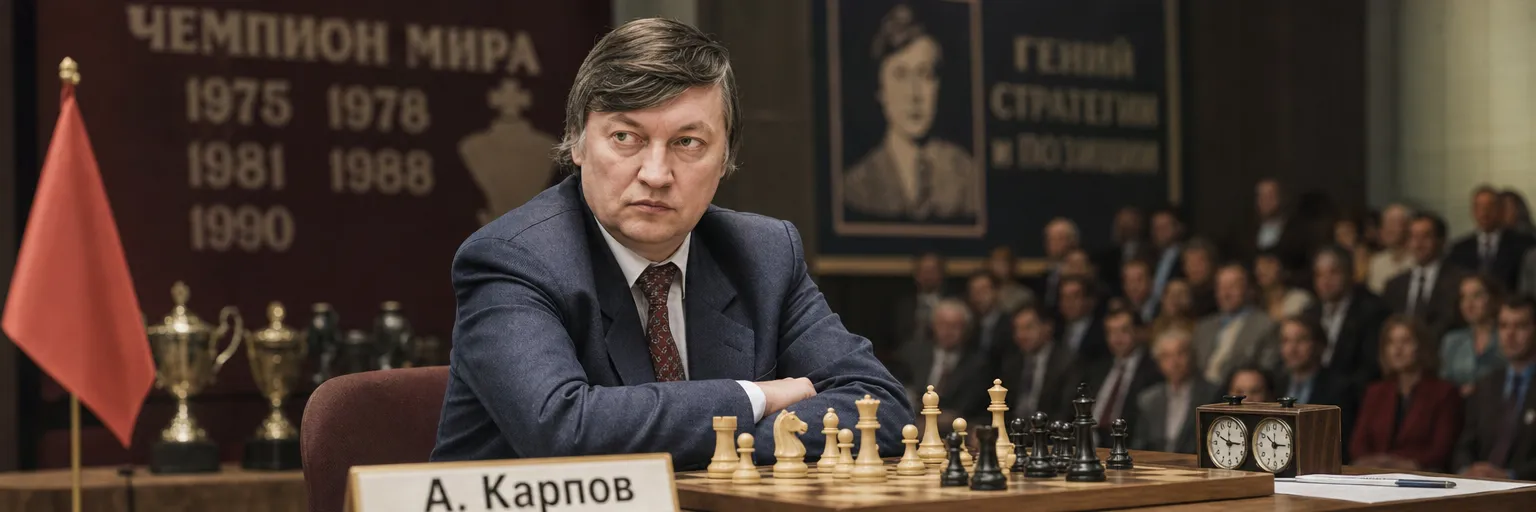
Anatoly Karpov’s lasting imprint on the world of chess
Few champions have a legacy that goes so far beyond raw results. Anatoly Karpov left his mark on several generations through a vision of the game based on control, precision, and economy of means. His name remains associated with a form of quiet excellence, where every move seems to reinforce an overall logic. This identity made Anatoly Karpov far more than a former world champion: a lasting reference in the world of chess.
A strategic model still studied today
Karpov’s legacy is first measured by the influence of his positional approach. His games are still analyzed in clubs, schools, and specialized books because they show how to exploit the slightest weakness, gradually improve one’s pieces, and neutralize any counterplay. This way of conducting the game profoundly enriched the strategic culture of chess and continues to inspire players seeking to understand the true depth of the game.
For him, patience was never passive. It served a rigorous, almost clinical method that redefined the notion of sustained pressure. In this sense, Anatoly Karpov left a mark comparable to that of the greatest teachers of the game: he showed that calm domination could be just as formidable as a spectacular attack.
An influence on generations of champions
Many grandmasters have acknowledged Karpov’s importance in their development. Even players with a more dynamic style studied his games to learn the art of prophylaxis, ideal piece placement, and the conversion of small advantages. His legacy is therefore not limited to an aesthetic school of thought: it reaches the very foundations of the modern understanding of chess.
This influence is also evident in contemporary preparation. In the age of engines and computer-assisted analysis, Karpovian concepts retain their full value. Machines calculate, but structural logic, control of key squares, and the restriction of the opponent’s play remain at the heart of high-level practice. This is where Anatoly Karpov’s contribution remains especially alive.
A major figure in the history of the game
His lasting imprint also stems from his place in the overall story of the World Championship. A champion of exceptional longevity, a rival to legends, and the embodiment of the Soviet school at its peak, Karpov lived through decades of transformation in the game without losing his status as an authority. His career continues to be cited whenever strategy, technical mastery, and positional intelligence are discussed.
Even today, mentioning Anatoly Karpov means speaking of a standard of excellence. His legacy can be seen in analysis, in teaching, in the memory of great rivalries, and in the way enthusiasts describe well-played chess. Few champions have left their mark on the history of chess with such force.
Renowned for his precision and extraordinary understanding of positions, Anatoly Karpov is often cited as one of the greatest strategists in the history of chess. This ability to simplify complex positions recalls the natural talent of another legendary champion: José Raúl Capablanca: the Cuban chess prodigy, famous for his exceptional intuition and mastery of endgames.
To continue discovering the iconic figures who have shaped the history of chess, explore our feature bringing together the greatest champions and talents of every era: Famous chess players: legends, champions, and modern stars.