 France
 English
 Deutsch
 Español
 Italiano
 Nederlands
 Polski
 Português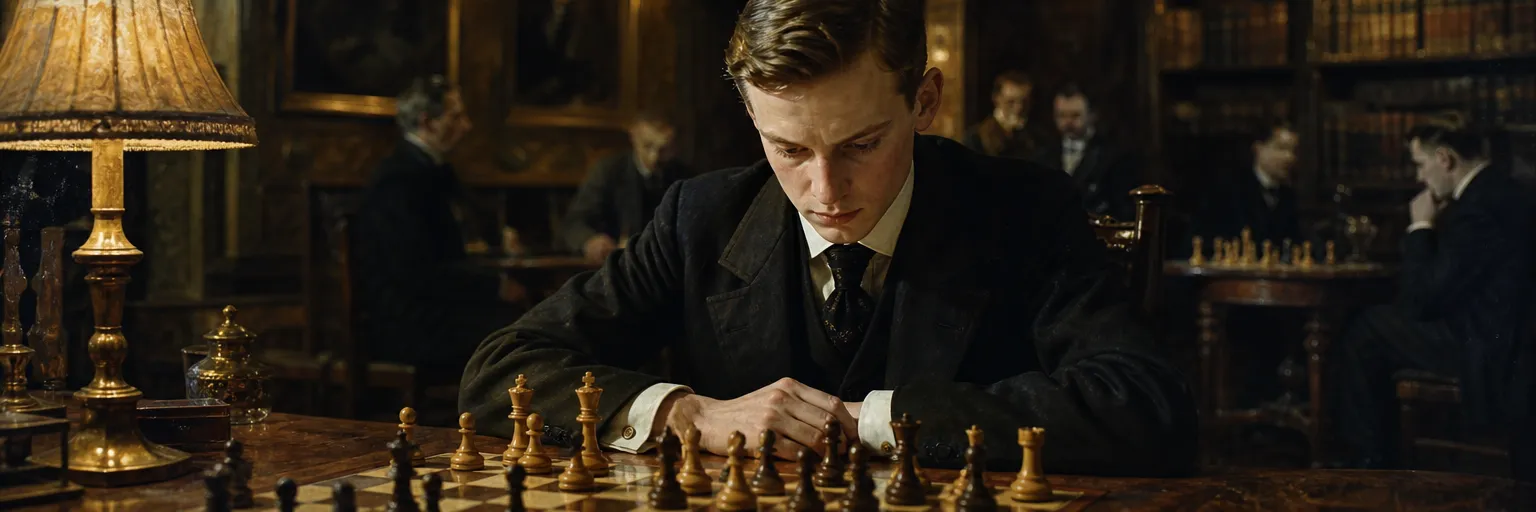
Alexander Alekhine’s early years and his rise in the world of chess
Alexander Alekhine was born in Moscow in 1892 into a wealthy family, in an environment where culture and education held an important place. From an early age, he discovered the game of chess and showed exceptional talent for calculation, combinations, and attack. As a child, he became passionate about tactical games and developed a style already defined by initiative, boldness, and a constant search for complications on the chessboard.
Early training focused on tactics
Like many future champions, Alekhine first improved through intensive study and regular practice. He analyzed masters’ games, solved problems, and took part in correspondence competitions, which sharpened his strategic vision. This period was essential in shaping the man who would become one of the greatest names in chess history. His taste for attack was not merely instinctive: it was also based on methodical preparation and a deep understanding of positions.
From early successes to international recognition
At the beginning of the 20th century, Alexander Alekhine began to draw attention in Russian and then European tournaments. His strong results against experienced opponents quickly confirmed the emergence of an extraordinary player. He racked up remarkable performances, impressed with the quality of his combinations, and established himself as a serious contender on the international stage. This rise to prominence was all the more remarkable because it came during an era rich in talent, when the competition was especially fierce.
An attacking style that built his reputation
What set Alekhine apart from the very start was his ability to turn slight advantages into devastating attacks. He excelled in dynamic positions, where piece activity took precedence over purely material considerations. His spectacular style appealed to amateurs and experts alike, as it combined creativity, precision, and a sense of sacrifice. As his career progressed, Alexander Alekhine thus built a reputation as a formidable player, capable of turning a game around through the sheer force of his imagination and tactical mastery.
The foundations of a future world champion
Alekhine’s early years laid the groundwork for his rise to the top. His dedication to work, ambition, and fighting spirit allowed him to progress through the ranks with great speed. Long before winning the world title, he was already seen as a major figure in chess, admired for his sharp style and attacking flair. His early years perfectly illustrate how precocious talent, supported by rigorous discipline, can lead to a central place in the world of international competition.
Alekhine’s playing style: creativity, calculation, and attacking flair
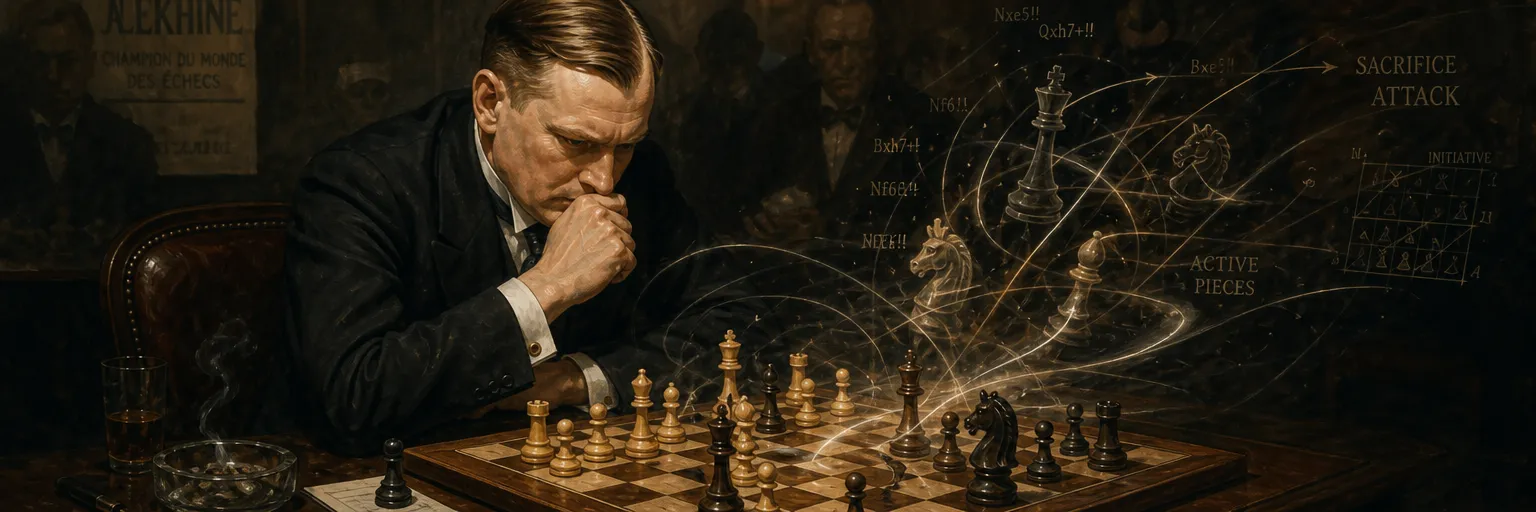
With Alexander Alekhine, every position seemed to hold the promise of imbalance. His play was not based solely on the initiative, but on a rare ability to turn a slight dynamic advantage into an irresistible offensive. This approach shaped his reputation as a spectacular champion, capable of envisioning deep continuations, coordinating his pieces with precision, and creating combinations where others saw only a complex position.
Imagination in the service of complicated positions
Alekhine excelled in structures rich in tactical possibilities. He willingly sought asymmetrical setups, temporary material imbalances, or unconventional piece placement in order to take his opponent off the beaten path. This constant search for active options perfectly illustrates his playing style, built on creating concrete problems to solve rather than simply accumulating static advantages.
His strength also came from his ability to anticipate the transformations of a position. An advanced pawn, an open diagonal, or a slightly exposed king was enough to fuel his imagination. In this context, Alekhine’s creativity was never gratuitous: it served a precise attacking plan, often prepared several moves in advance.
Calculation as the engine of initiative
If Alekhine still fascinates today, it is because his combinational genius rested on an extremely rigorous foundation. Behind the apparent spontaneity of his attacks, one finds exceptional calculation, capable of encompassing long variations with great accuracy. He knew how to assess when a sacrifice was sound, when a forcing sequence led to a lasting gain, and when it was simply necessary to keep up the pressure.
This technical mastery allowed him to make bold decisions without falling into approximation. His attacking play was therefore not merely instinctive: it was supported by a precise reading of his opponent’s resources, tactical motifs, and counterplay possibilities. It is this combination of inspiration and accuracy that makes his games so striking.
A keen sense of the opposing king and the decisive moment
Alekhine had a particular talent for spotting weaknesses around the enemy king. As soon as a square became vulnerable or a defensive piece was poorly placed, he directed all his energy toward exploiting that weakness. His attacking sense was based on timing: he knew when to open lines, when to mobilize his rooks, and when to sacrifice material to accelerate the pace of the offensive.
This grasp of the critical moment set the great champion apart from merely aggressive players. Where others launched a premature attack, Alekhine meticulously prepared the incursion of his pieces. Once the initiative was established, he imposed a sequence of threats that left his opponent little respite.
A lasting legacy in chess history
Alekhine’s play continues to influence modern generations, because it shows that a game of chess can be both scientific and artistic. His legacy goes beyond brilliant combinations: it reminds us that domination can arise from piece activity, psychological pressure, and the determination to exploit the slightest inaccuracy. In this respect, Alexander Alekhine remains one of the great references for understanding the balance between creativity, analytical precision, and attacking ambition at the highest level.
How Alexander Alekhine became world chess champion
After delivering a string of high-level performances in major international tournaments, Alekhine gradually established himself as the leading contender for the ultimate title. His rise was built on a rare combination of theoretical preparation, fighting spirit, and confidence in complex positions. In the 1920s, he refined his play against the world elite and methodically built his legitimacy to compete for the most coveted championship on the circuit.
A rise to prominence against the very best
Before conquering the crown, Alexander Alekhine put together a series of standout results against the greatest names of his time. His tournament successes, his ability to defeat opponents with varied styles, and his keen sense of initiative strengthened his reputation. More than a brilliant tactician, he became a complete competitor, capable of converting a slight advantage as well as turning around a tense position through a precise and energetic attack.
The challenge issued to José Raúl Capablanca
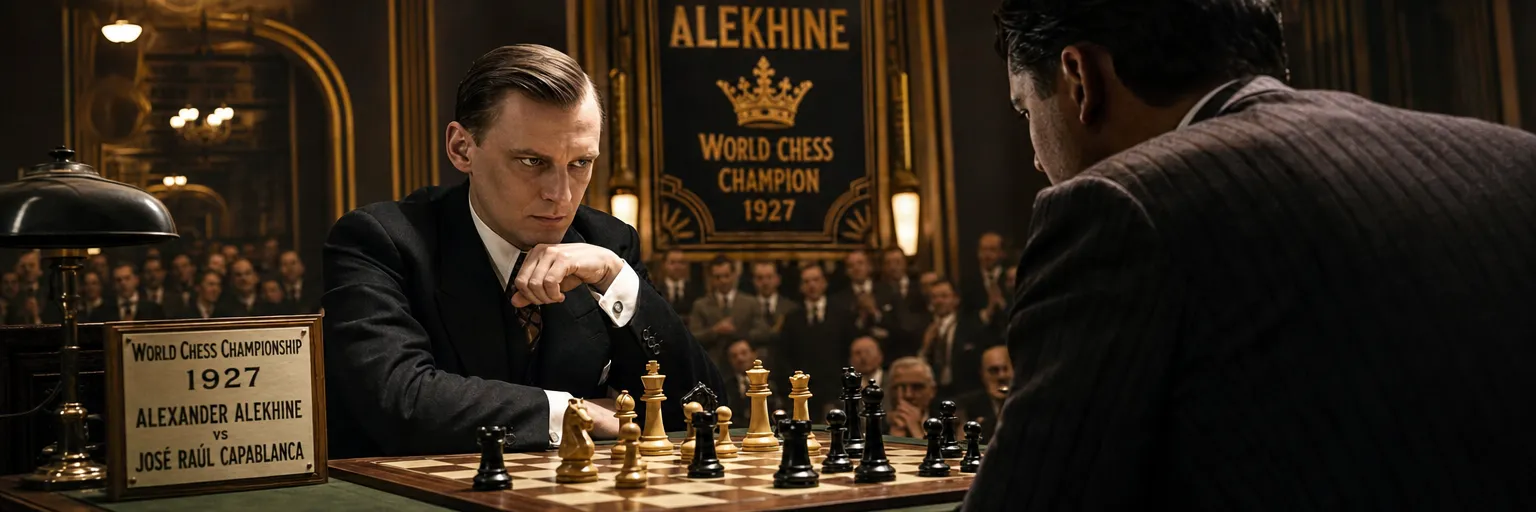
The decisive moment comes when he finally earns a title match against José Raúl Capablanca, then considered almost unbeatable. In 1927, in Buenos Aires, Alekhine approaches this confrontation with extremely serious preparation. Many observers see Capablanca as the favorite, because of his crystal-clear technique and mastery of endgames. Yet Alekhine manages to impose a richer, longer, and more nerve-racking battle, in which his endurance and ambition play an essential role.
The 1927 victory and its historical significance
By winning this match, Alekhine becomes world chess champion and achieves one of the greatest feats in the history of the game. This victory is not due solely to a few brilliant games: it rewards an overall strategy based on discipline, in-depth study of the opponent, and the determination to fight on every board to the very end. The triumph of Alexander Alekhine over Capablanca marks a turning point, as it shows that an incisive and ambitious style can also prevail at the highest level.
A reign forged through work and boldness
Having become world champion, Alekhine confirms that his coronation is no accident. His rise to the top is the result of years of refinement, a deep understanding of dynamic positions, and exceptional psychological strength. His journey to the title perfectly illustrates what made him unique: rigorous preparation, a pronounced taste for the initiative, and a unique ability to turn pressure into a concrete advantage on the chessboard.
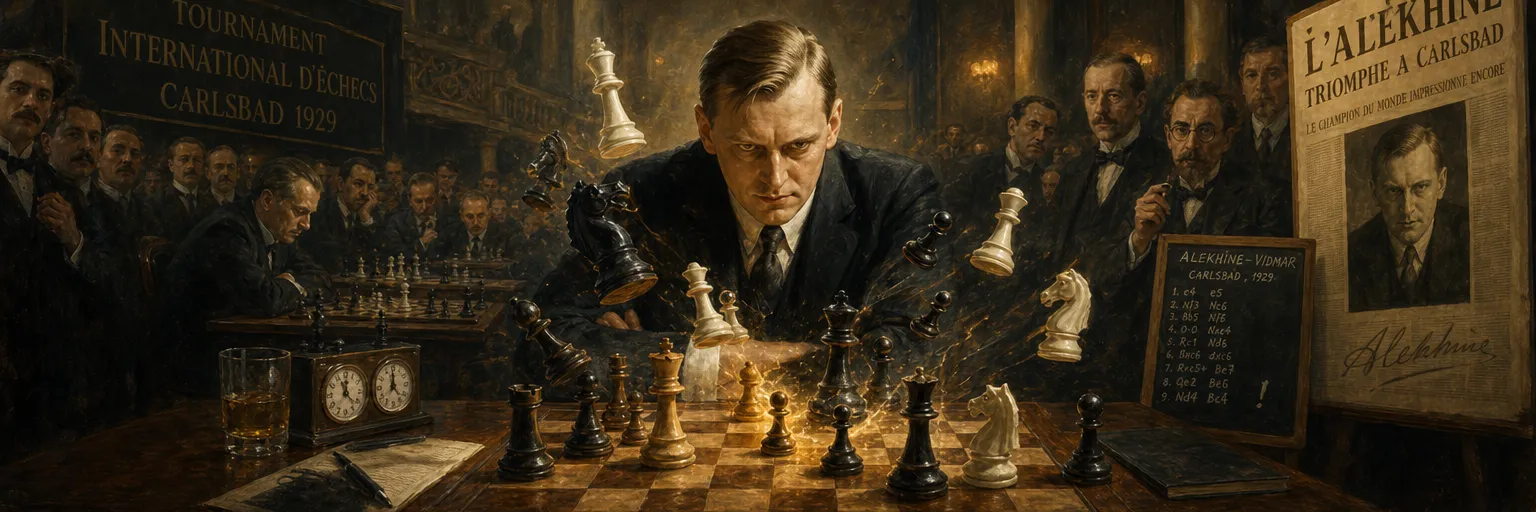
Alexander Alekhine’s most famous games
Some of Alexander Alekhine’s games have endured through the decades because they encapsulate everything that built his legend : constant initiative, dazzling combinations, and the ability to turn a slight advantage into a decisive attack. Through these encounters, one understands why his name remains associated with tactical genius and an extremely dynamic vision of the game.
Alekhine – Capablanca, 1927 World Championship
The 1927 match against José Raúl Capablanca is a defining moment in chess history. Alekhine did not merely win a title there : he imposed a more combative approach, built on psychological pressure, meticulous preparation, and calculated complications. Several games from this duel have become emblematic, as they show how he succeeded in unsettling a player considered almost unbeatable.
In these games, Alekhine alternates strategic caution with bursts of attack, proving that a great world chess champion is defined not only by solidity, but also by the ability to seize the right moment to take the initiative. This match is often cited as one of the major turning points in the history of chess.
Alekhine – Bogoljubov, the power of coordinated attack
The clashes against Efim Bogoljubov perfectly illustrate the way Alekhine built his offensives. Far from limiting himself to a spectacular sacrifice, he prepared his attacks through the gradual improvement of his pieces, until creating a position where every threat seemed to multiply. This mastery of coordination gives his victories an almost instructional dimension.
In several of these games, enthusiasts find what makes the Alekhine style unique : constant tension, active moves, and a deliberate search for imbalance. Even when the position still seems contained, he finds a way to open lines against the opposing king and turn the energy of his pieces into a true tactical storm.
Alekhine – Réti and a taste for complications
Against Richard Réti, Alekhine produced fascinating games pitting two major conceptions of modern chess against each other. Réti often sought positional flexibility and original structures, while Alekhine excelled at injecting complexity into positions that seemed balanced. The result is a series of idea-rich duels that are still studied today.
These encounters show that his talent was not based solely on direct attack. He also knew how to maneuver, wait, and then unleash a series of precise moves when his opponent let down his guard. This ability to move from strategic control to tactical explosion makes Alekhine one of the great references in chess combinations.
Alekhine – Nimzowitsch, between strategy and brutal rupture
The games played against Aron Nimzowitsch are also among the most commented on. They pit two profound minds against each other, capable of very different readings of the position. In them, Alekhine shows that he can compete on strategic ground before tipping the game in his favor thanks to an energetic and concrete sequence.
This type of victory sums up the richness of his legacy well : he was not an impulsive attacker, but a complete player, capable of preparing a breakthrough for a long time and then calculating all its consequences. That is also why his best games remain models for understanding the balance between positional planning and chess attack.
Why these games are still studied today
If Alexander Alekhine’s most famous games continue to be analyzed, it is because they offer far more than mere spectacle. They make it possible to observe how the initiative is born, how to exploit piece activity, and how to turn a lead in development into a winning attack. For enthusiasts and competitors alike, they are a valuable source of inspiration.
Revisiting these masterpieces, one realizes just how profoundly Alekhine shaped the evolution of chess through his creative ambition. His greatest victories are not merely historic successes : they embody a certain vision of attacking play, where imagination and precision always go hand in hand.
The tactical combinations that forged Alekhine’s legend
In the history of the sixty-four squares, few players have embodied the power of the tactical combination as forcefully as Alexander Alekhine. His attacks were not mere offensive bursts : they were built on calculation of rare depth, on the art of sacrifice, and on a keen understanding of piece coordination. It was this ability to unleash chaos at exactly the right moment that fueled his reputation as a genius of attacking chess.
Sacrifice as the trigger for attack
For Alekhine, sacrifice was never decorative. It was used to open lines, deflect a key defender, or lure the opposing king into a danger zone. Knights, bishops, rooks, and sometimes even the queen could be committed to a forced sequence if the position promised a lasting initiative. This calculated boldness played a major role in making Alekhine an absolute benchmark in chess tactics.
What remains impressive even today is the precision with which he chained together intermediate moves, successive checks, and intersecting threats. Where others sought immediate material gain, he often aimed for a complete collapse of the opponent’s position. His genius lay in this ability to transform a dynamic advantage into a decisive attack.
Combinations born from complex positions
Alekhine’s finest sequences often emerged from positions rich in tension, where every piece seemed to hang by a thread. He excelled in these unstable configurations because he saw hidden motifs faster than his contemporaries : pins, forks, deflections, skewers, or mating nets. His tactical vision rested on an extremely refined reading of the resources in the position, which made him the undisputed master of combinational calculation.
This mastery also allowed him to create complications even before the tactical opportunity was visible to the spectator. Alekhine often prepared his combinations several moves in advance, subtly improving the activity of his pieces. As a result, the tactical explosion seemed sudden, even though it was the outcome of patient preparatory work.
The opposing king at the center of his attacking imagination
A recurring feature of his most memorable games is his obsession with the enemy king. As soon as a weakness appeared around it, Alekhine mobilized all his forces with remarkable energy. Open files, active diagonals, advanced minor pieces : everything converged toward mounting pressure, often culminating in a spectacular king attack.
This orientation gave his play a dramatic dimension that fascinated the public. His combinations did not merely win a piece : they told a complete attacking story, carried through to checkmate or to an irreversible material gain. That is why so many of his games are still studied as models of chess combinations and tactical domination.
A legacy still studied by modern players
Alekhine’s tactical masterpieces continue to hold a prominent place in the training of ambitious players. They show how imagination can unite with rigor, and how a well-conducted initiative can overwhelm an otherwise solid defense. Studying his games means understanding that the beauty of chess is born not only from a brilliant move, but from the coherence of an attacking plan pursued relentlessly.
In this respect, Alekhine remains a major source of inspiration for all those who want to improve in the art of attack, sacrifice, and dynamic pressure. His legend was built on those moments when positional logic suddenly gave way to a tactical storm, leaving on the board the lasting imprint of a great world chess champion.
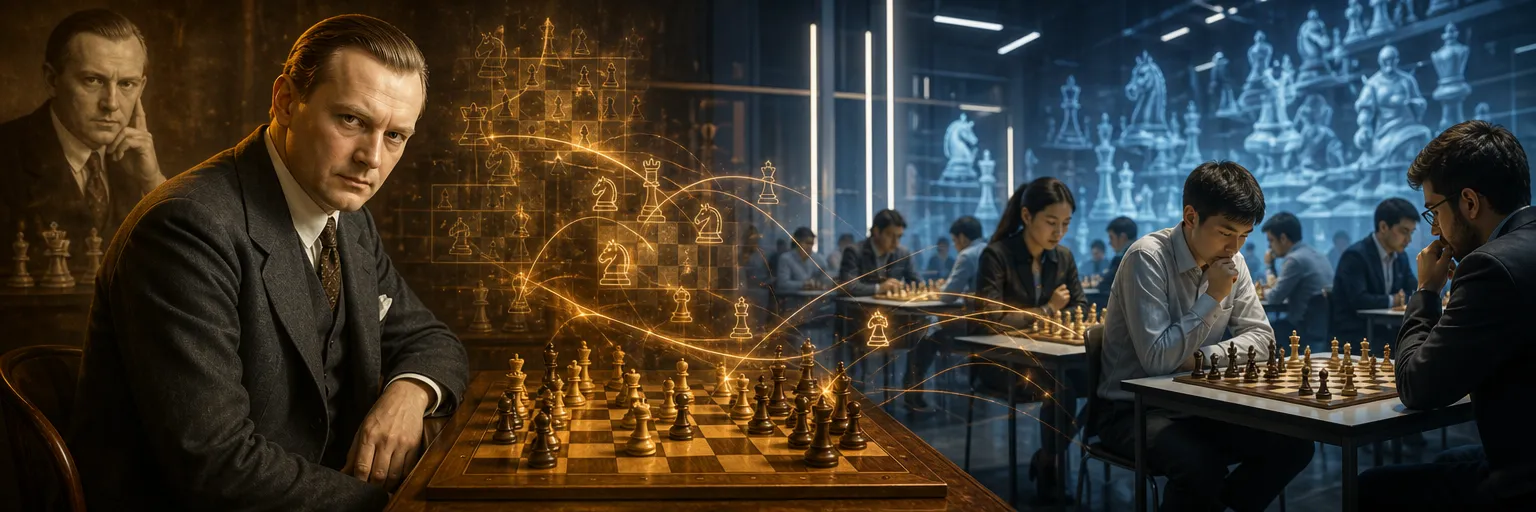
The influence of Alexander Alekhine on contemporary chess players
Far beyond his own era, Alexander Alekhine continues to fuel the thinking of grandmasters, coaches, and enthusiasts seeking to understand how a truly irresistible attack is born. His legacy is not limited to a handful of brilliant games : he helped shape a dynamic vision of chess, in which initiative, psychological pressure, and precision in calculation hold a central place. In this respect, his name remains a major reference in modern chess culture.
A model for players with an attacking style
Many contemporary competitors, including at the very highest level, draw inspiration from Alekhine when they seek to unbalance a position. His way of launching an offensive from sometimes minimal elements profoundly shaped the conception of attacking play. Modern players admire in him this ability to coordinate his pieces with rare intensity, while maintaining a very concrete vision of the variations. This approach influenced several generations of champions, captivated by a style in which creativity never conflicts with rigor.
A benchmark in tactical and strategic study
Alekhine’s games are still studied today in books, databases, and training courses because they offer exceptional material for working on tactics, calculation, and the transition from a positional advantage to a direct attack. His contribution is particularly valuable for players who want to understand how to turn better piece activity into concrete threats against the opposing king. In this sense, Alekhine left a lasting mark on chess pedagogy by showing that a successful attack is often born from patient strategic preparation.
A legacy visible in modern chess
Even in the era of analysis engines and computer preparation, Alekhine’s imprint remains perceptible. The best contemporary players still place great value on the initiative, the timely sacrifice, and the search for complications when the position allows it. This taste for controlled imbalances directly recalls the philosophy of the Russian-French world champion. His influence also appears in the way players approach certain ambitious openings, with the idea of quickly gaining the psychological and practical upper hand over the opponent.
Why Alekhine still fascinates new generations
If Alekhine remains so admired, it is also because his games combine spectacle, depth, and intellectual rigor. Young players discover in them a form of methodical boldness : it is not about attacking for no reason, but about creating the conditions for active domination before striking at the right moment. This lesson retains all its value in contemporary chess, where technical precision is essential but the spirit of initiative often makes the difference. In this respect, Alexander Alekhine remains one of the great models of combative thinking on the chessboard.
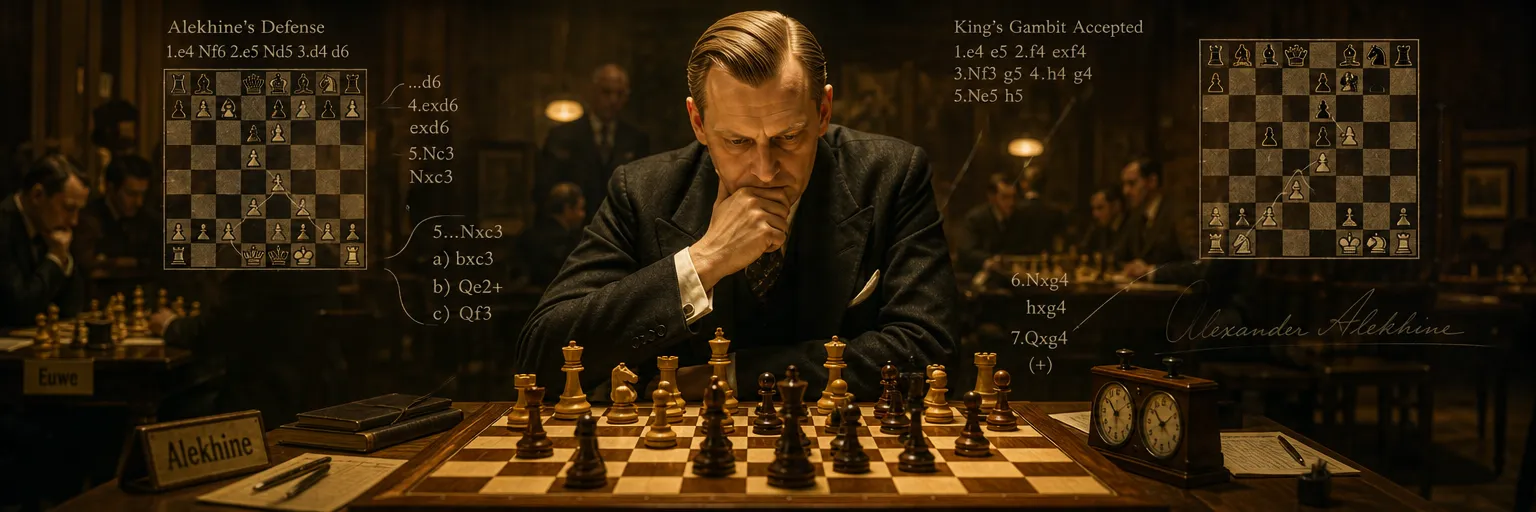
Alekhine’s favorite openings and their strategic impact
More than a simple choice of opening repertoire, Alexander Alekhine’s openings reflected a very precise vision of the game : to create imbalances early, steer the game toward dynamic positions, and keep the initiative for as long as possible. Whether playing White or Black, the Russian champion sought structures that could fuel his calculating ability, his taste for measured risk, and his tremendous attacking energy.
Systems designed to create imbalance
Alekhine did not view the opening as an isolated phase, but as the starting point of an overall plan. He was particularly fond of lines where rapid development, central pressure, and piece activity offered concrete attacking prospects. This approach explains why he often favored setups leading to a lasting initiative, even at the cost of temporary positional concessions. For him, the opening had to prepare a lively middlegame, rich in threats and tactical possibilities.
The Alekhine Defense, a strategic provocation that became a classic
Among the systems most closely associated with his name is naturally the Alekhine Defense, introduced by 1.e4 Nf6. With this bold idea, Black invites White to advance their central pawns and then attacks them. This choice perfectly sums up Alekhine’s spirit : accepting a certain amount of space conceded in the short term in order to better target the future weakening of the opponent’s center. From a strategic standpoint, this opening left its mark on history by showing that an imposing pawn center could also become a target. It helped enrich the theory of chess openings by emphasizing provocation, counterattack, and flexibility.
With White, the ambition to dictate the pace
When he had the white pieces, Alekhine often sought to gain a space or development advantage that could fuel an attack on the king. He willingly used 1.e4 to open the way to clear-cut positions, where the struggle for the center could lead to swift combinations. In the Ruy Lopez, Italian Game, or positions arising from the Queen’s Gambit when he adapted his style, his objective remained similar : activate his pieces as early as possible and create practical problems for his opponent. This way of approaching openings illustrates his ability to turn a slight initial edge into constant pressure.
A lasting impact on modern strategy
Alekhine’s legacy extends far beyond the variations that bear his name. His essential contribution lies in an idea that has become central to modern chess: an opening is not judged solely by the static balance of the position, but also by the dynamic chances it offers. In this sense, he helped legitimize more flexible concepts of the center, piece coordination, and counterplay. Many attacking players owe him the conviction that a powerful attack is prepared from the very first moves, through opening choices consistent with a clear strategic plan.
Why his choices are still studied today
Although contemporary analysis has refined the evaluation of many lines he used, Alekhine’s preferences continue to be studied because they reveal a deep understanding of the link between structure, activity, and initiative. His openings are a reminder that a great player does not seek only the best theoretical continuation, but also the ground on which his style can fully express itself. In this respect, studying Alexander Alekhine’s repertoire remains valuable for all those who want to understand how to connect strategy, tactical sense, and preparing an attack right from the opening.
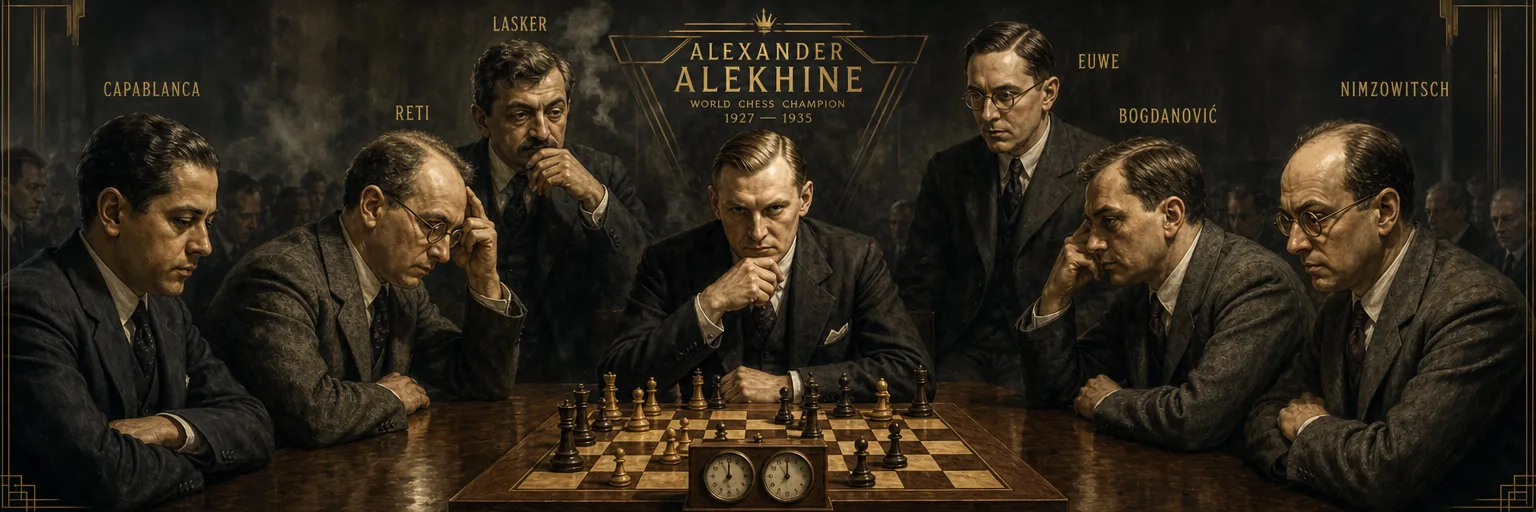
Alexander Alekhine’s great rivals at the pinnacle of chess
Alexander Alekhine’s career can also be understood through the champions and challengers he had to face in major tournaments and world title matches. Opposite him, the elite of his time served as a revealing test: each duel highlighted the depth of his calculation, his taste for risk, and his ability to impose an infernal pace on the chessboard. These confrontations shaped his reputation in chess history and strengthened his image as a formidable world champion.
José Raúl Capablanca, the most emblematic rival
Among all of Alekhine’s opponents, José Raúl Capablanca holds a special place. The Cuban, renowned for his positional clarity, impeccable technique, and apparent simplicity, represented almost the stylistic opposite of Alekhine. Their 1927 clash, during the world title match, remains one of the most memorable episodes in the history of the World Chess Championship. By triumphing over Capablanca, Alekhine was not merely defeating a reigning champion regarded by many as nearly unbeatable: he was demonstrating that a more tense, ambitious, and combative style of play could overcome legendary precision.
This rivalry goes beyond the simple matter of results. It embodies a clash of philosophies of the game : on one side, economy of means; on the other, creative energy and relentless attack. For many historians, it was against Capablanca that Alekhine built the most spectacular part of his legacy in chess.
Emanuel Lasker and the transition between two eras
Facing Emanuel Lasker, the former king of the sixty-four squares, meant measuring oneself against an extraordinary chess intellect. Even though Lasker belonged to an earlier generation, his longevity at the highest level still made him an absolute benchmark. The games between Alekhine and Lasker illustrated the meeting of two exceptionally rich conceptions of strategic combat : one forged in psychology and adaptation, the other driven by calculating momentum and initiative.
In the major international tournaments, Alekhine found in Lasker an opponent capable of resisting pressure, complicating practical decisions, and testing his maturity. These head-to-head encounters helped establish Alekhine among the greatest names in world chess, at a time when the hierarchy remained particularly demanding.
Efim Bogoljubov, a major challenger for the title
Efim Bogoljubov was one of the most important rivals of the period when Alekhine held the crown. The two men faced each other in world championship matches, and Bogoljubov, an enterprising and combative player, had a style dynamic enough to create real tension. Even though Alekhine managed to maintain his edge, these encounters show that he had to continually defend his status against solid, well-prepared, and ambitious challengers.
What makes Bogoljubov interesting in studying Alekhine’s career is that he was not merely a supporting figure in the master’s shadow. He was a credible competitor, capable of seizing the initiative and creating complex positions. Against him, Alekhine had to prove that his attacking sense was also matched by great discipline in managing a long match.
Max Euwe, the opponent who made the reign falter
The rivalry with Max Euwe is a reminder that even the greatest experience moments of fragility. In 1935, the Dutchman managed to defeat Alekhine and seize the world title, creating one of the era’s greatest surprises. Euwe had neither the romantic aura of certain masters nor Capablanca’s intimidating reputation, but he possessed methodical preparation, great rigor, and remarkable composure.
This defeat gives a particular depth to Alekhine’s career. It shows that offensive genius is not always enough when it runs up against methodical and relentless opposition. Yet what followed is just as revealing : Alekhine regained his title in 1937, confirming his ability to bounce back at the highest level of the world chess championship. Euwe thus remains one of the most significant opponents of his career, the one who briefly interrupted his reign before once again witnessing the master’s immense strength of character.
Rivalries that strengthened his legend
Capablanca, Lasker, Bogoljubov, and Euwe were not merely prestigious names on Alekhine’s record. Each played a role in building a legend founded on rigor, self-transcendence, and confrontation with the very best his era had to offer. By dominating or overcoming these exceptional opponents, Alekhine inscribed his name among the central figures in chess history, not only as a brilliant tactician, but also as a competitor capable of rising to the greatest challenges.
Key lessons from Alekhine’s attacking play
Observing Alekhine’s games reveals principles that are still highly useful for improving. His genius did not rest solely on spectacular sacrifices, but on a coherent way of preparing the attack, coordinating his pieces, and sensing the right moment to accelerate. His example shows that a truly effective chess attack is born from a blend of positional logic, precise calculation, and controlled boldness.
Creating the right conditions before striking
One of the great lessons left by Alexander Alekhine is that an attack cannot simply be declared. Before launching his pieces toward the opposing king, he improved his position, gained space, provoked weaknesses, and restricted the enemy’s defenses. This approach is a reminder that sound attacking play often begins with strategic details : better piece activity, control of key squares, and constant pressure on a vulnerable point.
For today’s players, this means learning to recognize favorable signs : lagging development, an exposed king, poorly coordinated pieces, or open files. Alekhine excelled in the art of turning a small advantage into a concrete threat, until defense became almost impossible.
Coordinating all the pieces toward a single objective
For Alekhine, attack was never the business of a single brilliant piece. Knights, bishops, rooks, and queen all took part in a collective effort, with remarkable harmony. This coordination is an essential lesson for any lover of tactics and strategy : a combination truly works only if the pieces support the same idea.
His games also show that activity often outweighs simple material count. In his style, a sacrifice had value only if it opened lines, drew in the opposing king, or paralyzed the defenders. In this, Alekhine teaches that one must always assess the dynamics of the position, not just its apparent balance.
Calculating far ahead without losing practical sense
Alekhine’s reputation as a tremendous calculator is fully deserved, but his strength went beyond the depth of his variations. He knew how to identify the critical lines, focus his attention on forcing moves, and choose continuations that maintained the initiative. To improve, the modern player can take away that a successful tactical combination depends as much on selecting the right variations as on the ability to visualize several moves ahead.
This ability was matched by a great practical sense. Alekhine did not seek complications for their own sake : he sought positions in which the opponent had to solve difficult problems under pressure. This is a valuable lesson in chess : the most fearsome attack is often the one that multiplies delicate decisions for the other side.
Taking the initiative and keeping it
Another major lesson lies in the value of the initiative. Alekhine understood that by dictating the rhythm of the game, he forced his opponent to respond rather than build their own plan. This ability to string threats together explains why so many of his victories give the impression of a continuous build-up of pressure.
From the perspective of a master of attack, this suggests not easing up on activity after an initial success. An effective attack often requires turning one threat into another, then into a decisive breakthrough. Alekhine excelled precisely in this sequence, moving from a spatial advantage to an initiative, and then from an initiative to a winning offensive.
Combining creativity and discipline
Alekhine’s legacy cannot be reduced to brilliant moves intended to impress. His style is a reminder that in chess, creativity achieves its best effects when it rests on a rigorous foundation. He dared a great deal, but on concrete foundations : rapid development, control of the lines, calculation of defensive resources, and a fine understanding of imbalances.
This is undoubtedly the most enduring lesson of his legacy. Studying Alekhine is not just about admiring a legendary world champion ; it is about learning how to build an attack methodically, sensing the exact moment when the energy of the position shifts, and understanding that flair becomes truly dangerous when it is grounded in clear thinking.
Alexander Alekhine’s legacy in chess history
Few world champions have left such a deep mark on the way the game is understood. Through his analytical rigor, his taste for calculated risk, and his ability to create explosive positions, Alexander Alekhine helped bring about lasting changes in both chess theory and practice. His name remains associated with an ambitious vision of the battle on the chessboard, where initiative, precision, and imagination form an inseparable whole.
A model for ambitious players
Alekhine’s influence extends far beyond his results and titles. For many enthusiasts, he still embodies the master of attack par excellence, capable of turning a strategic idea into a concrete offensive. His games show that a successful attack does not rely on intuition alone, but also on piece coordination, a sense of timing, and a very fine reading of the opponent’s weaknesses. In this respect, he remains a major reference in learning the art of attack.
A lasting contribution to chess culture
Alexander Alekhine’s legacy can also be seen in chess literature. His annotations, his commentaries, and the collections devoted to his best games have nourished generations of readers. By studying his masterpieces, players discover an approach in which tactical combinations are never isolated from the overall strategy. This ability to connect positional preparation with tactical explosion has left a strong mark on the history of modern chess.
An inspiration that remains relevant
Even in the era of analysis engines and computer preparation, Alekhine still holds a special place. Coaches and competitors continue to explore his games to better understand how the initiative is born and how a coherent attack is built. His career is a reminder that in chess, creativity is not opposed to rigor : it is often its culmination. That is why Alexander Alekhine’s legacy remains alive, both in the memory of historians and in the daily work of those who want to improve on the chessboard.
Thanks to his aggressive style and spectacular combinations, Alexander Alekhine left his mark on chess history as one of the greatest attacking players of all time. After his reign, a new generation of champions would emerge under the leadership of a methodical and visionary player: Mikhail Botvinnik: the father of the Soviet school of chess, whose influence would be felt for several decades.
This fascinating story is part of a long line of champions and strategists who helped shape the evolution of the game. Discover them in our dedicated guide: Famous chess players: legends, champions, and modern stars.