
 France
 English
 Deutsch
 Español
 Italiano
 Nederlands
 Polski
 Português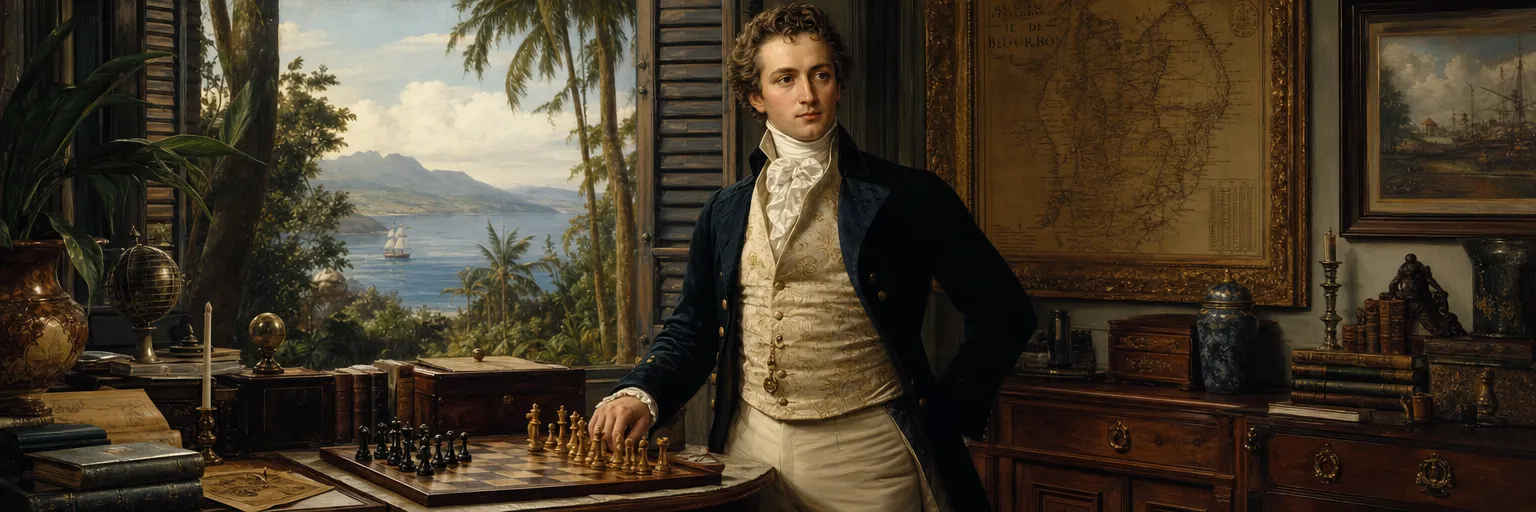
The origins of Louis-Charles Mahé de La Bourdonnais
Louis-Charles Mahé de La Bourdonnais was born in 1795, at a time when chess already held a distinctive place in European intellectual circles. Coming from a noble family, he grew up in an environment shaped by the military, administrative, and cultural legacy of the Ancien Régime, which helped form his character and taste for reflection from an early age.
A birth within the French nobility
The future champion belonged to the Mahé de La Bourdonnais family, a name associated with a certain social distinction and a history already firmly rooted in French memory. This family background gave him a privileged starting point, even though the troubled political context of the late 18th century profoundly disrupted the traditional landmarks of the nobility. In this unstable climate, Louis-Charles Mahé de La Bourdonnais developed a combative personality that would later be reflected in his chess playing style.
A decisive historical context
His childhood and youth unfolded in a France transformed first by the Revolution and then by the Empire. This period of rapid change influenced an entire generation, including those who frequented salons, cafés, and places of intellectual exchange. To understand La Bourdonnais’s rise, one must also take into account this environment in which personal merit was beginning to assert itself more strongly, including in disciplines such as chess.
First steps toward chess
Although the precise details of his early training sometimes remain limited in the sources, it is clear that Louis-Charles Mahé de La Bourdonnais showed remarkable abilities for calculation, anticipation, and strategy from a very early age. These qualities found an ideal outlet in chess, a game that was then enjoying real prominence in France. His early years took place in a world where Paris was already establishing itself as one of the great European centers of chess activity.
Paris and the legacy of the great players
The French capital played a fundamental role in his chess origins. By frequenting the places where knowledgeable enthusiasts and renowned masters met, he became part of a prestigious tradition inherited notably from Philidor. This legacy is essential to understanding how La Bourdonnais was able to emerge as a major figure: he was not simply an isolated talent, but the product of an exceptional cultural soil, where mastery of the game also became a form of intellectual recognition.
Thus, the origins of Louis-Charles Mahé de La Bourdonnais combine nobility, historical upheaval, and immersion in the world of Parisian chess. It is this combination of family heritage and a favorable context that paves the way for the rise of the man who would become France’s first great chess master.
The beginnings of a prodigy on the chessboard
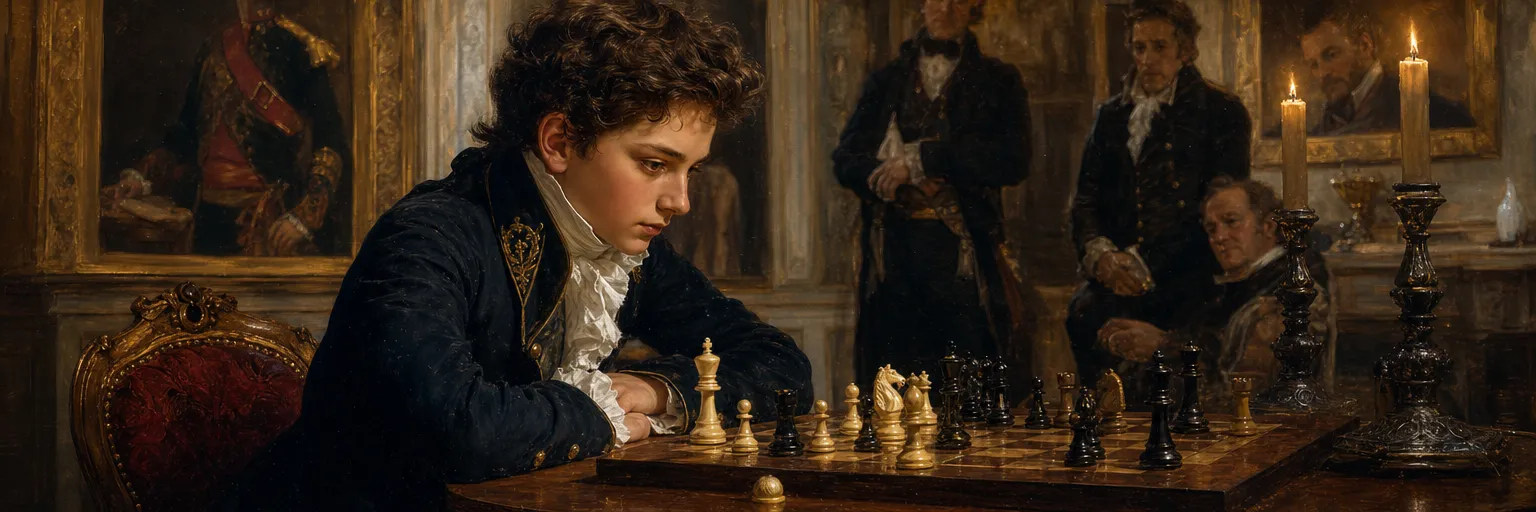
From a very early age, Louis-Charles Mahé de La Bourdonnais displayed an uncommon ease in front of the sixty-four squares. Where others patiently learned the rules, he already seemed to grasp the game’s deeper logic, tactical sequences, and positional imbalances with striking speed. This precocity quickly built his reputation in circles where chess was practiced as much as an art as an intellectual confrontation.
Meteoric progress
His early years of play were marked by intensive learning and an insatiable curiosity. La Bourdonnais did not simply play: he observed, memorized, and refined his understanding of every game. This ability to absorb playing patterns quickly allowed him to progress at an exceptional pace, until he established himself as a true prodigy in specialist circles.
At a time when the transmission of chess knowledge relied mainly on direct experience, he developed a style based on initiative, attack, and concrete mastery of positions. This energetic approach already foreshadowed the future French grandmaster he would become, admired for his fighting spirit and keen sense of decision-making.
The influence of Parisian circles
The development of his talent also took place in a favorable context. Paris was then one of the great centers of European chess culture, and the meeting places between players offered La Bourdonnais an ideal ground for improvement. By facing a variety of opponents, often more experienced than himself, he gradually forged remarkable resilience and growing confidence in his play.
These repeated encounters played a decisive role in his development. They allowed him not only to test his ideas, but also to impose his personality on the chessboard. His name thus began to circulate insistently among those following the rise of French chess, aware that they were witnessing the emergence of an exceptional player.
The foundations of a future dominance
Even before reaching full maturity, La Bourdonnais already showed the qualities that would become his greatest strengths at the highest level: a quick reading of positions, great mental endurance, and a constant determination to seize the advantage. His early years therefore reflect not only a precocious calling, but truly the birth of a champion capable of leaving a lasting mark on the history of chess in France.
By looking at this early rise, it becomes clear why Louis-Charles Mahé de La Bourdonnais is often regarded as the first great French chess master. His early games, his attacking temperament, and his accelerated learning laid the foundations for a career destined to shine far beyond the Parisian salons.
How La Bourdonnais became the first great French chess master
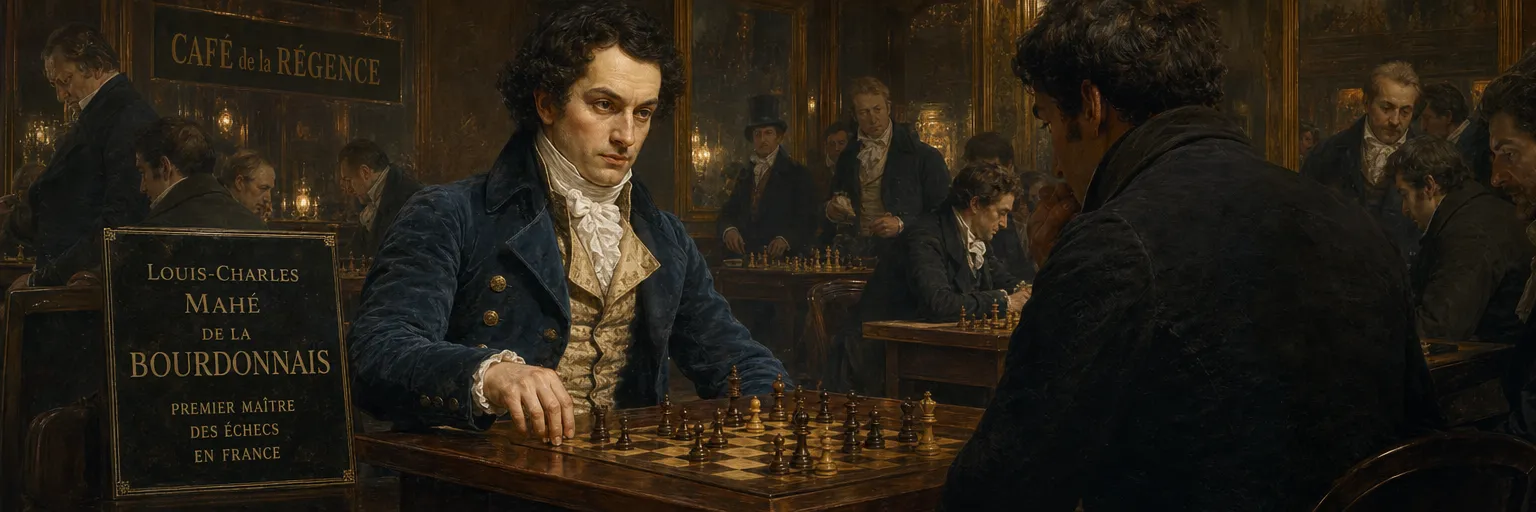
Over the years, La Bourdonnais established himself as an essential reference in the world of chess, to the point of being considered by many as the first great French chess master. This rise was not based on an official title, which did not exist in his time, but on tangible dominance over the best players of his era, a superior understanding of the game, and a reputation that extended far beyond France’s borders.
A rise shaped by practice and competition
His rise to prominence was built in the most active Parisian circles, where every game became a test of resilience, calculation, and intuition. By regularly facing experienced opponents, La Bourdonnais refined an energetic, attacking, and remarkably precise style. This ability to string together victories under demanding playing conditions helped make La Bourdonnais a respected name throughout the European chess world.
Recognition through superiority over his rivals
What truly set the French player apart was his ability to dominate the leading figures of his time. In the 19th century, when the concept of a world championship had not yet been formalized, the hierarchy was defined through direct encounters. By winning top-level matches and displaying rare consistency, he earned the unofficial status of best French player, then of a leading master on the international stage.
The match against McDonnell, a decisive turning point
His confrontation with the Irishman Alexander McDonnell remains the most emblematic episode of this rise to prominence. These series of games, played in 1834, fascinated enthusiasts and served as a true benchmark for measuring the value of the two champions. La Bourdonnais’s overall superiority during this historic duel reinforced his image as a French chess masterof exceptional renown and secures his place among the greatest names in the history of the game.
A style of play that leaves a lasting mark on its era
La Bourdonnais does not merely win: he also influences the way the game is conceived. His sense of initiative, tactical vision, and ability to turn a slight advantage into a decisive attack impress his contemporaries. This overall mastery explains why he is often presented as the first French chess champion, even if this label remains retrospective. His legacy rests as much on his results as on the mark he left on chess culture.
A reputation built far beyond France
By establishing his name in cafés, specialist circles, and accounts devoted to the great clashes of the 19th century, he gives French chess new visibility. Through his performances, Louis-Charles Mahé de La Bourdonnais becomes the embodiment of national excellence capable of rivaling the finest European talents. It is this combination of victories, prestige, and influence that explains why he remains, even today, a foundational figure in the history of chess in France.
Le Café de la Régence, cradle of his legend
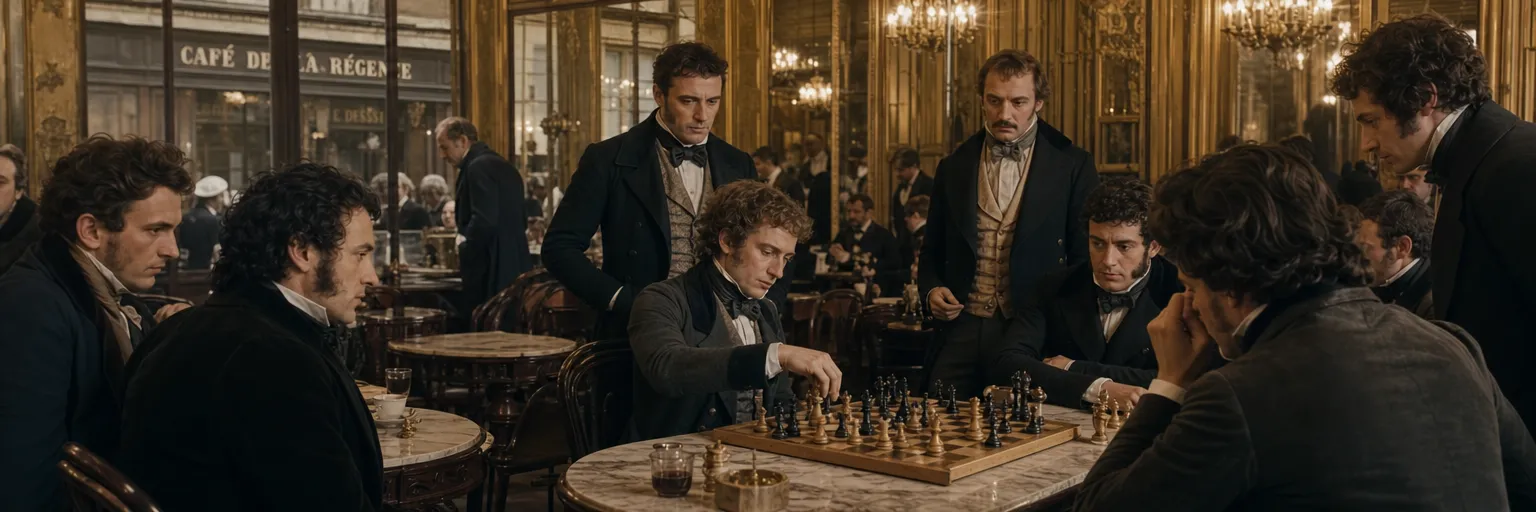
In the heart of Paris, the Café de la Régence was the main stage on which Louis-Charles Mahé de La Bourdonnais forged his reputation. This iconic venue, frequented by discerning enthusiasts, seasoned players, and curious passersby, was then considered the true nerve center of chess in France. It was in this demanding atmosphere that the man who would become the first great French chess master refined his style, asserted his authority, and built a reputation that quickly extended beyond the borders of Paris.
A leading venue for Parisian chess
The Café de la Régence was not simply a fashionable establishment: it represented a space for intellectual confrontation where each game could make or break a reputation. Since the 18th century, this café had attracted the finest players and helped make Paris an essential capital of the game. By distinguishing himself there regularly, La Bourdonnais became part of a prestigious tradition while renewing the image of the modern champion: combative, creative, and formidably effective.
A ground for learning and dominance
Faced with a wide range of opposition, La Bourdonnais developed at the Café de la Régence an understanding of the game of rare depth. The daily clashes, often fiercely contested, allowed him to refine his tactical vision and sense of initiative. In this competitive environment, he did not merely learn: he dominated. His presence ultimately became self-evident, to the point of making the café one of the strongest symbols of his rise.
The birth of a lasting reputation
La Bourdonnais’s fame rests not only on his victories, but also on the aura bestowed on him by this mythical venue. The Café de la Régence then served as a stage on which the legend of great players was forged. By triumphing in this prestigious setting, he cemented his status as a major figure in 19th-century chess. Thus, long before modern international competitions gave structure to the discipline, this Parisian café played a direct role in building his legend and the legacy of France’s first great chess master.
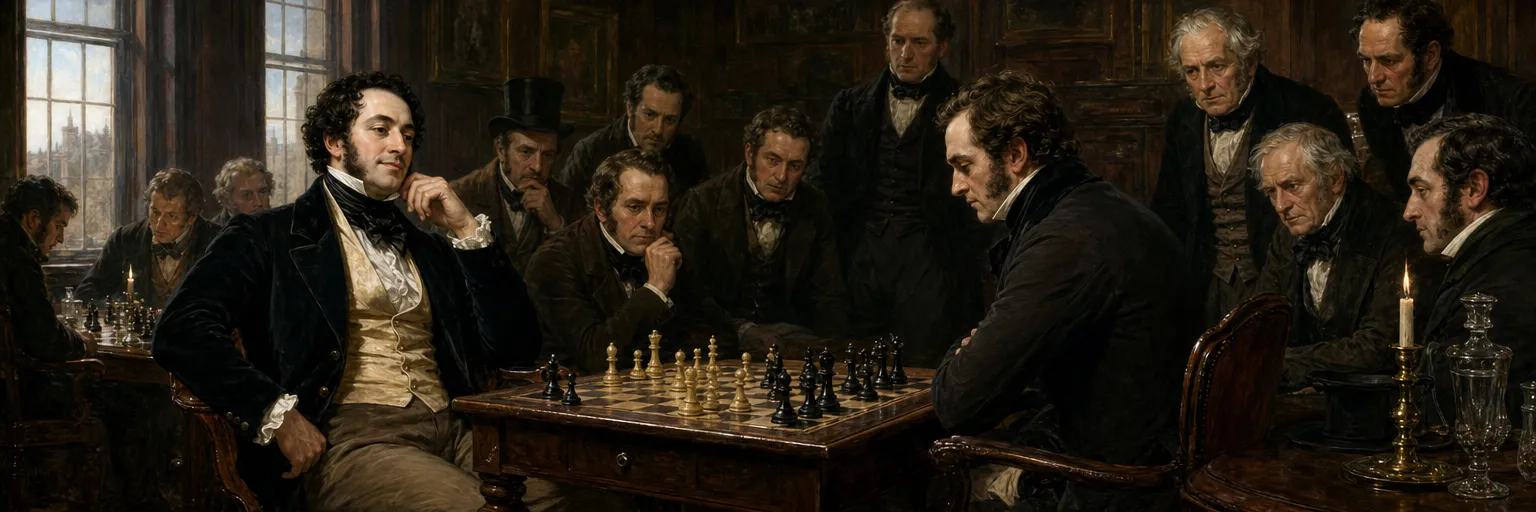
The legendary duels between La Bourdonnais and Alexander McDonnell
In 1834, London became the setting for a confrontation that remains famous in the history of the game. The meetings between La Bourdonnais and Alexander McDonnell went beyond the simple framework of an individual contest : they embodied one of the first great international chess showdowns, pitting the French school, rich in tradition, against a British opponent feared for his fighting spirit.
A rivalry that captivated Europe
At that time, La Bourdonnais was already recognized as one of the most powerful players of his era. McDonnell, an influential merchant and passionate chess player, had established himself as the leading British representative. Their series of matches drew the attention of enthusiasts, chroniclers, and intellectual circles alike, such was the symbolic significance at stake. Long before modern championships, these duels thus took on an almost global dimension.
Marathon matches of exceptional standard
The two men played several series of games, with an intensity rare for the time. La Bourdonnais ultimately prevailed overall, but the struggle was close, demanding, and spectacular. These encounters left a lasting mark on the history of chess games through their volume, quality, and strategic depth. They also showed how high-level competition can reveal very different styles : on the one hand, La Bourdonnais’s energetic precision ; on the other, McDonnell’s tactical boldness.
A strategic laboratory ahead of its time
Beyond the result, these encounters represent a valuable source for theory. Many positions from their games were studied for decades, particularly in openings and pawn structures. Observers see in them the emergence of a more modern way of thinking, in which preparation, initiative, and the exploitation of the opponent’s weaknesses take on central importance. Through these battles, La Bourdonnais confirms his standing among the greatest masters of the 19th century.
A reputation strengthened by legend
Posterity has remembered these matches as one of the high points of the French champion’s career. By defeating McDonnell in this now legendary series, La Bourdonnais reinforced his image as a major figure in French chess and an essential reference on the European stage. These duels contributed greatly to his legend and explain why his name remains associated with the great founding moments of modern chess.
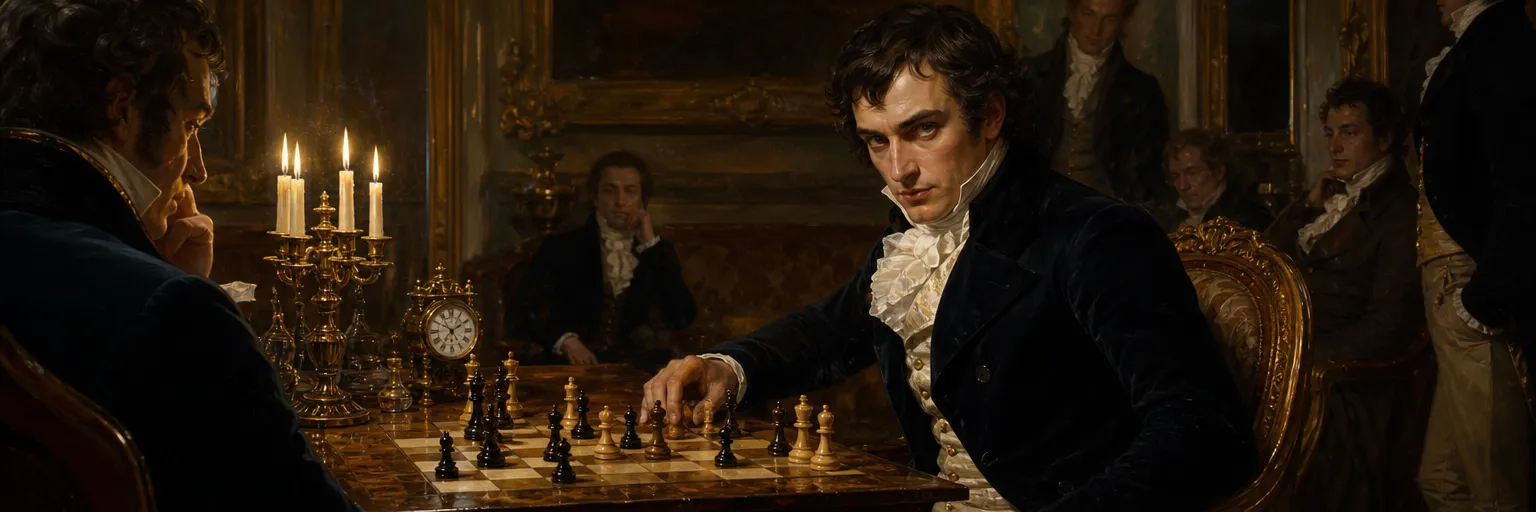
La Bourdonnais's playing style and his strategic strengths
On the chessboard, La Bourdonnais stands out for an approach that is energetic, concrete, and remarkably clear-sighted. His play is not based solely on boldness: he combines a sense of initiative, a refined reading of positions, and the ability to exploit the slightest weakness in his opponent’s camp. This mastery explains why his name remains associated with the rise of top-level chess in the 19th century.
An attack built on initiative
La Bourdonnais often sought to gain the upper hand from the opening, not for the sake of spectacle, but to impose his rhythm. He excelled in open positions, where piece activity, rapid development, and pressure on the enemy king became decisive weapons. This keen sense of tempo allowed him to turn a slight advantage into a sustained offensive, an essential quality in a great chess player.
A tactical sense combined with genuine positional depth
Reducing his talent to attack alone would, however, be incomplete. Behind his brilliant combinations, La Bourdonnais displayed an already very modern understanding of pawn structure, strong squares, and piece coordination. He knew when to exchange, when to maintain tension, and how to gradually improve his position before delivering the decisive blow. This combination of tactics and strategy helps make him, in the eyes of many historians, the first great French chess master.
Remarkable endgame mastery
One of his most impressive strengths lay in his endgame technique. Where others squandered their advantage through haste, La Bourdonnais showed method, patience, and great precision in calculation. He often converted superior positions with composure, proof of an overall understanding of the game. This solidity in endgames further enhanced his reputation in the world of competitive chess.
A combative style that left its mark on his era
This blend of controlled aggression, strategic sense, and technical rigor deeply impressed his contemporaries. La Bourdonnais thus embodies a major stage in the evolution of the game, midway between romantic traditions and a more structured vision of competition. His legacy goes beyond his victories alone: he helped define what excellence in chess could be, in France as well as across Europe.
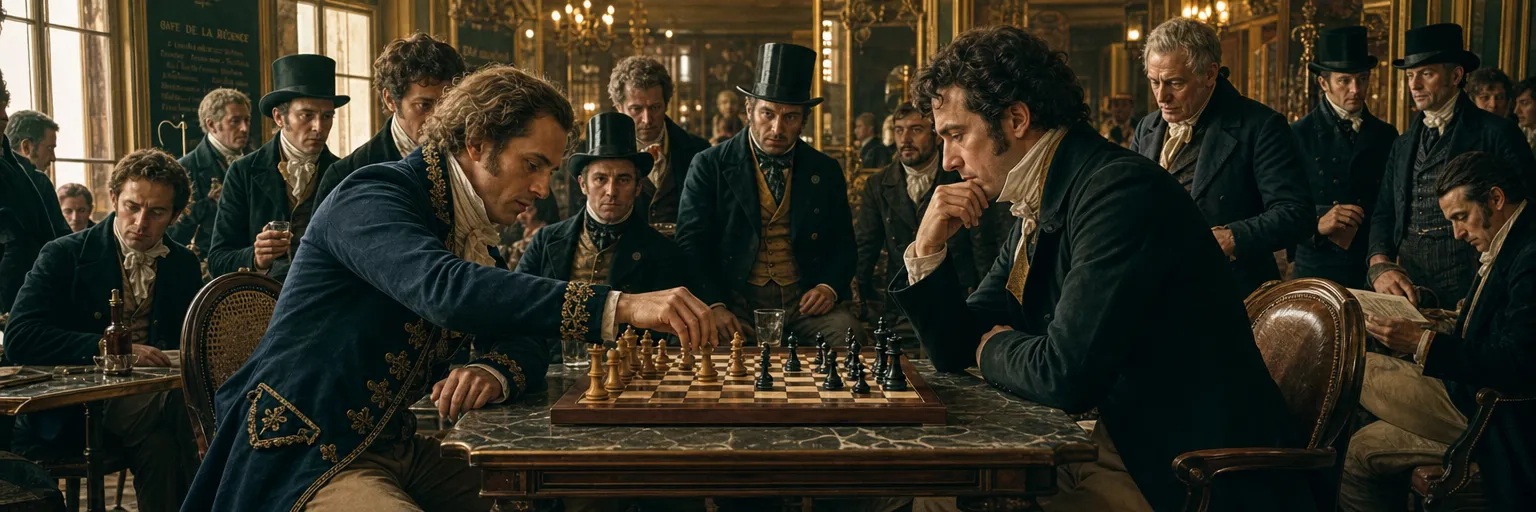
La Bourdonnais’s most memorable games
Among the countless encounters played by Louis-Charles Mahé de La Bourdonnais, certain games hold a special place in the memory of chess enthusiasts. They illustrate not only the French champion’s tactical strength, but also his ability to turn slight advantages into clear victories. Through these encounters, we can see why his name remains associated with the great moments of romantic chess and the rise of chess in the 19th century.
The clashes against McDonnell, the peak of his career
La Bourdonnais’s most famous games are undoubtedly those played against Alexander McDonnell in 1834. This series of matches, contested in London, is often regarded as one of the first great international events in chess history. In them, La Bourdonnais demonstrates a remarkable ability to adapt, alternating direct attacks, positional maneuvers, and well-controlled endgames.
Several of these duels have remained famous for their intensity. The Frenchman imposed a high tempo, willingly accepted complications, and often managed to seize the initiative very early. These games greatly contributed to forging his image as the first great French chess master, as they reveal an understanding of the game ahead of its time.
Brilliant attacks and a keen sense of initiative
What makes La Bourdonnais’s games so memorable is the way he exploits the slightest weakness in his opponent’s position. In several famous encounters, he quickly develops his pieces, controls the center, and launches decisive offensives against the enemy king. His play is not based solely on daring: it also relies on precise calculation and excellent coordination of forces.
Many of his combinations impressed later analysts. They reveal a player capable of anticipating several sequences in advance while maintaining a clear grasp of the strategic stakes. This combination of tactical energy and positional rigor explains why his best games continue to be studied by chess enthusiasts.
Endgames that reveal the full extent of his mastery
Although La Bourdonnais is often admired for his attacks, his endgames deserve just as much attention. Some of his most instructive games show his ability to convert a minimal advantage through methodical technique. Where others would have rushed, he often chose the safest path, gradually improving the position of his pieces until his opponent resigned.
This more restrained aspect of his play reminds us that his talent was not limited to offensive flair. It also confirms the breadth of his range, an essential quality in the man whom many still regard as the first great French chess master.
Why these games remain benchmarks
La Bourdonnais’s notable games are not important only for their result. They are historical milestones, because they bear witness to an era when modern theory was still in its infancy, yet individual genius could already produce masterpieces. By studying his finest encounters, we discover a player who was inventive, combative, and profoundly modern in his conception of chess.
Even today, these matches serve as benchmarks for understanding the evolution of the game and the birth of a high-level French tradition. They fully contribute to the legend of Louis-Charles Mahé de La Bourdonnais and explain why his legacy remains so alive in the history of chess.
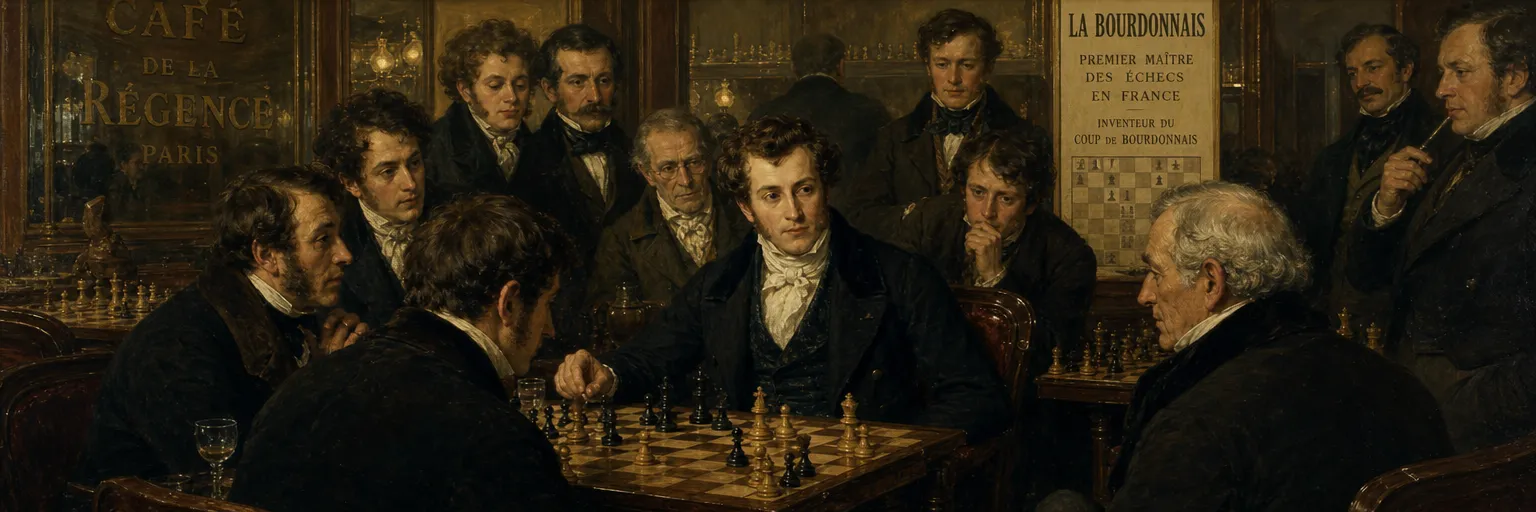
La Bourdonnais’s influence on the history of chess in France
Far beyond his personal results, La Bourdonnais profoundly shaped the way chess was perceived, played, and admired in France. Through his exceptional level, his renown, and his constant activity in specialist circles, he gave the game new visibility and helped make Paris one of the major centers of chess culture in the 19th century.
A model for French generations
A reference figure for many players of his time, he embodies the emergence of a genuine national tradition. His career long sustained the idea that a French champion could dominate the international scene, which explains why his name remains associated with the rise of chess in France. Through his successes, he opened a symbolic path for all those who later sought to make the French school shine.
The influence of the Café de la Régence
His influence was not limited to the chessboard: it was also rooted in a place that became legendary. By excelling at the Café de la Régence, La Bourdonnais enhanced the prestige of this Parisian venue, already frequented by intellectuals and enthusiasts. Thanks to him, this landmark of French chess gained an even stronger reputation, attracting players, observers, and amateurs who came to gauge the level of the capital.
A lasting sporting and cultural legacy
The legacy of La Bourdonnais also lies in the place he holds in the founding narratives of the discipline. Often presented as the first great French chess master, he symbolizes an essential stage in the professionalization and media exposure of the game. His name thus comes up whenever the history of French champions, the evolution of competitions, and the construction of a national memory around great French masters are discussed.
A mark still visible today
Although training methods, tournaments, and analysis have evolved profoundly, the image of La Bourdonnais retains a particular strength. It reminds us that before the modern era, a French player had already imposed his authority against the best. This historical dimension still sustains his place in the heritage of chess and explains why he remains an essential figure whenever the roots of French excellence on the chessboard are evoked.
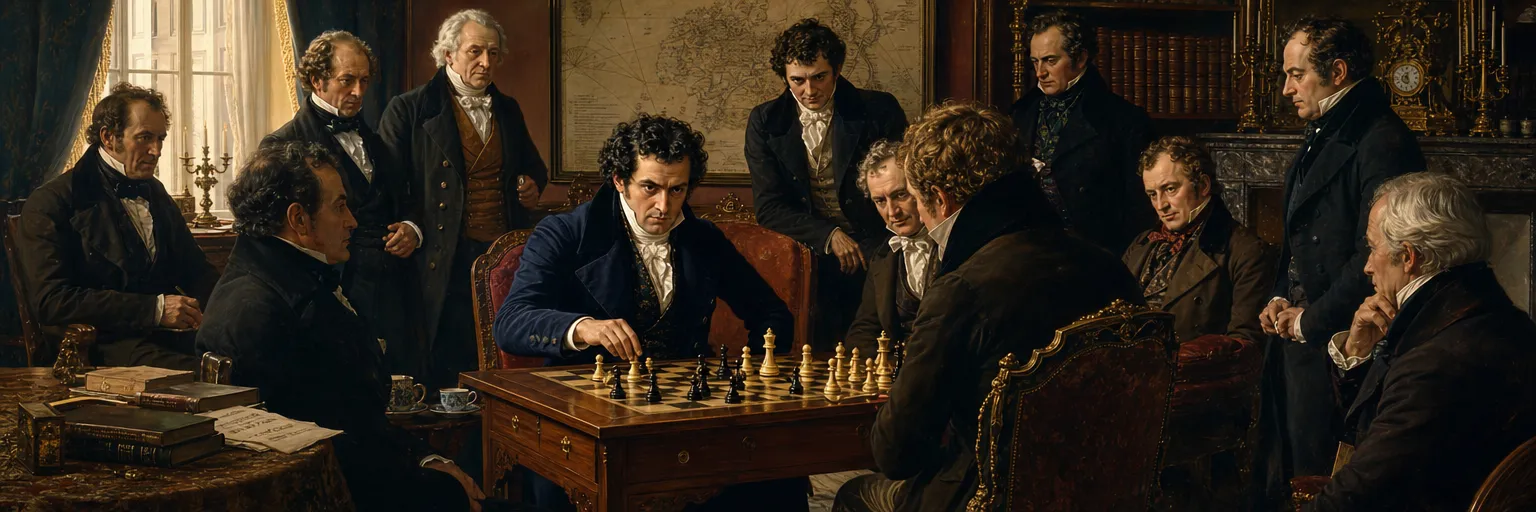
La Bourdonnais facing the greatest European players of his time
Assessing the value of Louis-Charles Mahé de La Bourdonnais means looking at the quality of the opponents he faced in the main chess centers of the continent. In a Europe where masters challenged one another as much for honor as for reputation, he managed to dominate or hold his own against the most respected figures, gradually consolidating his status as the first great French chess master.
A supremacy recognized in chess circles
At the beginning of the 19th century, official competitions were rare, and the hierarchy among players was built mainly through private matches, café encounters, and the testimony of contemporaries. In this context, La Bourdonnais established himself as one of the most feared names in Europe. His technical mastery, adaptability, and endurance over long series of games allowed him to gain the upper hand over many rivals from France, England, and Germany.
His renown quickly spread beyond Paris. The travelers, analysts, and enthusiasts who frequented the Café de la Régence spread his image as an almost undisputed champion. At a time when chess was still taking shape, this informal recognition carried immense value: it made him a European benchmark long before the emergence of modern championships.
Defining rivalries with foreign masters
Among the most famous encounters, those that pitted him against the best British players played a central role in building his legend. His name naturally remains associated with the clashes against Alexander McDonnell, regarded as one of the high points of 19th-century chess. These matches showed that he not only knew how to attack brilliantly, but also how to withstand pressure in long, complex, and highly publicized contests.
Beyond McDonnell, La Bourdonnais also faced other top-level players whose reputations were already firmly established in their respective countries. Each duel helped strengthen his authority on the international stage. Where many players shone locally, he managed to confirm his superiority against a wide variety of styles and schools of chess thought.
A European champion before the era of official titles
Although the title of world champion did not yet exist in an institutional form, several chess historians consider La Bourdonnais to have been the strongest player in the world during part of his career. This assessment rests precisely on his results against the best European representatives of his time. His career illustrates a dominance earned on the chessboard, without an official framework, but with genuine sporting legitimacy.
By standing up to the greatest names of his era, he also helped raise the profile of chess in France. His successes against foreign masters gave the country a leading figure admired far beyond its borders. It is this international dimension, as much as his pure talent, that explains why Louis-Charles Mahé de La Bourdonnais remains a major figure in the history of chess.
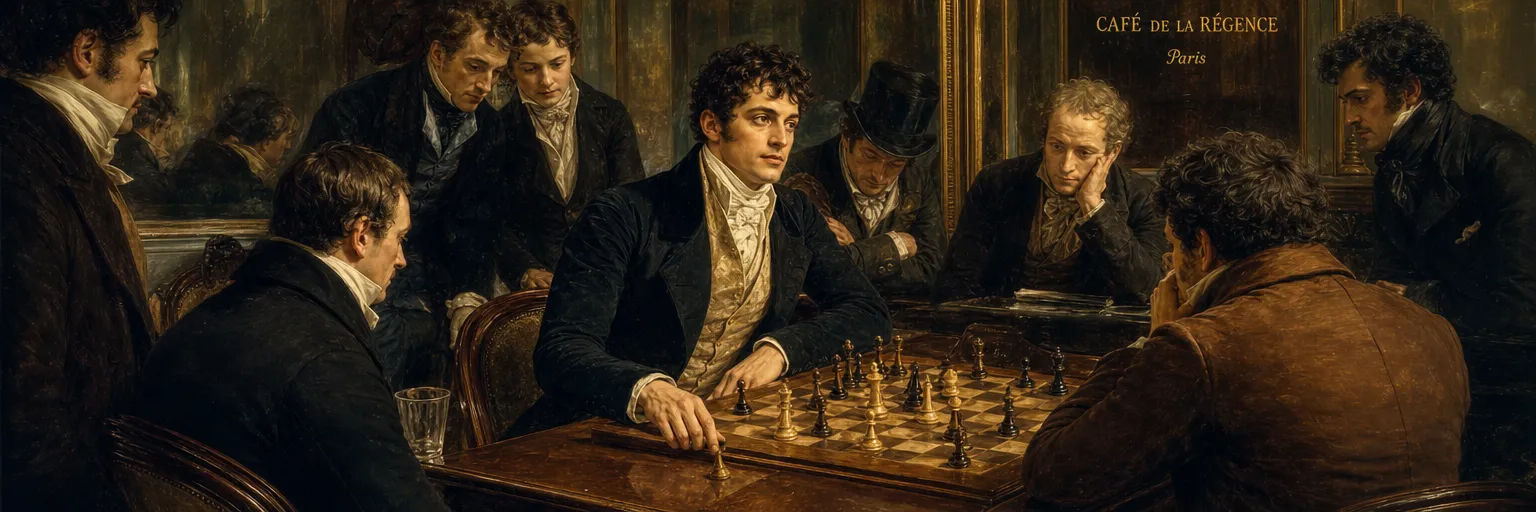
Why Louis-Charles Mahé de La Bourdonnais remains a chess benchmark
His name continues to span generations because he embodies competitive excellence, creative daring, and the emergence of a true French school of chess. In the history of the game, Louis-Charles Mahé de La Bourdonnais is not merely a standout champion: he represents a foundational model, often associated with the image of the first great French chess master and with the lasting affirmation of French prestige on the European chessboard.
A dominance that defined its century
La Bourdonnais’ strength lies first and foremost in his sporting authority. At a time when modern competitions did not yet exist in their current form, he established himself as one of the most feared players of his era. His repeated successes, his mastery of complex positions, and his ability to take the initiative made him a major figure in the history of chess in France. This tangible dominance explains why his legacy is not based on myth alone, but on recognition built on results and clashes at the very highest level.
A strategic legacy still studied today
If La Bourdonnais remains relevant, it is also because his play still holds real educational value. His sense of development, his taste for attack, and his endgame intelligence reveal a complete player, capable of combining energy and precision. For many enthusiasts, studying his games helps explain how the great classical principles took shape in practice. In this respect, La Bourdonnais remains a benchmark for anyone interested in the evolution of the game and the roots of top-level play.
A central figure in the French chess memory
La Bourdonnais’ legacy also rests on his symbolic place. In the collective imagination of enthusiasts, he is one of the first Frenchmen to have elevated chess to an almost heroic dimension. His career, his famous duels, and his influence at the Café de la Régence helped anchor his name in the cultural heritage as much as in the sporting one. It is this rare combination of performances, influence, and renown that makes him a figure still cited whenever the great legends of chess are discussed.
A benchmark for understanding today’s champions
Looking back at his career also makes it possible to better grasp what a great player is: the ability to impose a style, inspire one’s contemporaries, and leave a lasting mark beyond immediate victories. In this sense, Louis-Charles Mahé de La Bourdonnais provides an essential point of reference for comparing eras and understanding how the very notion of a champion was built. That is why he remains, even today, an essential reference in the world of chess.
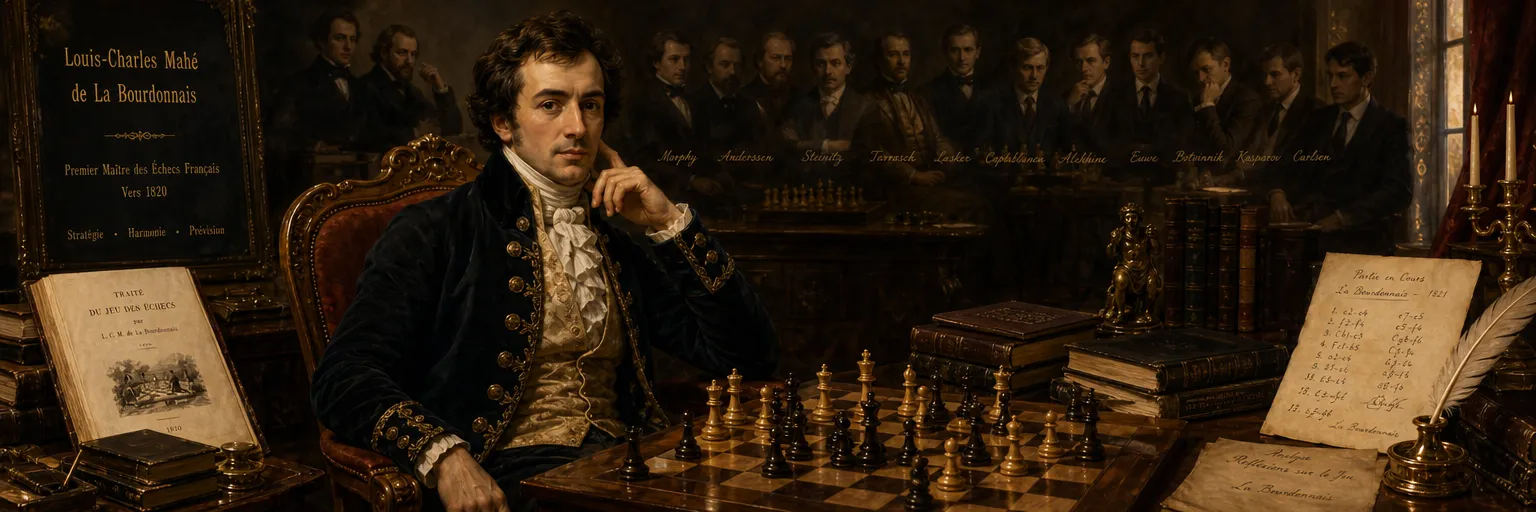
The legacy left by the first great French chess master
Across the decades, the mark left by Louis-Charles Mahé de La Bourdonnais has never truly faded. A founding figure of the national chess tradition, he passed down far more than a remarkable list of achievements: a way of thinking about the game, teaching it, and helping it shine. His career thus continues to fuel the memory of enthusiasts who see him as the first great French chess master.
A lasting benchmark for future generations
La Bourdonnais’s prestige was built on his victories, but above all on the imprint they left on the culture of the game. In France, his name long served as a point of comparison for measuring the value of the best players. This symbolic status helped make Louis-Charles Mahé de La Bourdonnais a major figure in the history of chess in France, much like a pioneer capable of paving the way for an entire line of competitors.
A model of fighting spirit and creativity
His legacy also rests on his style. La Bourdonnais left a lasting impression through his sense of initiative, his taste for dynamic positions, and his ability to turn a slight advantage into a decisive attack. This playing identity fed his legend and reinforced his status as a chess benchmark. Even today, his games are studied to understand how tactical energy can combine with a strategic vision that was particularly modern for his time.
A reputation that extends beyond his century
Although his era differed profoundly from today’s competitive landscape, the recognition he enjoys remains intact. Historians, players, and enthusiasts remember him as a champion who helped shape the international reputation of French chess. In this respect, Louis-Charles Mahé de La Bourdonnais remains far more than a great name from the past: he embodies an essential stage in the building of French chess greatness and in the memory of the first great French chess master.
A major figure in French chess in the 19th century, Louis-Charles Mahé de La Bourdonnais helped France shine on the international stage. More than a century later, another French player established himself among the world elite thanks to his talent and consistency at the highest level: Maxime Vachier-Lagrave: the champion of modern French chess, often nicknamed MVL by chess enthusiasts.
From French pioneers to contemporary stars of the international circuit, discover the journeys of the players who have shaped the history of chess in our dedicated selection: Famous chess players: legends, champions, and modern stars.