
 France
 English
 Deutsch
 Español
 Italiano
 Nederlands
 Polski
 Português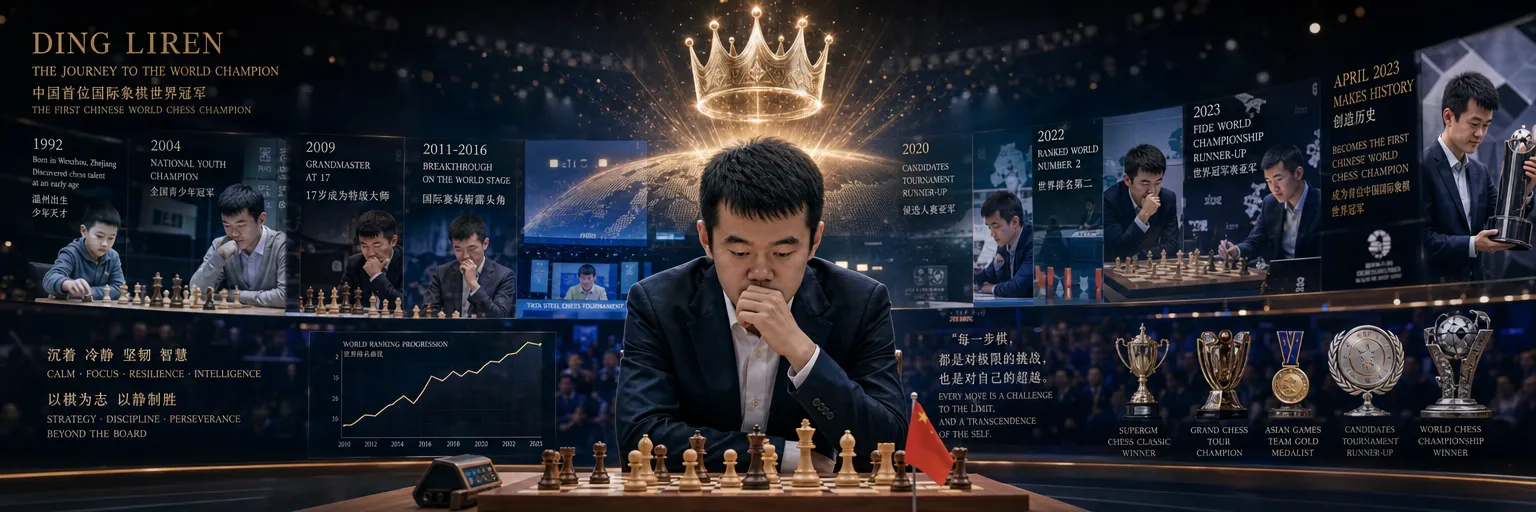
Ding Liren’s journey to the top of world chess
Ding Liren’s journey illustrates a remarkable rise in the history of modern chess. Born in China, he gradually established himself as one of the most solid and respected players on the international circuit. Thanks to rigorous preparation, outstanding strategic mastery, and exceptional composure, he successfully cleared every stage leading to the world elite.
Promising beginnings in China
From a very young age, Ding Liren showed extraordinary aptitude for chess. His talent developed in a country where the discipline was growing in popularity and becoming more structured. By winning several national competitions, he quickly drew the attention of observers and became one of China’s great hopes. This early progress laid the foundations for his future success on the international stage.
A rise to prominence on the international stage
Over the course of tournaments, Ding Liren stood out for his playing style, which was at once precise, patient, and formidably effective. He delivered one high-level performance after another against the world’s top grandmasters, strengthening his reputation as an exceptional competitor. His ability to remain unbeaten over long streaks of games confirmed both his level and his consistency at the very highest tier.
The turning point toward the world title
The crowning achievement came when he established himself as one of the most credible contenders for the ultimate title. His path to the world championship was marked by great resilience, especially in moments of intense psychological pressure. By reaching the top, Ding Liren did not merely achieve a personal feat: he also became a powerful symbol for chess in China and across Asia.
A champion with historic impact
By becoming China’s first world chess champion, Ding Liren ushered in a new era for the sport. His success inspired a new generation of players and confirmed China’s growing importance in the chess world. His journey to the top of world chess thus remains an example of perseverance, discipline, and sporting excellence.

Ding Liren’s early years and training in China
Born on October 24, 1992, in Wenzhou, Zhejiang Province, Ding Liren grew up in an environment where strategy games held an important place. From an early age, he showed a strong ability to concentrate, a solid memory, and a marked taste for analysis. These qualities quickly caught the attention of his teachers, who saw in him a young talent capable of standing out in the demanding world of chess.
A talent spotted from childhood
Like many Asian prodigies, Ding Liren discovered chess at a very young age. In China, the practice of this discipline benefits from a structured framework, with specialized schools, qualified coaches, and a particularly effective talent identification system. In this setting, the future champion very quickly learned to master the fundamentals, develop his tactical vision, and build a methodical approach to the game.
His first results in youth competitions quickly confirmed his potential. He was not merely a promising player: he already displayed rare maturity, great patience, and an ability to keep his cool against more experienced opponents. These traits would later become one of the hallmarks of the Chinese world chess champion.
The rigor of the Chinese training system
Ding Liren’s progress fits into the broader context of China’s rise in international chess. For several decades, the country has invested in training its young players by combining intensive practice, regular competition, and top-level technical support. This organization allows exceptional profiles to emerge with a particularly strong strategic foundation.
Over the years, Ding benefited from this demanding structure, which emphasizes discipline, preparation, and consistency. He refined his opening repertoire, improved his positional play, and learned to convert the slightest advantages into victories. This rigorous school of training played a major role in shaping the man who would become Ding Liren, a leading figure in modern chess.
Early success on the national stage
Before establishing himself on the world stage, Ding Liren first made a name for himself in China. His performances in the national championships reflected rapid progress and remarkable consistency. In a country where competition is fierce, managing to rise among the very best is already a considerable achievement.
These early successes played an essential role in his mental development. They allowed him to gain experience, face different styles of play, and strengthen his confidence. By asserting himself on the national stage, he laid the foundations for a career that would later take him to the top, ultimately making him the first Chinese world chess champion.
A style shaped by learning and patience
From his formative years, Ding Liren developed a restrained, precise, and deeply thoughtful style. Where some young talents focus above all on immediate attack, he stands out for his ability to understand complex positions and wait for the right moment to act. This strategic patience became a major asset in his development.
His youth journey thus shows that his rise was not the result of chance, but of methodical learning and constant work. In China, he built the technical and mental foundations that would later allow him to make chess history and become a new benchmark for an entire generation of players.

The standout achievements that revealed a future champion
Long before winning the world crown, Ding Liren delivered a string of top-level performances that drew the attention of the entire chess world. His rise was not built on a single flash of brilliance, but on a series of impressive results against the international elite, confirming that he already had the makings of a future champion.
National titles that pointed to an exceptional trajectory
One of the first strong signs of his immense potential came when he became Chinese champion at a particularly young age. In a country where competition is fierce and the level keeps rising, this success was clear proof of his strategic maturity. This national title strengthened his status as one of the great hopes of Chinese chess and showed that he could handle pressure in demanding competitions.
A steady rise against the best players in the world
Over the course of international tournaments, Ding Liren stood out for his solidity, calculating ability, and composure in complex positions. He put together a series of benchmark performances against established grandmasters, allowing him to secure a lasting place among the very best. This rise through the rankings fueled the idea that a Chinese world champion could soon emerge in a field long dominated by other nations.
The unbeaten streak that made a lasting impression
Among the most widely discussed achievements of his career, his long unbeaten streak remains a defining moment. Staying undefeated over so many games at this level requires extreme concentration, rigorous preparation, and remarkable mental resilience. This performance strengthened his reputation as a player who is difficult to beat and confirmed that he already belonged to the very exclusive circle of credible contenders for the top of world chess.
Decisive performances in major international competitions
Ding Liren also shone in several major events, notably at the Olympiads and in prestigious tournaments on the international circuit. His results against the best players on the planet highlighted his ability to deliver in the biggest moments. With each new performance, he reinforced his image as a Chinese grandmaster capable of competing with the absolute benchmarks of his era.
A complete playing style that foreshadowed the title
What made his achievements particularly striking was also the quality of his style. Ding Liren combines defensive precision, tactical creativity, and an excellent understanding of endgames. This versatility often made the difference in long, tense games, where true champions reveal themselves. Long before his title, many already saw him as a major figure in the history of chess in China and a natural candidate for the ultimate crowning achievement.
How Ding Liren became the first Chinese world champion
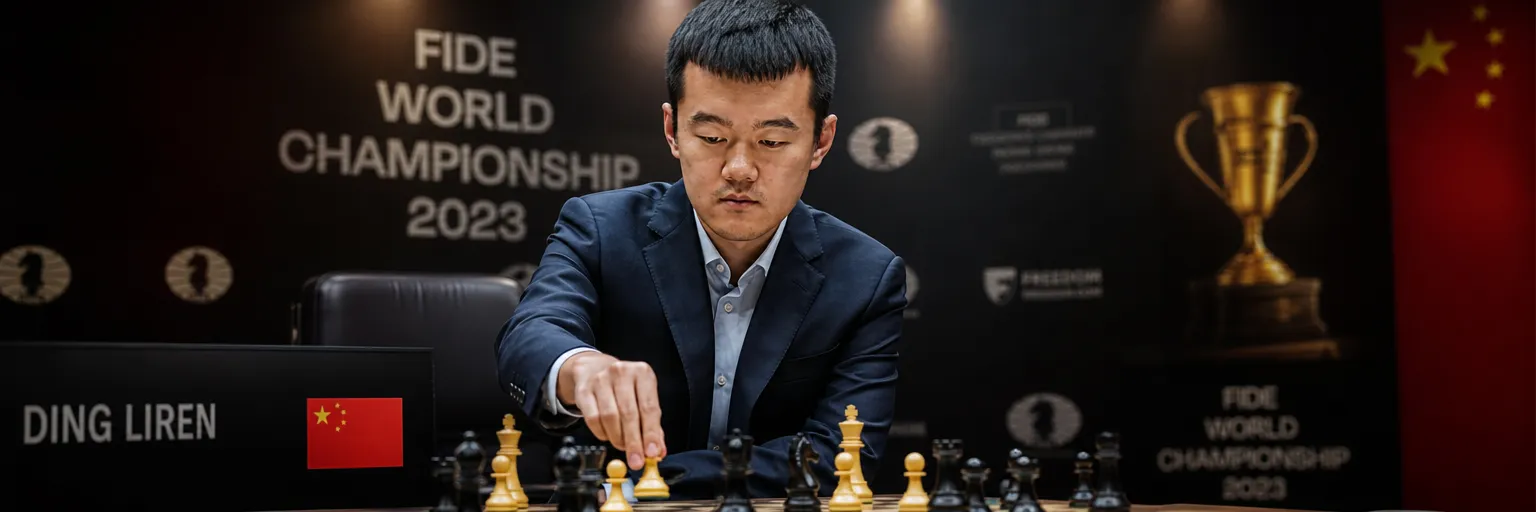
Ding Liren’s conquest of the world title was built on a rare combination of resilience, opportunities seized, and exceptional composure in decisive moments. By becoming the first Chinese world champion in chess, he marked a historic turning point both for his career and for the growth of chess in China.
A place seized in exceptional circumstances
The road to the world championship did not follow a classic scenario. After the qualifying tournaments and the adjustments linked to the world cycle, Ding Liren earned his chance to compete for the ultimate crown. This opportunity became a major event for chess enthusiasts, as it allowed a Chinese player to aim for the top in the most prestigious competition on the circuit.
His presence at this level was no accident. For several years, Ding Liren had established himself among the elite thanks to his consistency, strategic depth, and ability to compete with the best international grandmasters. This rise paved the way for a possible world title.
A decisive duel for the world crown
During the 2023 World Championship match, Ding Liren faced Ian Nepomniachtchi in an intense confrontation marked by twists and turns and immense psychological pressure. Each game showcased the subtlety of his play, but also his ability to bounce back after difficult moments, an essential quality for becoming world champion.
The duel proved especially close, with neither player able to gain a definitive advantage during the classical games. In the end, it was in the rapid tiebreaks that Ding Liren made the difference. His boldness in critical positions and his precision under pressure were decisive in securing this World Chess Championship.
Mental strength as a key factor
Beyond his technical preparation, one of the most striking elements of his triumph remains his mental resilience. Ding Liren often had to contend with immense pressure, linked to the importance of the event and the anticipation surrounding the possibility of becoming the first Chinese world champion. His ability to stay focused in decisive moments played a central role.
This psychological dimension partly explains why his success resonated so strongly in the chess world. It was not just a sporting victory, but also a demonstration of emotional control in the face of one of the game's greatest challenges.
A historic victory for China and world chess
By winning the world crown, Ding Liren opened a new chapter in the history of Chinese chess. China had already established itself as a major power in several international competitions, especially in women's and team events, but this triumph in the premier category carried a uniquely symbolic significance.
His triumph confirms the rise of chess in China and increases the game's visibility among an even wider audience. For many young players, Ding Liren is now proof that a Chinese player can reach the highest level and prevail at the top of the world hierarchy.
The duel for the world crown that changed the history of chess
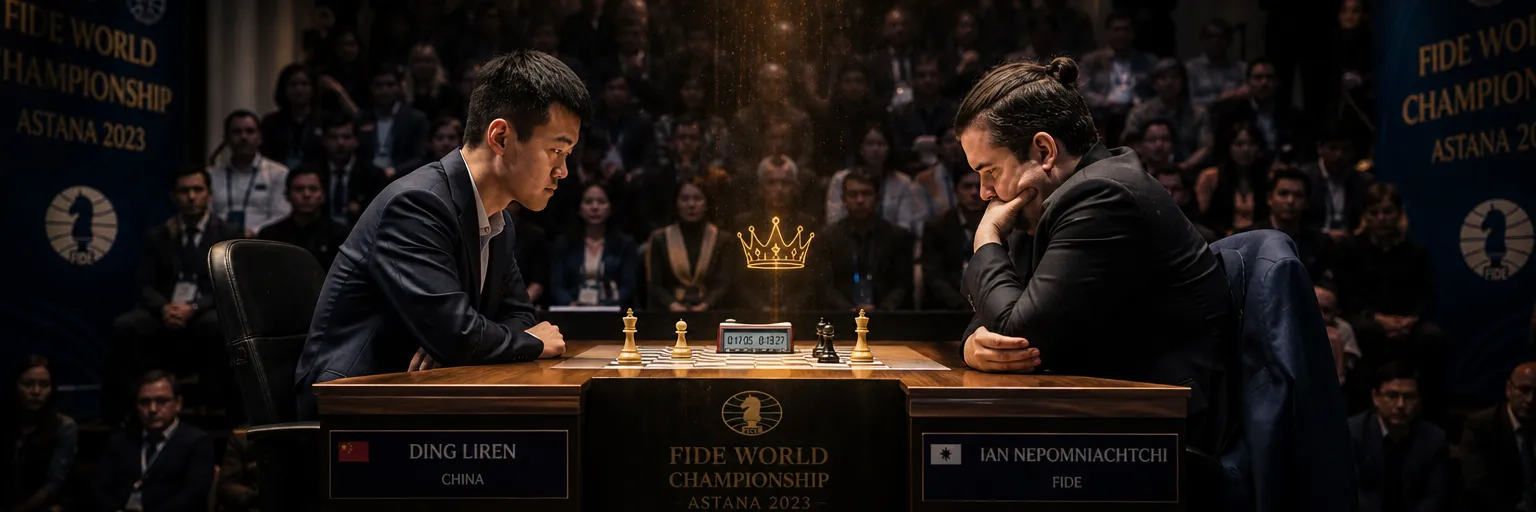
In Astana, in 2023, the match for the ultimate title delivered a scenario of rare intensity. Facing Ian Nepomniachtchi, Ding Liren battled in a tense, spectacular, and deeply symbolic showdown for the world of the 64 squares. Beyond the simple sporting result, this final marked a historic turning point : with this victory, Ding Liren became the first Chinese world chess champion, writing his name among the greatest legends of the discipline.
A world championship under extreme pressure
This head-to-head for the world crown took place in a particular context, with immense pressure on both players. Each game revealed bold choices, twists and turns, and top-level theoretical preparation. Ding Liren, often seen as more reserved than some of his rivals, demonstrated remarkable mental strength against an experienced opponent who was dangerous in tactical positions.
Decisive games right down to the final suspense
The 2023 World Chess Championship was marked by strong emotional swings. Neither player managed to gain a definitive advantage, which made the duel especially captivating for enthusiasts and the general public alike. The suspense lasted until the rapid tiebreak games, where Ding Liren showed great composure at the most critical moment. His final victory illustrated his ability to withstand pressure and seize the decisive moment.
A victory that goes beyond the game itself
Ding Liren’s crowning achievement represents not only the culmination of an exceptional individual journey. It also symbolizes China’s rise in world chess, after years of investment, training, and results at the highest level. By becoming world champion, he opened a new chapter in chess history and increased the visibility of the sport among a new generation of Asian players.
Why this match remains historic
This duel will remain one of the most memorable moments of the modern era. Through its intensity, suspense, and symbolic significance, it redefined the usual benchmarks of the world title. Ding Liren’s victory confirmed that a Chinese player could not only compete with the absolute elite, but also prevail at the very top. In this sense, this match truly changed the history of chess.

Ding Liren’s playing style and his greatest strengths
For Ding Liren, mastery is not limited to mere technical solidity: it is built on a rare balance of strategic precision, tactical creativity, and psychological composure. His approach to the game is as appealing for its elegance as for its effectiveness, which explains why he has established himself as one of the leading figures in modern chess.
Remarkable versatility on the chessboard
One of Ding Liren’s most striking qualities is his ability to adapt to all types of positions. He can thrive in closed, patient, positional structures, then suddenly change the pace when the position calls for tactical energy. This versatility makes him particularly difficult for his opponents to prepare against, because his repertoire never confines him to a single playing pattern.
Against the best players in the world, Ding Liren displays a deep understanding of positional balances. He excels in the art of gradually improving his pieces, limiting the opponent’s counterplay, and turning small advantages into concrete chances. This ability to navigate between several registers makes him a Chinese world champion with an especially complete profile.
A highly refined strategic sense
Ding Liren’s style is based in large part on a very subtle reading of the needs of each position. Rather than forcing the initiative at all costs, he often chooses the most harmonious plan, the one that strengthens his coordination while creating lasting problems for his opponent. This strategic vision allows him to control the tempo of a game without giving the impression of seeking direct confrontation with every move.
His way of building slow but constant pressure is reminiscent of the greatest specialists of positional play. He identifies weaknesses, key squares, and imbalances to exploit with precision. In top-level games, this lucidity often makes the difference, especially when the margin for error becomes razor-thin.
Tenacious defense and exceptional composure
Among Ding Liren’s great strengths, his defensive ability holds a central place. Even under pressure, he retains astonishing serenity and finds resources that are difficult to detect. This resilience has allowed him to save many complicated positions against the world elite, reinforcing his reputation as an extremely hard player to beat.
This composure also shows itself in critical moments, when psychological tension becomes just as important as the quality of the moves. Ding Liren rarely gives in to panic, which is a major asset in the most prestigious competitions. This mental stability contributed greatly to his rise to the title of China’s first world chess champion.
Formidable technique in the endgame
Endgames represent another area in which Ding Liren consistently excels. His technique allows him to convert the slightest advantages, but also to hold difficult positions thanks to remarkable precision. In this phase of the game, he shows great rigor, with a sharp sense of piece placement and timing.
This mastery of endgames perfectly rounds out his profile. Where some players shine mainly in the opening or in tactical complications, Ding Liren emerges as a competitor capable of remaining dangerous until the very last moves. This quality reinforces his image as a complete player in the history of Chinese and international chess.
Subtle but decisive creativity
Although his style is often associated with sobriety, his capacity for invention should not be underestimated. Ding Liren knows how to introduce original ideas, sometimes very subtle ones, that gradually change the evaluation of a position. His creativity is not always spectacular at first glance, but it often proves decisive over the course of a game.
It is precisely this combination of discipline, imagination, and resilience that makes his play so fascinating. By combining theoretical preparation, practical intelligence, and emotional control, Ding Liren has established himself as a major figure in modern chess and as a role model for an entire generation of chess enthusiasts.

Ding Liren's most iconic games
Some encounters are enough to capture the stature of a champion, and Ding Liren’s already hold a special place in the history of modern chess. Through their strategic quality, psychological tension, and symbolic significance, they show why the Chinese world chess champion has left a lasting mark on his era. Each iconic game reveals a facet of his talent, blending deep preparation, tenacious defense, and a sense for the decisive moment.
The victory against Ian Nepomniachtchi in Astana
The most famous game of his career is naturally the one that allowed him to claim the world crown against Ian Nepomniachtchi in 2023. In the rapid tiebreaks of the Astana match, Ding Liren knew how to take calculated risks in an already extremely tense position. His famous 46th move, which instantly became one of the most talked-about of the year, illustrated his ability to combine courage, intuition, and precision under immense pressure. This victory sealed his status as the first Chinese world champion and turned this encounter into an essential reference for all chess enthusiasts.
Top-level duels against Magnus Carlsen
Even before becoming world champion, Ding Liren had already delivered several standout performances against Magnus Carlsen. His games against the former world champion often showed that he could compete with the best player of his generation, not only in terms of theory, but also in complex endgames and unbalanced positions. One of the most memorable remains his victory at the 2019 Sinquefield Cup, where he capitalized on the slightest inaccuracy to turn around a difficult situation. These encounters strengthened his image as a credible contender for the top of world chess.
A legendary unbeaten streak
Among the performances that built his reputation, his long unbeaten run at the highest level deserves special mention. Remaining undefeated for 100 classical games against elite opposition is a rare feat, reflecting his exceptional consistency. Several games from this period became iconic not because they were spectacular from the opening, but because they revealed complete mastery of timing, defense, and the transition into endgames. This consistency played a major role in establishing Ding Liren as a leading figure among international grandmasters.
Games that reveal his composure
What often sets Ding Liren apart in his greatest games is his ability to stay clear-headed in the most tense positions. Where others seek immediate complications, he knows how to wait, improve his pieces, and strike at the exact right moment. Several of his successes in Candidates tournaments or major team competitions illustrate this sense of control. His most iconic games are therefore not just prestigious victories: they also embody a way of understanding the game, shaped by patience, depth, and remarkable mental strength.

Ding Liren's impact on chess in China
With his world title, Ding Liren gave Chinese chess a powerful symbol, capable of going beyond the sporting sphere to influence the very image of the discipline in the country. By becoming China's first world chess champion, he validated years of collective progress and showed that a player trained in China could reach the absolute summit in a world long dominated by Europe and the former USSR.
A historic milestone for Chinese sport
This victory carries special significance, as it firmly inscribes Ding Liren in the history of national sport. China already had a strong tradition in women’s chess and had shown steady progress in the men’s game, but the men’s world title remained a symbolic frontier. His success therefore strengthened the legitimacy of chess in China as a discipline of excellence, on a par with other sports in which the country aims to shine.
A role model for the new generation
Beyond the prestige, Ding Liren has become a tangible reference point for young players. His journey proves that patient progress, rigorous preparation, and great mental stability can lead to the very highest level. In schools, clubs, and academies, his name now serves as an example for a generation that sees Chinese chess not only as a field of intellectual learning, but also as a path to international recognition.
Greater visibility for the discipline
The impact of his title also helped broaden the audience for competitions, analysis, and chess culture in China. Mainstream media, which had already given occasional attention to major tournaments, found in the success of Ding Liren world champion a unifying story. This exposure encourages public interest, boosts enrollment in training structures, and promotes investment around events, coaching, and game broadcasting.
A lasting legacy for elite chess
Ding Liren’s influence is not limited to the emotion of a coronation. It could have a long-term impact by consolidating Chinese ambitions at the highest world level. His title sets a precedent, raises standards, and reinforces the idea that another champion from the country may emerge in the future. In this sense, Ding Liren did not merely win a crown: he opened a new chapter in the history of chess in China, where reaching the summit no longer appears as an exception, but as a goal that is now credible.
Ding Liren facing the greatest players of his generation
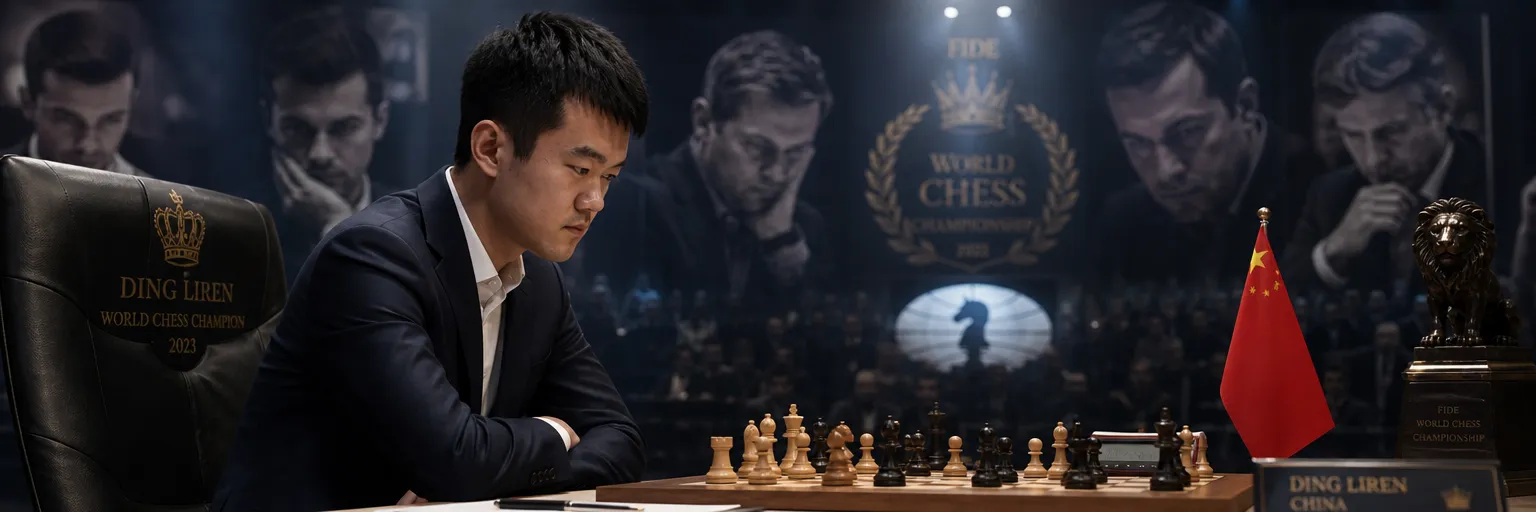
Assessing Ding Liren’s place among the world elite means looking at his encounters with the absolute benchmarks of contemporary chess. Against opponents such as Magnus Carlsen, Ian Nepomniachtchi, Fabiano Caruana, and Hikaru Nakamura, the Chinese world champion has shown that he is not the product of a one-off achievement, but a lasting presence at the highest level.
Top-level duels against Magnus Carlsen
Among the most closely watched matchups was naturally the one that pitted him against Magnus Carlsen. Ding Liren often proved capable of neutralizing the former king of world chess, including in complex positions where few players held up as well. His unbeaten run over a long series of classical games reinforced his image as an extremely hard player to defeat, even against the world number one of his generation.
These encounters also revealed an essential quality: Ding Liren knows how to adapt his plan to the profile of his opponent. Against Carlsen, he often favored defensive precision, strategic patience, and the ability to stay clear-headed in tense endgames. This ability to stand up to the best player of the era contributed greatly to his legitimacy among the contenders for the ultimate title.
A decisive rivalry with Ian Nepomniachtchi
Ian Nepomniachtchi’s name remains inseparable from the moment Ding Liren entered history. Their clash for the world crown illustrated two different approaches to the game: on one side, the Russian’s speed of execution and dynamism; on the other, the Chinese representative’s depth of calculation and resilience. In this context, Ding Liren was able to respond to the most extreme pressure to become China’s first world chess champion.
Beyond the Astana match, this rivalry shows that Ding Liren knows how to raise his level against the most dangerous players in classical time controls. His victory did not only reward his preparation: it confirmed his mental strength in the moments when everything hangs in the balance.
Against Caruana, Nakamura, and the elite of international tournaments
Against Fabiano Caruana, Ding Liren has often produced games of great theoretical richness, marked by remarkable precision in the opening and middlegame. Against Hikaru Nakamura, he had to contend with a more unpredictable, sharper style, demanding constant vigilance. These matchups highlight one of his greatest qualities: he remains effective against radically different profiles.
At major international events, Ding Liren did not merely settle for being a solid outsider. He regularly occupied the top of the world rankings, proving that he belonged to the very small circle of players capable of beating any opponent in a single game or over an entire tournament. This consistency against the best further enhances the significance of his world title.
A stature built on consistency
What sets Ding Liren apart against the greatest players of his generation is less the brilliance of a single feat than the accumulation of benchmark performances. Holding Carlsen, triumphing over Nepomniachtchi, competing with Caruana, and meeting the challenge posed by Nakamura: all elements that paint the portrait of a grandmastercomplete, respected throughout the chess world.
His journey thus confirms that his title is no coincidence. By facing, and then overcoming, the strongest figures of his era, Ding Liren established his name among the leading champions of the 21st century.

Ding Liren's Elo rating and career progression
Reading Ding Liren's Elo rating makes it possible to follow precisely the rise of a player who has become a global benchmark. Year after year, his results in major tournaments, his consistency against the elite, and his ability to remain at the very highest level over time have confirmed the rise of the future Chinese world chess champion.
A rapid rise to the world elite
Ding Liren first established himself as one of the best players in his country before turning that national status into international recognition. His Elo progressed steadily thanks to strong performances against experienced grandmasters, followed by increasingly convincing results in top-level competitions. This development illustrated not only his talent, but also remarkable competitive stability, an essential quality for climbing the world chess rankings.
The 2800 Elo mark and confirmation at the top
Crossing the symbolic 2800 Elo mark is an achievement reserved for a very select circle. Ding Liren reached this milestone, proof of his lasting place among the very best players on the planet. At this level, every point gained reflects extremely high-level performances against exceptional opposition. This milestone reinforced his image as a credible contender for the ultimate title and confirmed that Ding was no longer just a great Chinese player, but a central figure in world chess.
Performances that reflect a career built over time
Ding Liren's Elo trajectory cannot be reduced to a brief surge. It reflects a career built on consistency, discipline, and resistance to pressure. His unbeaten streaks, strong results in the Olympiads, and performances in elite closed tournaments have consolidated his place at the top. This consistency is all the more striking because it has been maintained in an extremely competitive environment, where the slightest underperformance can quickly cause a drop in the FIDE Elo rankings.
A key indicator of his rise to the world title
In Ding Liren’s case, Elo served as a clear indicator of his competitive maturity. His ranking among the world’s best players legitimized his place in the battle for the crown and paved the way for his historic triumph. By looking at the progression of his career through this lens, we can better understand how he became the first Chinese world champion in the history of classical chess, combining technical excellence, consistency, and the ability to meet the demands of the highest level.

Why Ding Liren’s crowning is historic for chess
Ding Liren’s crowning goes far beyond the individual victory of an exceptional grandmaster: it marks a turning point in the history of world chess. By becoming the first Chinese world chess champion, he opened a new era for a discipline long dominated by Europe and the former USSR, while confirming China’s lasting rise to prominence at the highest level.
A world first for China
Until Ding Liren’s crowning, no Chinese player had won the supreme title in classical time control in the men’s category. This achievement therefore carries immense symbolic significance. It validates decades of investment, training, and structuring in chess in China, a country already highly successful in women’s competitions and team Olympiads.
With this title, Ding Liren becomes far more than a champion: he embodies a decisive step in the internationalization of the world crown. His success proves that the summit of chess is no longer reserved for a few historic nations, but now reflects truly global competition.
A shift in the balance within the world elite
Ding Liren’s triumph also illustrates the changing geography of chess. Over the past several decades, the world hierarchy has gradually diversified, with the emergence of new centers of excellence in Asia. The world title won by a Chinese player confirms this redistribution of power and sends a strong signal to the entire chess community.
This crowning shows that modern preparation, analytical rigor, and experience gained in major competitions now enable players from different backgrounds to reach the top. In this sense, Ding Liren has helped redefine the image of the world champion in the 21st century.
A source of inspiration for an entire generation
The historical significance of this victory is also measured by its impact on young players. Seeing a Chinese player become world champion sets a concrete, powerful, and motivating precedent. For many children, coaches, and federations, Ding Liren’s journey becomes proof that the ultimate goal is attainable.
In a vast country where internal competition is already extremely intense, this kind of success can further accelerate the development of chess. It boosts the media visibility of the discipline, inspires new vocations, and reinforces the idea that China can establish itself at the heart of the world elite for the long term.
A title won in a particularly significant context
The historical dimension also lies in the circumstances surrounding this triumph. The 2023 world title match was played in a climate of great anticipation, following Magnus Carlsen’s withdrawal from defending his crown. Ding Liren knew how to seize this rare opportunity, but above all to turn it into victory at the end of a tense, demanding, and psychologically very intense confrontation.
This ability to remain clear-headed in critical moments adds to the value of his achievement. His rise to the title is not merely a statistical event; it is a defining moment in chess history, because it combines symbolic significance, a geographical shift, and sporting intensity.

Ding Liren’s legacy in the world of chess
Beyond his title, Ding Liren has already left a lasting mark on the international stage. By becoming the first Chinese world champion, he opened a new chapter for chess, showing that a player from China could not only join the elite, but also prevail at the very top of the world hierarchy.
A role model for the new generation
His journey inspires many young players, in China and elsewhere. Through his seriousness, discretion, and depth of play, Ding Liren offers a different model, built more on consistency than on provocation. This image reinforces the idea that at the highest level of chess, patience, preparation, and emotional control can lead to the ultimate title.
A powerful symbol of the internationalization of chess
Ding Liren’s rise also confirms the geographical evolution of the game. Long dominated by Europe and the former Soviet Union, the chess world has expanded considerably. His triumph gives immense visibility to Asia in major competitions and helps make the world championship even more universal.
An influence that goes beyond results
Ding Liren’s legacy is not limited to his list of achievements. His understated style, composure under pressure, and ability to bounce back in difficult moments are already shaping his image as a respected champion. For many observers, he embodies a decisive stage in the modern history of chess, one in which the diversity of schools and cultures is fully asserting itself at the highest level.